The City is (still) a battlesuit for surviving the future.

Just watched Sir Norman Foster present at the World Design Congress in London, on cities and urbanism as a defence against climate change.

This excellent image visualises household carbon footprints – highlighting in coincidental green the extreme efficiency of NYC compared to the surrounding suburban sprawl of the emerging BAMA.

Sir Norman Foster presenting at the World Design Congress in London, discussing urbanism and climate change while a colorful map of household carbon footprints in New York City is displayed.

16 years ago this September, while at BERG, I wrote a piece at the invitation of Annalee Newitz for a science fiction focussed blog called io9 called “The City is a battlesuit for surviving the future.

It’s still there: bit-rotted, battered, and oozing dangerously-outdated memetic fluids, like a Mark 1 Jaeger.

Bruce Sterling was (obliquely) very nice about it at the time, and lots of other folks wrote interesting (and far-better written) rebuttals.

I thought as it’s a 16 year old now, I should check in on it, with some distance, and give it a new home here.

I thankfully found my original non-edited google doc that I shared with Annalee, and it’s pasted below…

My friend Nick Foster is giving the closing keynote at the event Sir Norman spoke at tomorrow. He just wrote an excellent book on our attitudes to thinking about futures called “Could Should Might Don’t” – which I heartily recommend.

My little piece of amateur futurism from 2009 has a dose of all four – but for the reasons Sir Norman pointed out, I think it’s still a ‘Could’.

And… Still a ‘Should’.

The City is (still) a battlesuit for surviving the future.

Now, 16 yrs later, we ‘Might‘ build it up from Kardashev Streets


[The following is my unedited submission to io9.com, published 20th September 2009]

The city is a battlesuit for surviving the future.

Looking at the connections between architects and science-fiction’s visions of future cities

In February of this year I gave a talk at webstock in New Zealand, entitled “The Demon-Haunted World” – which investigated past visions of future cities in order to reflect upon work being done currently in the field of ‘urban computing’.

In particular I examined the radical work of influential 60’s architecture collective Archigram, who I found through my research had coined the term ‘social software’ back in 1972, 30 years before it was on the lips of Clay Shirky and other internet gurus.

Rather than building, Archigram were perhaps proto-bloggers – publishing a sought-after ‘magazine’ of images, collage, essays and provocations regularly through the 60s which had an enormous impact on architecture and design around the world, right through to the present day. Archigram have featured before on io9 [http://io9.com/5157087/a-city-that-walks-on-giant-actuators], and I’m sure they will again.
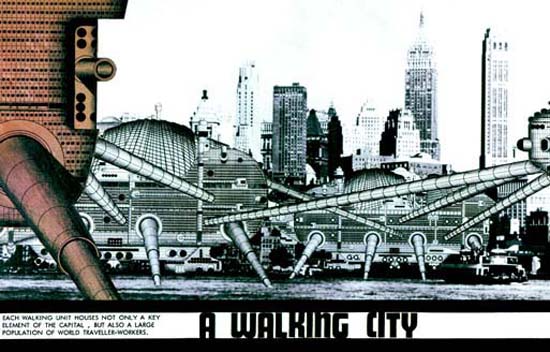
Archigram's "Walking City" Project: An artistic depiction of a futuristic city designed to be mobile, with mechanical elements and skyscrapers in the background, representing a conceptual vision of urban living.

They referenced comics – American superhero aesthetics but also the stiff-upper-lips and cut-away precision engineering of Frank Hampson’s Dan Dare and Eagle, alongside pop-music, psychedelia, computing and pulp sci-fi and put it in a blender with a healthy dollop of Brit-eccentricity. They are perhaps most familiar from science-fictional images like their Walking City project, but at the centre of their work was a concern with cities as systems, reflecting the contemporary vogue for cybernetics and belief in automation.

Exterior view of the Pompidou Centre in Paris, showcasing its unique architectural design with exposed structural elements and colorful escalators.

Although Archigram didn’t build their visions, other architects brought aspects of them into the world. Echoes of their “Plug-in city” can undoubtedly be seen in Renzo Piano and Richard Rogers’ Pompidou Centre in Paris.

Much of the ‘hi-tech’ style of architecture (chiefly executed by British architects such as Rogers, Norman Foster and Nicholas Grimshaw) popular for corporate HQs and arts centers through the 80s and 90s can be traced back to, if not Archigram, then the same set of pop sci-fi influences that a generation of British schoolboys grew up with – into world-class architects.

Lord Rogers, as he now is, has made a second career of writing and lobbying about the future of cities worldwide. His books “Cities for a small planet” and “Cities for a small country” were based on work his architecture and urban-design practice did during the 80s and 90s, consulting on citymaking and redevelopment with national and regional governments. His work for Shanghai is heavily featured in ‘small planet’ – a plan that proposed the creation of an ecotopian mega city. This was thwarted, but he continues to campaign for renewed approaches to urban living.

Colorful graphic featuring a futuristic city skyline with the text 'People Are Walking Architecture' prominently displayed. The design includes abstract shapes and visual elements associated with urban architecture and the concept of people as integral to city structures.

Last year I saw him give a talk in London where he described the near-future of cities as one increasingly influenced by telecommunications and technology. He stated that “our cities are increasingly linked and learning” – this seemed to me a recapitulation of Archigram’s strategies, playing out not through giant walking cities but smaller, bottom-up technological interventions. The infrastructures we assemble and carry with us through the city – mobile phones, wireless nodes, computing power, sensor platforms are changing how we interact with it and how it interacts with other places on the planet. After all it was Archigram who said “people are walking architecture”

Dan Hill (a consultant on how digital technology is changing cities for global engineering group Arup) in his epic blog post “The Street as Platform” [http://www.cityofsound.com/blog/2008/02/the-street-as-p.html] says “…the way the street feels may soon be defined by what cannot be seen by the naked eye”.

He goes on to explain:

“We can’t see how the street is immersed in a twitching, pulsing cloud of data. This is over and above the well-established electromagnetic radiation, crackles of static, radio waves conveying radio and television broadcasts in digital and analogue forms, police voice traffic.  This is a new kind of data, collective and individual, aggregated and discrete, open and closed, constantly logging impossibly detailed patterns of behaviour. The behaviour of the street.”

Adam Greenfield, a design director at Nokia wrote one of the defining texts on the design and use of ubiquitous computing or ‘ubicomp’ called “Everyware” [http://www.studies-observations.com/everyware/] and is about to release a follow-up on urban environments and technology called “The city is here for you to use”.

In a recent talk he framed a number of ways in which the access to data about your surroundings that Hill describes will change our attitude towards the city. He posits that we will move from a city we browser and wander to a ‘searchable, query-able’ city that we can not only read, but write-to as a medium.

He states

“The bottom-line is a city that responds to the behaviour of its users in something close to real-time,  and in turn begins to shape that behaviour”

Again, we’re not so far away from what Archigram were examining in the 60’s. Behaviour and information as the raw material to design cities with as much as steel, glass and concrete.

The city of the future increases its role as an actor in our lives, affecting our lives.

This of course, is a recurrent theme in science-fiction and fantasy. In movies, it’s hard to get past the paradigm-defining dystopic backdrop of the city in Bladerunner, or the fin-de-siècle late-capitalism cage of the nameless, anonymous, bounded city of the Matrix.

Perhaps more resonant of the future described by Greenfield is the ever-changing stage-set of Alex Proyas’ “Dark City”.

For some of the greatest-city-as-actor stories though, it’s perhaps no surprise that we have to turn to comics as Archigram did – and the eponymous city of Warren Ellis and Darrick Robertson’s Transmetropolitan as documented and half-destroyed by gonzo future journalist-messiah Spider Jerusalem.

Transmet’s city binds together perfectly a number of future-city fiction’s favourite themes: overwhelming size (reminiscent of the BAMA, or “Boston-Atlanta Metropolitan Axis from William Gibson’s “Sprawl” trilogy),  patchworks of ‘cultural reservations’ (Stephenson’s Snowcrash with it’s three-ring-binder-governed, franchise-run-statelets) and a constant unrelenting future-shock as everyday as the weather… For which we can look to the comics-futrue-city grand-daddy of them all: Mega-City-1.

Ah – The Big Meg, where at any moment on the mile-high Zipstrips you might be flattened by a rogue Boinger, set-upon by a Futsie and thrown down onto the skedways far below, offered an illicit bag of umpty-candy or stookie-glands and find yourself instantly at the mercy of the Judges. If you grew up on 2000AD like me, then your mind is probably now filled with a vivid picture of the biggest toughest, weirdest future city there’s ever been.

This is a future city that has been lovingly-detailed, weekly, for over three decades years, as artist Matt Brooker (who goes by the psuedonym D’Israeli) points out:

Working on Lowlife, with its Mega-City One setting freed from the presence of Judge Dredd, I found myself thinking about the city and its place in the Dredd/2000AD franchise. And it occurred to me that, really, the city is the actual star of Judge Dredd. I mean, Dredd himself is a man of limited attributes and predictable reactions. His value is giving us a fixed point, a window through which to explore the endless fountain of new phenomena that is the Mega-City. It’s the Mega-City that powers Judge Dredd, and Judge Dredd that has powered 2000AD for the last 30 years.

Brooker, from his keen-eyed-viewpoint as someone currently illustrating MC-1, examines the differing visions that artists like Carlos Ezquerra and Mike McMahon have brought to the city over the years in a wonderful blogpost which I heartily recommend you read [http://disraeli-demon.blogspot.com/2009/04/lowlife-creation-part-five-all-joy-i.html]

Were Mega-City One’s creators influenced by Archigram or other radical architects?

I’d venture a “yes” on that.
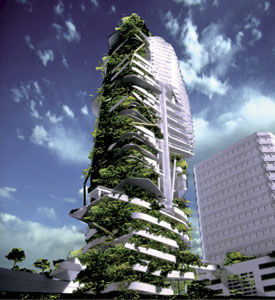
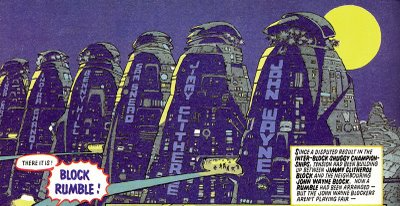
Mike McMahon, seen to many, including Brooker and myself as one of the definitive portrayals of The Big Meg renders the giant, town-within-a-city Blocks as “pepperpots” organic forms reminiscent of Ken Yeang (pictured here), or (former Rogers-collaborator) Renzo Piano’s “green skyscrapers”.

While I’m unsure of the claim that MC-1 can trace it’s lineage back to radical 60’s architecture, it seems that the influence flowing the other direction, from comicbook to architect, is far clearer.

Here in the UK, the Architect’s Journal went as far as to name it the number one comic book city [http://www.architectsjournal.co.uk/story.aspx?storyCode=5204830]

Echoing Brooker’s thoughts, they exclaim:

“Mega City One is the ultimate comic book city: bigger, badder, and more spectacular than its rivals. It’s underlying design principle is simple – exaggeration – which actually lends it a coherence and character unlike any other. While Batman’s Gotham City and Superman’s Metropolis largely reflect the character of the superheroes who inhabit them (Gotham is grim, Metropolis shines) Mega City One presents an exuberant, absurd foil to Dredd’s rigid, monotonous outlook.”
Back in our world, the exaggerated mega-city is going through a bit of bad patch.

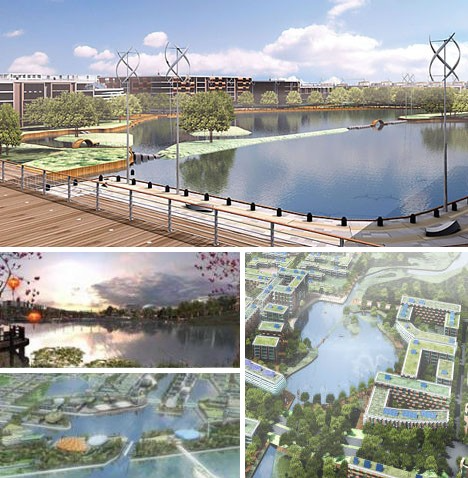
The bling’d up ultraskyscraping and bespoke island-terraforming of Dubai is on hold until capitalism reboots, and changes in political fortune have nixed the futuristic, ubicomp’d-up Arup-designed ecotopia of Dongtan [http://en.wikipedia.org/wiki/Dongtan] in China.

But, these are but speedbumps on the road to the future city.

There are still ongoing efforts to create planned, model future cities such as one that Nick Durrant of design consultancy Plot is working on in Abu Dhabi: Masdar City [http://en.wikipedia.org/wiki/Masdar_City] It’s designed by another alumni of the British Hi-tech school – Sir Norman Foster. “Zero waste, carbon neutral, car free” is the slogan, and a close eye is being kept on it as a test-bed for clean-tech in cities.

We are now a predominantly urban species, with over 50% of humanity living in a city. The overwhelming majority of these are not old post-industrial world cities such as London or New York, but large chaotic sprawls of the industrialising world such as the “maximum cities” of Mumbai or Guangzhou [http://en.wikipedia.org/wiki/Guangzhou]. Here the infrastructures are layered, ad-hoc, adaptive and personal – people there really are walking architecture, as Archigram said.

Hacking post-industrial cities is becoming a necessity also. The “shrinking cities” project, http://www.shrinkingcities.com, is monitoring the trend in the west toward dwindling futures for cities such as Detroit and Liverpool.

They claim:

“In the 21st century, the historically unique epoch of growth that began with industrialization 200 years ago will come to an end. In particular, climate change, dwindling fossil sources of energy, demographic aging, and rationalization in the service industry will lead to new forms of urban shrinking and a marked increase in the number of shrinking cities.”

However, I’m optimistic about the future of cities. I’d contend cities are not just engines of invention in stories, they themselves are powerful engines of culture and re-invention.

David Byrne in the WSJ [http://is.gd/3q1Ca] as quoted by entrepreneur and co-founder of Flickr, Caterina Fake [http://caterina.net/] on her weblog recently:

“A city can’t be too small. Size guarantees anonymity—if you make an embarrassing mistake in a large city, and it’s not on the cover of the Post, you can probably try again. The generous attitude towards failure that big cities afford is invaluable—it’s how things get created. In a small town everyone knows about your failures, so you are more careful about what you might attempt.”

Patron saint of cities, Jane Jacobs, in her book “The Economy of Cities” put forward the ‘engines of invention’ argument in her theory of ‘import replacement’:

“…when a city begins to locally produce goods which it formerly imported, e.g., Tokyo bicycle factories replacing Tokyo bicycle importers in the 1800s. Jacobs claims that import replacement builds up local infrastructure, skills, and production. Jacobs also claims that the increased produce is exported to other cities, giving those other cities a new opportunity to engage in import replacement, thus producing a positive cycle of growth.”

Urban computing and gaming specialist, founder of Area/Code and ITP professor Kevin Slavin showed me a presentation by architect Dan Pitera about the scale and future of Detroit, and associated scenarios by city planners that would see the shrinking city deliberately intensify – creating urban farming zones from derelict areas so that it can feed itself locally. Import replacement writ large.

He also told me that 400 cities worldwide independently of their ‘host country’ agreed to follow the Kyoto protocol. Cities are entities that network outside of nations as their wealth often exceeds that of the rest of the nation put together – it’s natural they solve transnational, global problems.

Which leads me back to science-fiction. Warren Ellis created a character called Jack Hawksmoor in his superhero comic series The Authority.

The surname is a nice nod toward psychogeography and city-fans: Hawksmoor was an architect and progeny of Sir Christopher Wren, fictionalised into a murderous semi-mystical figure who shaped the city into a giant magical apparatus by Peter Ackroyd in an eponymous novel.

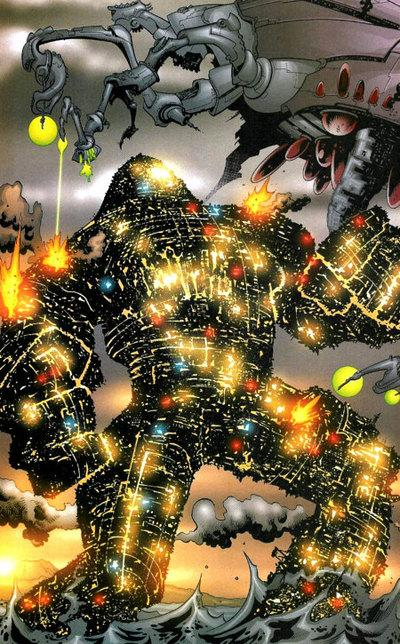
Ellis’ Hawksmoor however was abucted multiple times, seemingly by aliens, and surgically adapted to be ultimately-suited to live in cities – they speak to him and he gains nourishment from them. If you’ll excuse the spoiler, the zenith of Hawksmoor’s adventures with cities come when he finds the purpose behind the modifications – he was not altered by aliens but by future-humans in order to defend the early 21st century against a time-travelling 73rd century Cleveland gone berserk. Hawksmoor defeats the giant, monstrous sentient city by wrapping himself in Tokyo to form a massive concrete battlesuit.

Cities are the best battlesuits we have.

It seem to me that as we better learn how to design, use and live in cities – we all have a future.

Household Spirits for Stations: InfoTotems at Brockley Station

I left my job at Lunar Energy last month and August has been about recharging – some holidays with family and also wandering London a bit catching up with folks, seeing some art/design, and generally regenerative flaneur-y.

Yesterday, for instance, was off to lunch with my talented friends at the industrial design firm Approach Studio in Hackney.

This entailed getting the overground, and in doing so found something wonderful at Brockley Station.

Placed along the platform were “InfoTotems” (at least that’s what they were called on the back of them). Sturdy, about 1.5m high and with – crucially in the bright SE London sunlight of August – easily-readable low-power E-Ink screens.

E-ink “InfoTotem” at Brockley Station, SE London

They seemed to function as very simple but effective dynamic way-finding, nudging me down the platform to where it predicted I’d find a less-busy carriage.

Location sensitive, dynamic signage: E-ink “InfoTotem” at Brockley Station, SE London

Wonderfully, when I did so, I got this message on the next InfoTotem.

“You’re in the right place”: contextual reassurance from E-ink “InfoTotem” at
Brockley Station, SE London

Nothing more than that – no extraneous information, just something very simple, reassuring and useful.

It felt really appropriate and thoughtful.

Not overreaching, over promising , overloading with *everything* else this thing could possible do as a software-controlled surface.

Very nice, TfL folks.

E-ink “InfoTotem” at Brockley Station, SE London: Back view, UID…

I’m going to try to do a bit more poking on the provenance of this work, and where it might be heading, as I find it really delightful.

So far, I think the HW itself might be this from a small UK company called Melford Technologies .

It made me recall one of my favourite BERG projects I worked on, “The Journey” which was for Dentsu London – looking at ways to augment the realities of a train journey with light touch digital interventions on media surfaces along the timeline of the experience.

Place-based reassurance: Sketch for “The Journey” work with BERG for Dentsu London

Place-based reassurance: E-Ink magnetic-backed dynamic signage. Still from “The Journey” work with BERG for Dentsu London

I think what I like about the InfoTotems – is that instead of a singular product doing a thing on the platform, it’s treated as a spatial experience between the HW surfaces, and as a result it feels like a service inhabiting the place, rather than just the product.

Without that overloading I was referring to, what else could they do?

Obviously this example of nudging me down the platform to a less-busy carriage is based on telemetry it’s received from the arriving train.

Could there be more that conveys the spirit of the place – observations or useful nuggets – that are connected to where you are temporarily, but where the totems sit more permanently.

In “The Journey” there’s a lovely short bit where Jack is travelling through the UK countryside and looks at a ticket that has been printed for him, a kind of low-res augmented reality.

It’s a prompt for him to look out the window to notice something, knowing where he’s sitting and what time he’s going to go past a landmark.

Could low-powered edge AI start do something akin to this? To build out context or connections between observations made about the surroundings?

Cyclist counter sign in Manchester UK, Image via road.cc

We’ve all seen signs that count – for example ‘water bottles filled’ or ‘bike riders using this route today’ – but an edge AI could perhaps do something more lyrical, or again use the multiple positioned screens along the platform to tell a more serialised, unique story.

Maybe something like Matt W’s Poem/1 e-ink clock – with industrial design from Approach Studio, coincidentally!

Maybe it has a memory of place, a journal. It would need some delicate, sensitive, playful non-creepy design – as well as technological underpinnings ie. Privacy preserving sensing and edge-AI.

I recall Matt Webb also working with Hoxton Analytics who were pursuing stuff in this space to create non-invasive sensing of things like traffic and footfall in commercial space.

In terms of edge AI that starts to relate to the spatial world, I’m tracking the work of friends who have started Archetype.ai to look at just that. I need to delve not it and understand it more.

Perhaps it would then also need something like the work that Patrick Keenan and others did back at Sidewalk Labs to create a typology of sensing in public places.

“A visual language to demystify the tech in cities.” – Patrick Keenan et al, Sidewalk Labs, c2019

Of course the danger is once we start covering it in these icons of disclosure, and doing more and more mysterious things with our totems, we lose the calm ‘just enough internet’ approach that I love so much about this current iteration.

Maybe they’re just right as they are – and I should listen to them…

Electrosheds workshop at AHO, May 2023

It was wonderful to be invited back to AHO after such a long time to give a talk (see separate post) and a workshop for the interaction design students.

I decided to try a “walkshop” following in the footsteps (ahem) of James Bridle, Adam Greenfield, Deb Chachra (and many others I’m sure) to investigate how the invisible networks of electricity in our everyday lives, and the environment around us.

I based it loosely on Kevin Kelly’s “Big Here” quiz – that aims to ask (tough) questions that locate you in the technical, logistical and natural ecologies we are embedded in.

If I’d thought of it i should have shown the first 30 minutes of the first episode of James Burke’s “Connections”too.

We started the day with a short talk from me (the slides of which are below) introducing the topic and how we’d examine it in the walkshop.

After that we went on a ‘local energy safari’ and then for a few hours the students prepared responses and communication pieces based on what they’d found. I’ll post some of those separately.

It was a beautiful spring day – which was perfect for a ‘walkshop’ – and the students were enthusiastic participants in what I think was a *partially* successful experiment.

I’ll write a bit about that in another post on their responses.

Huge thanks to Mosse for the invitation and all the AHO students for their energy and patience!

I’d love to try this again – or have others try it! Please do get in touch if you’d like to do it somewhere else in Europe, or better yet invite me to do it with you!

Update [September 28th 2023]: Before I did this I was sadly not aware of Jenny Odell’s fantastic 2013 project “Power Trip”, which explores this territory beautifully.

I found the project coincidentally while sending a friend Odell’s site, based on his discovery of some google maps derived artworks, which I’d associated for years with the artist.

Back at Google Creative Lab, we’d worked with her on creating giant murals on the sides of data centres – themselves places of infrastructural fascination and critique by many of the artists referenced in this workshop…


Electrosheds Intro talk

One of my favourite pieces by Kevin Kelly is this – the ‘watershed quiz’.

In this he asks a set of questions which locate you in your ‘Big Here’.

You start where you are, and begin to pull the thread out to larger and larger scales…

“You live in the big here. Wherever you live, your tiny spot is deeply intertwined within a larger place, imbedded fractal-like into a whole system called a watershed, which is itself integrated with other watersheds into a tightly interdependent biome. At the ultimate level, your home is a cell in an organism called a planet. All these levels interconnect. What do you know about the dynamics of this larger system around you? Most of us are ignorant of this matrix. But it is the biggest interactive game there is. Hacking it is both fun and vital.”

The Big Here Quiz, Kevin Kelly https://kk.org/cooltools/the-big-here-qu/
Questions from The Big Here Quiz, Kevin Kelly https://kk.org/cooltools/the-big-here-qu/
Tubes by Andrew Blum

Andrew’s book is a striking piece of “Big Here” writing – pulling on the thread of his squirrel-sabotaged internet cabling and ending up half way around the world watching divers swim ashore carrying backbone-fibre over their shoulders.

I want us to do something similar with our energy, leaving this room and following where our energy is coming from, and noting how others are embedded similarly.

We’re going to leave AHO and ‘pull on the thread of your electrons’, like Andrew Blum did with his connectivity bits…

• From the power you touch & use out to the distribution, then transmission

• Look for hints of new topologies, local production and new forms – what might be taking hold, hybrids, commercial, official, unofficial, municipal, local, improvised…

Then

• Create a journal / map / notes to record your impressions

• A piece of communication to yourself

• To others

Please remember!

It doesn’t have to be “correct” – think like an amateur naturalist… record observations, things you see and interpret.

Think about spotting phenomena: behaviour, difference and context from observation – not worrying if you have the correct names or specialist knowledge to understand the system in abstract.

This morning I tried pulling on the thread from the apartment I’m staying at…

Electrical touch points in the apartment block I stayed in Oslo.

I looked up the names I found on the various (old) bits of electrical infrastructure in the apartment. This gave me some threads to pull on.

To pull on those threads I consulted the wonderful Open Infrastructure Map.

The area around AHO on Open Infrastructure Map

Do you recognise this building?

Akersberget Substation, across the street from AHO

Yep – it’s right across the street from AHO. And it’s the first link in a big chain from this area out to where the electrons we’re using right now probably originate.

Let’s pull the thread!

Zooooooming out – we can see some next links in the chain

Zooming out from Grunerløkka on Open Infrastructure Map
Zooming out to see the electrical infrastructure of Central Oslo

Looking at this, we can make a decision to follow the thread through the Sogn Substation back to the generating sources.

Sogn Substation, Oslo
Zooming out to the area surrounding Oslo to view possible generation sources

Again, we can decide to follow the thread of our electrons to one of the nearest hydroelectric generators – Nore II around 180km away.

Nore II Hydroelectric station, ~180km NW of Oslo

We could drive there in about 3hrs – or take a very long but scenic cycle there in the extended Norwegian (summer) day…

I mean, it looks lovely there!

Nore II Power Station, image by Amit Rathore

So – just from your desktop you can explore pulling on your energy thread. But today, we’re going to go outside and walk around our area to see what we can find.

We’re going to explore the Grunerløkka area in groups

Preparing to leave for the walkshop

[We then left AHO in groups and explored the area in our “Local Energy Safari”]

We had lunch!

[After returning from the energy safari walkshop component, we attempted ‘design responses’ to what was found for about 90mins – this was in hindsight too short, but there were still some great outputs]

Now we’re going to make some designed responses to what we saw, recorded, found.

Again – these could be communications or mappings, or more generative/speculative responses. Here are some prompts from me, let’s see what we get!

Some prompts to get the students started

You might have spotted interesting new hybrids emerging – what could those lead to?

Think about new hybrid forms that are emerging as “energy on the street”

You could think about social structures that could emerge around adversity or abundance – for instance some of the energy-sharing practices that emerged around Occupy Sandy in NYC.

And for inspiration only, the work of Clifford Harper in 1970s on ‘radical technology’ reprogramming and using appropriate technology to share resources in a town

Clifford Harper, Radical Technology

Again for inspiration – perhaps make a page from a future whole earth catalog documenting technology, practices, methods around your energy safari ideas.

The Whole Earth Catalog as a genre/format inspiration

Alternative Unknowns

Chris Woebken and Elliott Montgomery practice together as The Extrapolation Factory here in NYC. They often stage shows, workshops and teach a blend of speculative design provocation, storytelling, and making.

I first met them both at the RCA, and so I was thrilled when they asked me in late summer to be part of their show at ApexArt that would be based on the premise of designing future systems or objects for New York City’s Office of Emergency Management.

The show is on now until December 19th 2015 at ApexArt, but I thought I’d write up a little bit of the project I submitted to the group show along with my fantastic collaborators Isaac Blankensmith and Matt Delbridge


The premise

Chris and Elliott’s first recruit was writer Tim Maughan who based on the initial briefing with the OEM created a scenario that we as designers and artists would respond to, and create props for a group of improvisational actors to use in a disaster training simulation. More of that later!

Here’s what we got early on from Tim by way of stimulus…

Backdrop
NYC has been hit by a major pandemic (the exact nature of which is still to be decided – something new/fictitious). The city has been battling against it for several weeks now, with research showing that it may spread easily via the transit system. The city, in association with the public transport and the police are enforcing a strict regime of control, monitoring, and  – where necessary – quarantining. By constant monitoring of infection data (using medical reports, air monitoring/sampling, social media data mining etc) they are attempting to watch, predict, and hopefully limit spread. Using mobile ‘pop-up’ checkpoints they are monitoring and controlling use of buses and the subway, and in extreme cases closing off parts of the city completely from mass transit. Although it seems to be largely working, and fatalities have been relatively low so far, it has created an understandable sense of paranoia and distrust amongst NYC citizens.  

Setting
The Canal street subway station, late evening.

Scenario
Our characters are two individuals heading home to Brooklyn after leaving a show at apexart. They are surprised to find that the streets seem fairly empty. Just as they reach Canal station they are alerted (via Wireless Emergency Alert) that quarantine and checkpoint procedures have been activated in the neighbourhood, and a pop-up infection checkpoint has been set up at the entrance to the subway. They’ve never encountered one of these before, but in order to get home they must pass through it by proving they do not pose an infection.


Our proposals

I submitted two pieces with Isaac and Matt for the show.

The first concept “Citibikefrastructure” was built out into a prop which features in the gallery, the second concept “Bodyclocks” featured in the catalog and briefly in the final performed scenario.

1. “Citibikefrastructure”

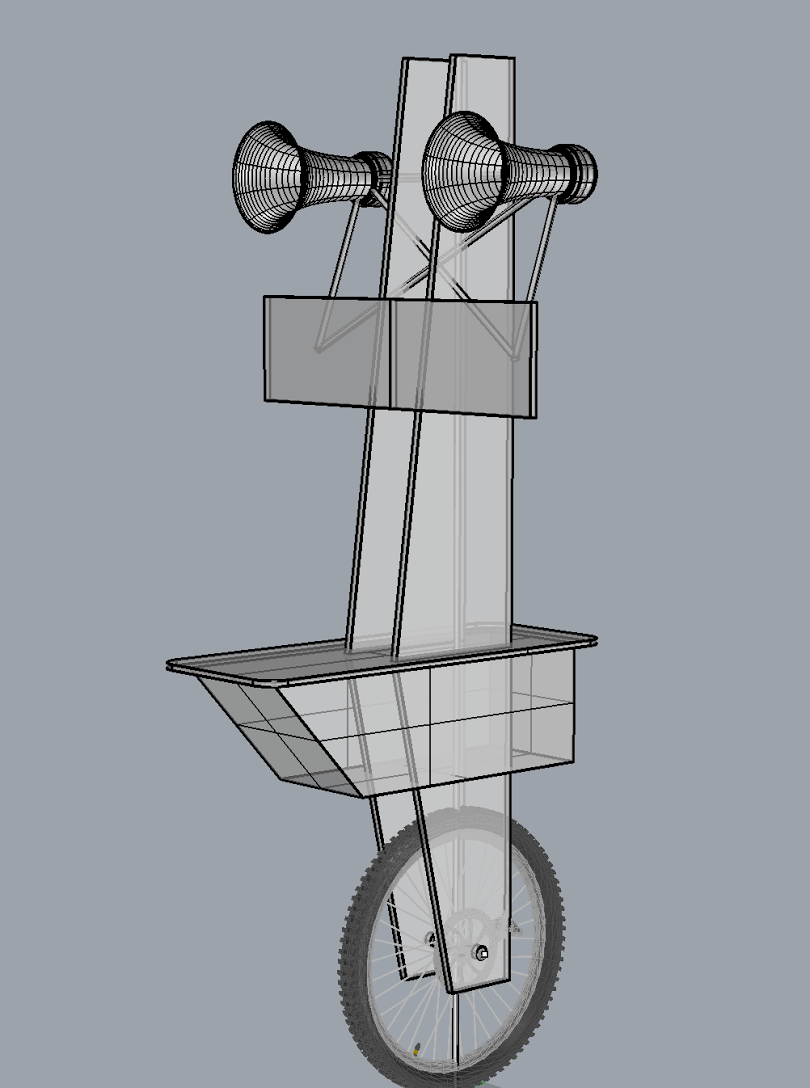
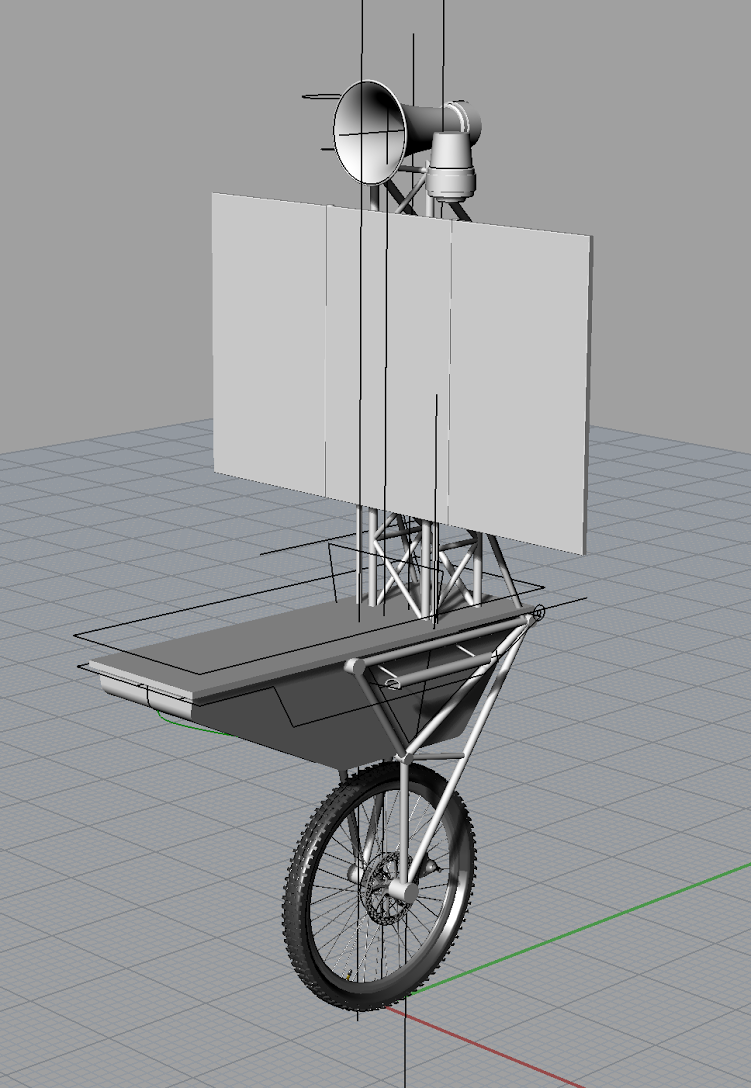
This first concept uses the NYC citibike bike share program as a widely installed base of checkpoints / support points in the city that have data and power, plus very secure locking mechanisms connected to the network.

The essential thought behind this project was this: What if these were used in times of emergency with modular systems of mobile equipment that plugged into them?

I started to think of both top-down and bottom-up uses for this system.

Top-down uses would be to assist in ‘command and control’ type situations and mainly by the OEM and other emergency services in the city.

  • TOP-DOWN:
    • e.g. Command post
      • Loudhailer system
      • Solar panels
      • Space heaters
      • Shelter / lights / air-conditioning
      • Wireless mesh networking
      • Refrigerator for medicine / perishable materials
      • Water purification

But perhaps more promising to me seemed ‘bottom-up’ uses

  • BOTTOM-UP:
    • USB charging stations
      • Inspiration: after Hurricane Sandy many people who still had electricity offered it up via running powerstrips and extension cords into the streets so people could charge their mobile devices and alert loved ones, keep up with the news etc.
    • Wireless mesh networking – p2p store/forward text across the citibike network.
    • Information display / FAQomputer
      • e-ink low power signs connected to mesh
      • LE bluetooth connection to smartphones with ‘take-away’ data
        • PDF maps
        • emergency guides
        • Bluetooth p2p Noticeboard for citizens
      • Blockchain-certified emergency local currency dispenser!
        • Barter/volunteer ‘cash’ infrastructure for self-organising relief orgs a la Occupy Sandy

1:1 Sketch proto

IMG_6768

After making some surreptitious measurements of the Citibike docking stations, I started to build a very simple 1:1 model of one of these ‘bottom-up’ modules for the show at the fantastic Bien Hecho woodworking academy in Brooklyn’s Navy Yard.

IMG_6890

IMG_6887

IMG_7373

Detail design and renderings

Meanwhile, Isaac had both taken my crappy sketches far beyond into a wonderfully-realised modular system and created some lovely renders to communicate it.

citibike_IB-1
Initial sketch by Isaac Blankensmith

citibike_ib-2
Isaac then started to flesh out a modular system that could accommodate the majority of the use-cases we had brainstormed.


CitiBike_Poster
Citibikefrastructure final renderings and compositing in situ by Isaac Blankensmith http://www.isaacblankensmith.com

Ortho_Poster
Citibikefrastructure final renderings and compositing in situ by Isaac Blankensmith http://www.isaacblankensmith.com

Some final adjustments were made to the sketch model on the days of installation in the gallery – notably the inclusion of a flashing emergency light, and functioning cellphone charger cables which I hopd would prove popular with gallery visitors if nothing else!

2. “Bodyclocks”

This one is definitely more in the realm of ‘speculative design’ and perhaps flirts with the dystopian a little more than I usually like to!

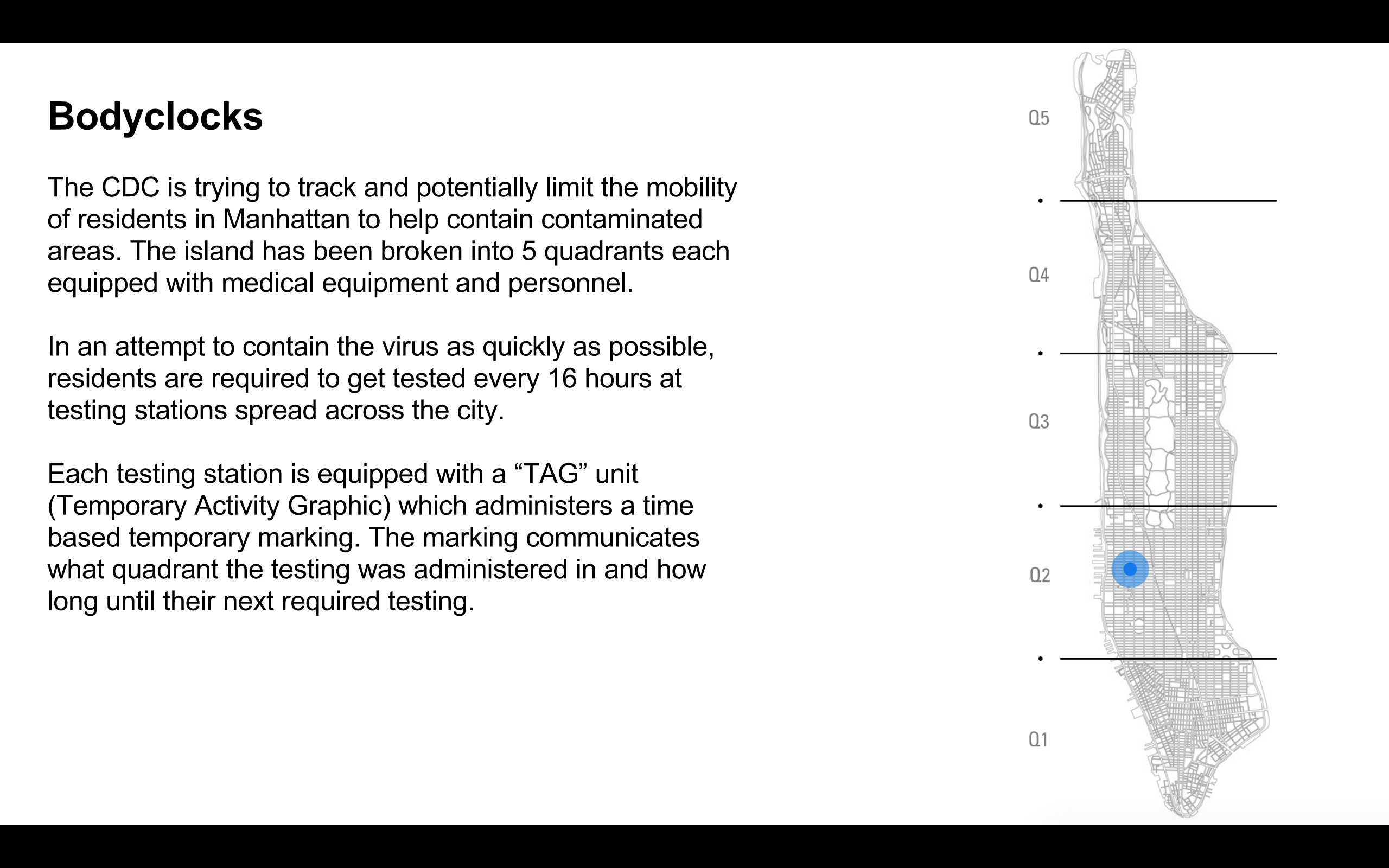
Bodyclocks riffs off the clocks-for-robots concept we sketched out at BERG that created computer-readable objects sync’d to time and place.

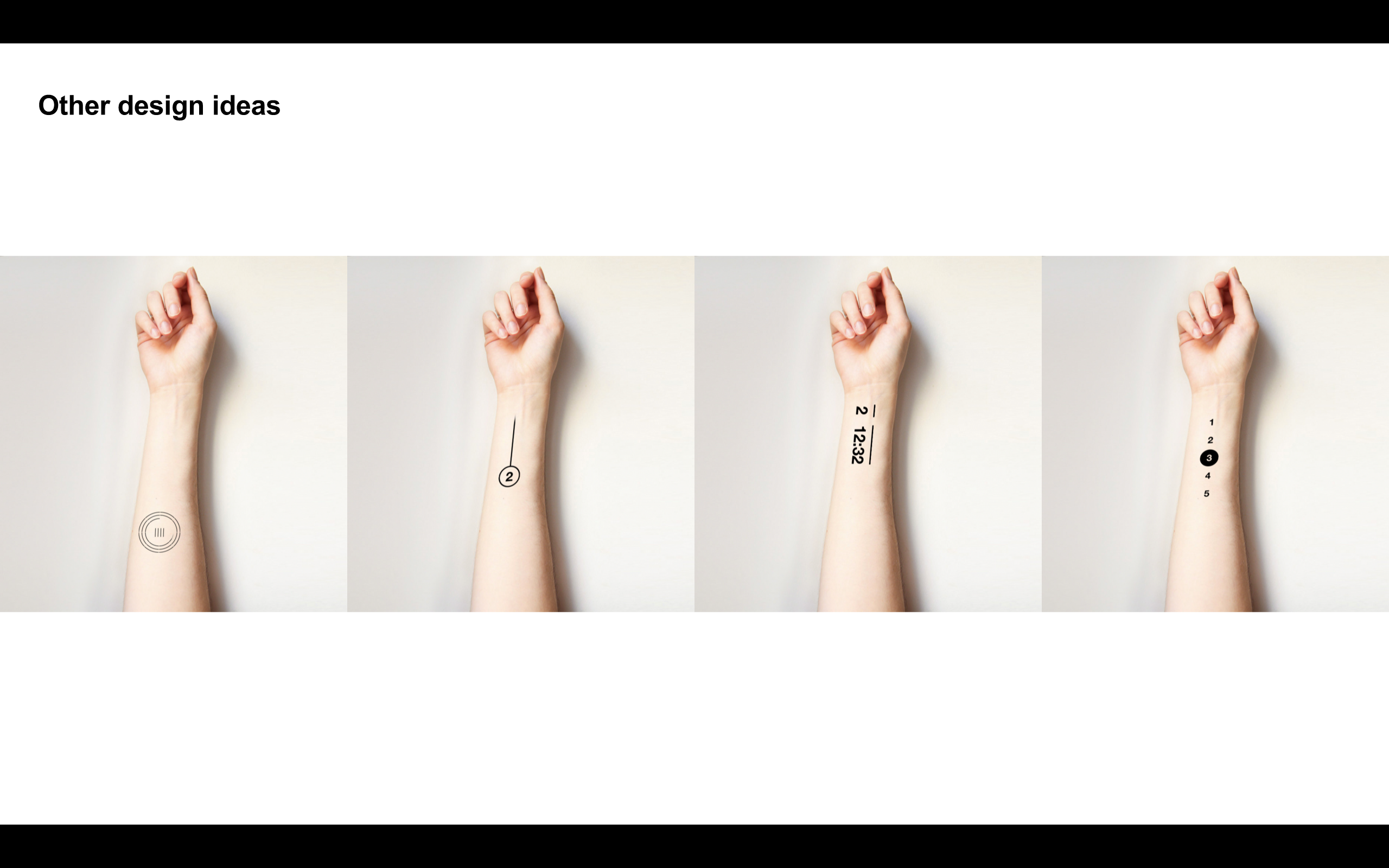
Bodyclocks extends this idea to some kind of time-reactive dye, inkjet-squirted onto skin by connected terminals in order to verify and control the movements of individuals in a quarantined city / city district…

Screen Shot 2015-11-24 at 11.21.25 PM

I’d deliberated chosen to ‘parasite’ this onto the familiar and mundane design of the ‘sanitation spray’ stations that proliferated suddenly in public/private spaces at the time of the H1N1 scare of 2009…

When you think about it, a new thing appeared in our semi-public realm – a new ritual, with it.

People would quickly habituate such objects and give themselves new temporary tracking ‘tattoos’ every time they crossed a threshold…

So, the dystopian angle is pretty obvious here. It doesn’t tend to reflect well on societies when they start to force people to identifying marks after all…

We definitely all talked about that a lot and under what circumstances people would tolerate or even elect to have a bodyclock tattoo. Matt Delbridge started creating some fantastic visuals and material to support the scenario.

Screen Shot 2015-11-24 at 11.31.58 PM

Screen Shot 2015-11-24 at 11.32.18 PM

Screen Shot 2015-11-24 at 11.32.21 PM

arm.png

Screen Shot 2015-11-24 at 11.32.16 PM

For the purposes of the show and the performances, Matt D. even made a stamp that the actors could use to give each other bodyclocks…

IMG_4084

Would the ritual of applying it in order to travel through the city be seen as something of a necessary evil, much like the security theatre of modern air travel? Or could a visible sign of how far you needed to travel spur assistance from strangers in a city at times of crisis? This proposal aimed to provoke those discussions.


The show and performance

One of the most interesting and exciting parts of being involved in this was that Chris and Elliott wanted to use actors to improvise with our designs as props and Tim’s script and prompt cards as context.

IMG_8466

I thought this was a brilliant and brave move – unreliable narrators and guides taking us on as designers and interpreting the work for the audience – and perhaps exposing any emperor’s new clothes or problematic assumptions as they go…


What’s next?

Well – there’s a workshop happening with the OEM based around the show on December 11th. I’m not going to be able to attend but I actually hope that the citibike idea might get some serious discussion and perhaps folks from the bikesharing companies that use such system might entertain a further prototype…


The year of bicycle thinking

Back in the UK, I’d been commuting by bike seriously for most of my thirties – by Brompton at first then from Brockley to our lovely bike racks at BERG most days on my Roll-1.

I’d done a few big rides in the past with the BRIG CC, including the Dunwich Dynamo.

However 2014 was the year that I seriously got the cycling bug, and NYC not London was where it happened.

Bought a road bike

At the advice of my brother-in-law, got myself the entry level all-carbon Cannondale, the Super-Six Evo 105
My cannondale

5boro

I was quite daunted by this – my first long ride in NYC. It wasn’t that big, about 40miles. It’s a fantastic leisurely ride however, with no cars and access to places bikes aren’t usually permitted like the BQE and Verrezano Narrows bridge. Great fun.

Riding to the rockaways

From Brooklyn in the summer there’s a great ride to be had down to Coney Island from Prospect Park and then further out into the Rockaways.

The city falls away quite quickly to suburbia, then nature then seaside surfurbia again.

And the reward at the end is the sea, juice and tacos!

NYC Century Bike Tour


The NYC Century Bike Tour was the big one though – and I’d thought I’d built up enough confidence riding through the summer to take it on.

It’s a bit of a challenge to follow the course, and you can get led astray in some of the sparser sections where the crowd of cyclists thins out to one or two hoping the person in front knows where they are going… As a result, got back to Prospect Park and realised I still had about a mile to go to make the 100! So, a lap of the park it was before I could really finish…

Palisades, 9W and River Road in Autumn…

Undoubtedly however, the 9W and River-Road route is the reason I’ve taken to road cycling so heavily in NYC. It’s simply beautiful, especially in Autumn.

From Brooklyn it’s a bit of a shlep to the start of the route at the GWB, but get over the Brooklyn Bridge early enough and even that is a treat.

You can’t really complain when you’re on the dedicated bike lane of the West-Side Highway for most of that either… But there’s a certain relief when you reach the little red lighthouse and you know the good stuff is about to begin.

Once over the GWB you can opt to head deeper into New Jersey and then back into New York State via the 9W, or more usually in Autumn to take in the colours of “The Fall” as they say in these parts and ride the rolling hills of River Road.

Strava

The other culprit for getting me deeper into road riding was of course Strava, and the ‘gamification’ of rides, competing with myself and friends. Also possibly the camaraderie of cursing Strava when it crashed or didn’t record your ride properly…

In all seriousness though, Strava (and my community there) does keep me riding and seems to help me incrementally improve my riding. I’m starting to get deeper into exploring new routes and possibly one day I’ll actually commit to some proper training through it…

Winter riding

Finally – I think the cold but sunny and dry nature of most of the winter in NYC really appealed to me – the 9W got quieter, and I started heading out further.

My favourite destination quickly became Rockland Lake.

My fuel stops started to get regular too – Bunbury’s, The 9W market (oh the egg and bacon sandwich after 40miles is perfect…), The Runcible Spoon, and Gypsy Donut…

Massive thanks to Kim Granlund for acting as personal coach and guide through 2014!

Five Zillion Channels of Not-Even-Wrong

The chairman writes:

*Everybody’s got a theory about the Internet-of-Things and its killer applications.

*It reminds me of the days when the Information Superhighway was all about 500-channel television. Nowadays we’ve got five zillion channel television, and it’s scarcely recognized as an existent technical reality. Those historical acts of foresight are so beside the point now that they’re “not even wrong.”

Sold: One Brompton

The way to LDN's heart is on a brompton

I got my Brompton six years ago, while I was still reverse-commuting every day from central London to Hampshire. Nokia’s UK design studio was located in glamorous Farnborough at the time, and quite a few of us travelled west from Waterloo for an hour or so, where there was a incredibly-depressing shuttle bus to the anonymous office park where we drank a lot of tea and tried to seduce implacable engineers and product managers with endless flash mockups of what we thought were better UIs than s60.

But that’s a tale for another day.

The train ride you could cope with – competitive crosswording with Matt Brown, Joe McCloud’s stream of consciousness narration of the suburban landscapes we trundled through (think Jonathan Meades meets Bill Hicks), Eddie’s terrible puns – but wait for the shuttle bus and the cramped, smelly bus ride itself were the last straw for many, who opted to bike the last couple of miles to the office every day instead.

There were a few tribes – the fast and furious fixies of Adam and Silas, Tom and Mattias the oak-legged mud-loving MTBers… and then, me… initially on a Strida, with its rubber belt, tiny wheels, pennyfarthing-seating and terrifying twitch-steering.

1st commute

Despite it’s quirks, I loved the Strida – at least compared to the shuttle bus. It was perfect for the train -> work -> train -> pub -> first floor flat daily life I had back then.

Strida Day #1

The lack of gears started to be noticed on even the slight climbs between Farnborough station and Nokia HQ, so after only a few months, in September 2006 I upgraded to my Brompton.

Wheels for yr mind

Up until last year it was my primary bike – until I started cycling my entire route to work rather than folding up and getting on the train. It sat forlorn in the studio, and then my kitchen – until last Saturday when I sold it to welovebromptons.co.uk, from where it will hopefully find a new home.

I loved my brompton as I’ve not loved many of my possessions. Not only for it’s utility and efficency – but also for what it represented: British design, engineering and manufacture.

I was fortunate to be invited to the Brompton factory in 2010.

Visiting the Brompton Bicycles factory, July 2010 - 17

I believe that at the time it was (and it still maybe) the only full manufacturing site in London. It was fantastic to see the skill, care and attention to detail that was given to every process.

Visiting the Brompton Bicycles factory, July 2010 - 04

Also the integration of design, engineering and manufacture – the continuum of concern that the designers had for the material and human processes at work in the factory.

Visiting the Brompton Bicycles factory, July 2010 - 14

Visiting the Brompton Bicycles factory, July 2010 - 06

Visiting the Brompton Bicycles factory, July 2010 - 07

Design was not an abstract activity, but an integral one – with a tight feedback loop from the shop floor, the testing suites, the customer service.

And the shop floor itself was a treat for a designer – a rainbow of coated metal…

Visiting the Brompton Bicycles factory, July 2010 - 08

So, sadly it’s goodbye to all that for now, no longer will I be able to tuck my green machine into the convenient parking bay provided by The Shepherdess…

The Bromptronozord

But I dare say I’ll own one again, one day.

Handsome, handsome machines.

W. Brian Arthur Vs Silicon Roundabout, ‘Start-Up Britain’ and other shake-and-bake approaches

I’m currently reading ‘The nature of technology’ by W.Brian Arthur.

It presents quite the juxtaposition to things like ‘East London Tech City‘ and other recent UK government initiatives.

“Real advanced technology—on-the-edge sophisticated technology—issues not from knowledge but from something I will call deep craft. Deep craft is more than knowledge. It is a set of knowings. Knowing what is likely to work and what not to work. Knowing what methods to use, what principles are likely to succeed, what parameter values to use in a given technique. Knowing whom to talk to down the corridor to get things working, how to fix things that go wrong, what to ignore, what theories to look to. This sort of craft-knowing takes science for granted and mere knowledge for granted. And it derives collectively from a shared culture of beliefs, an unspoken culture of common experience.

Such knowings root themselves in local micro-cultures: in particular firms, in particular buildings, along particular corridors. They become highly concentrated in particular localities.

There’s been some hoo and some haa – about where we work – Shoreditch, Hoxton, near Old St., which my former colleague Matt Biddulph dubbed (as a joke) “Silicon Roundabout“.

The press and politicians seem suprised by the ‘sudden’ growth in technology and design companies in the area, but its been the centre of the London internet ‘industry’ since the mid 1990’s – and been home to artists, designers and printers for decades.

It has also, bizarrely, equated what is going on in the area with providing a large industrial park in Startford full of massive multi-million dollar transnational incumbents e.g. McKinsey, Cisco, Facebook and Google.

In reference to the long-now of place and craft, in ‘The nature of technology’, Arthur quotes Alfred Marshall:

“When an industry has thus chosen a locality for itself, it is likely to stay there long: so great are the advantages which people following the same skilled trade get from near neighborhood to one another. The mysteries of the trade become no mysteries; but are as it were in the air, and children learn many of them unconsciously.”

Sounds a lot like Old St!

He adds:

Technology proceeds out of deep understandings of phenomena, and these become embedded as a deep set of shared knowings that resides in people and establishes itself locally—and that grows over time. This is why countries that lead in science lead also in technology. And so if a country wants to lead in advanced technology, it needs to do more than invest in industrial parks or vaguely foster “innovation.” It needs to build its basic science without any stated purpose of commercial use”

So – probably better to not cut education, or funding for science – rather than encouraging people to ‘do a logo’.

This stuff takes a long time, and requires patient support not soundbites or 5-step plans.

As Arthur points out (with my emphasis):

“Building a capacity for advanced technology is not like planning production in a socialist economy, but more like growing a rock garden. Planting, watering, and weeding are more appropriate than five-year plans.

The Ray Davies Preservation Society

Just finished watching Julian Temple’s film about Ray Davies and The Kinks: “Imaginary Man”.

It’s incredibly tender toward it’s subject – which is at once Ray, his music, the band – and London.

Ray Davies: Imaginary Man

The Turner-esque, painterly imagery alternates with more graphic compositions of Davies’ peregrinations around North London.

Ray Davies: Imaginary Man

It’s a series of psychographic sketches, punctuated by Kinks songs – in archive footage, in cover versions and most affectingly perhaps, hummed, sung and stumbled through by Davies as he strolls.

Ray Davies: Imaginary Man

He’s cast by the film as a flawed-heir to Blake – wandering London, inventing his own sung-systems rather than be enslaved by another man’s.

Ray Davies: Imaginary Man

This blog goes into far more detail and appreciation.

If you can hunt it down online do.

Ray Davies: Imaginary Man

If only to revel in London as Temple and Davies do.

Ray Davies: Imaginary Man

My thanks to both of them.

Ray Davies: Imaginary Man