Cornelius has a posse

cornelius

It’s the 25 anniversary of the Miner’s Strike.
I was around 11 or 12 at the time, along with the Falklands War and the ongoing existential background-radiation (!) of the Cold War it was one of the defining events of the 1980s that I ‘woke up’ in.

My elder siblings were watching Boys from The Blackstuff to make sense of the recession, the end of Britain-as-industrial-power and the human toll it was taking.

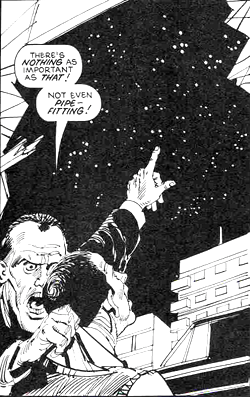
I read Skizz.

Skizz is still one of the best slices of storytelling, and certainly characterisation Alan Moore has ever done I think.

If you’re not familiar with it, then the all-too-brief wikipedia entry sums it up quite well as “E.T. meets Boys from the Blackstuff“. It can still bring me to the verge of tears, and to think this was in a comic still at the time aimed at and read by kids is remarkable and wonderful.

The sad demise of the DFC aside, I really hope that as we tumble into seemingly-similar times, someone else will write something as powerful and moving and life-affirming for a younger audience.

Reblog this post [with Zemanta]

Joe Jackson and Jamais Cascio Vs The Collapsitarians

"The end of all things is near."

On the (27 hour) plane ride back from New Zealand, I watched a lot of movies, some unremarkable – some wonderful. Watching Happy-Go-Lucky was painful for some reasons, and beautiful for others – but it definately hit me with the pink laserbeam between the eyes.

Watching classics like The Apartment and Manhattan made me wonder at the romances we’d write about some cities, and Slumdog Millionaire bizarrely seemed like a continuation of that: a romance of the maximum-city.

But, beside that – everytime a movie finished, the entertainment system reset to it’s main menu, with one of those airline entertainment system pseudo-radio stations playing on a loop.

And I hit the same point in the loop everytime.

And at that point in the loop played the same song everytime.

The song was a romance of the city.

A romance of electricity and colour and life and density of opportunity.

Electricity so fine
Look and dry your eyes

The song was “Stepping Out” by Joe Jackson.

Go and listen.

Watch.

I’ll stay put.

In recent months I’ve definitely fallen into a Collapsitarian rut of sorts.

A comprehensive map of all possible human futures

We -
Are young but getting old before our time

This won’t do.

As Jamais Cascio says, quoting Evelin Lindner:

“Pessimism is a luxury of good times. In difficult times, pessimism is a
self-fulfilling, self-inflicted death sentence.”

The wave of stuff coming down the lightcone is for sure a Danmaku-like bullet-curtain of environmental, societal and technical challenges, but I like Danmaku!

That’s where the action is, where the flow is felt, and where design wrangling of the sweetest kind can be done.

So, more wrangling, less hand-wringing.

Big bets should be made.

Happy-gets-lucky!

It took at 27 hour flight to realise that 27 years ago in 1982, Joe Jackson knew this and planted a time capsule into culture to help me with 2009.

It’s The Anti-Collapsitarian Anthem.

We -
So tired of all the darkness in our lives
With no more angry words to say
Can come alive
Get into a car and drive
To the other side

That’s some foresight, right there. So if you are feeling a little collapsitarian, try stepping out.

You -
Can dress in pink and blue just like a child
And in a yellow taxi turn to me and smile
We’ll be there in just a while
If you follow me

Thanks Joe.

Reblog this post [with Zemanta]

The Ambiguity of Play(ce)

I’m in Wellington, New Zealand at WebStock.

It’s the first session – Jane McGonigal is talking about games, and I start thinking about the less-goal directed, more ambiguous world of play – my twin obsession with place.

I look up Brian Sutton-Smith, who wrote The Ambiguity of Play – probably my favourite book on the subject (which I think I was introduced to by Simon or Pat, or both…) and guess what…

He’s from Wellington.

—-

Update: even crazier – he now lives in Sarasota, Florida – where I went last October…

Reblog this post [with Zemanta]

Who Stole My Volcano? Or: How I Learned to Stop Worrying and Love the Dematerialisation of Supervillain Architecture.

Sir Ken Adam in conversation with Sir Christopher Frayling, V&A

I saw Sir Ken Adam, production designer of numerous Bonds, Chitty-Chitty-Bang-Bang and Dr. Strangelove amongst other movies, interviewed by Christopher Frayling at the V&A last Friday, as part of their current Cold War Modern exhibit.

As a result, Frayling concentrated the conversation on those iconic Cold War images of the war room in Dr. Strangelove, and the numerous lairs for Bond Villains he had designed.

Frayling described these lairs with a lovely turn of phrase, paraphrasing Corbusier’s “houses are machines for living in” – that they were “Machines for being a meglomaniac in”.

Adam responded that his intention was to make the Bond Villain a contemporary creature. They should embedded in the material culture of the times – albeit with the resources of a meglomaniac millionaire or billionaire – and also able to reach a little bit beyond into a near-future as those resources allow.

Although rather than maintaining a purely high-modernist aesthetic, Adam’s villains were ostentatious, status-seeking magpies, with their old masters from a daring heist, siberian tiger rugs and priceless antiques on display next to their Eames recliners and Open-plan freestanding fireplaces.

“Gantries and Baroque” might be the best name for the look though, as this finery was, of course, all inside the ‘sanctum-sanctorum’ of their lair – generally they would have maintained such a well-appointed apartment somewhere within a more massive and industrial death-dealing facility staffed by uniformed private armies.

Frayling pointed out this repeating formula in the 60s and 70s Bond movies to the audience. A hidden fortress, that had to be discovered, infiltrated and destroyed with a girl/goddess as guide – but not to be destroyed before we could take in some of the fine lifestyle touches that supervillainy gave as rewards.

But then in an almost throw-away aside to Adam, he reflected that the modern Bond villain (and he might have added, villains in pop culture in general) is placeless, ubiquitous, mobile.

His hidden fortress is in the network, represented only by a briefcase, or perhaps even just a mobile phone.

Where’s the fun in that for a production designer?

Maybe it’s in the objects. It’s not the pictures that got small, but the places our villains draw they powers from.

Perhaps the architypical transformation from gigantic static lair to mobile, compact “UbiLair” is in the film Spartan, where Val Kilmer’s anti-heroic ronin carries everything he needs in his “go-bag” – including a padded shooting mat that unfolds from it to turn any place into a place where he holds the advantage.

Move beyond film and I immediately think of my favourite supervillain of the year, Ezekiel ‘Zeke’ Stane from Matt Fraction‘s masterful run on the comicbook Invincible Iron Man.

As Fraction puts it:

Zeke is a post-national business man and kind of an open source ideological terrorist, he has absolutely no loyalty to any sort of law, creed, or credo. He doesn’t want to beat Tony Stark, he wants to make him obsolete. Windows wants to be on every computer desktop in the world, but Linux and Stane want to destroy the desktop. He’s the open source to Stark’s closed source oppressiveness. He has no headquarters, no base, and no bank account. He’s a true ghost in the machine; completely off the grid, flexible, and mobile. That absolutely flies in the face of Tony’s received business wisdom and in the way business is done. There are banks and lawyers and you have facilities and testing. Stane is a much more different animal. He’s a much smarter, more mobile and much quicker to respond and evolve futurist.

Zeke has no need for specialised infrastructure beyond commodity gear than he can improvise and customise. He doesn’t need HeliCarriers or giant military-industrial infrastructure like Tony Stark. He just needs his brain and his hate. As Fraction says in an interview:

I was trying to figure out what a new Iron Man would look like, and I figured, well, there wouldn’t be a suit anymore. The user would be the suit. I just started to riff on that, on cybernetics and riffing on weaponized bodymod culture stuff. Tony’s old money, old world, old school and old model manufacture. So where would Stane, a guy that had no manufacturing base and no assembly facilities, get his tech? Everything would need power sources, so how would that work? Where would the surgeries be performed? How would he pay for it? What’s his ideology? I started reading up on 4G war and warfare. And on and on until I understood Stane’s reality, and how Stane would wage war on Stark Industries and Tony both.

So – for a “4th generation warfare” supervillain there aren’t even objects for the production designer to create and imbue with personality. The effects and the consequences can be illustrated by the storytelling, but the network and the intent can’t be foreshadowed by environments and objects in the impressionist way that Adam employed to support character and storytelling.

But – what about materialising, visualising these invisible networks in order to do so?

Dan Hill just published a spectacular study of his – into the ‘architecture’ of wifi in a public space. They make visible the invisible flows of the network around tangible architecture, and the effect that has on how people inhabit that tangible space.

Interesting, deeply-interesting stuff.

Me, I just think that’s what’s fluxing and flexing around the 4th Gen Bond Villain.

That’s what could telegraph to us, the audience their bad intentions. That’s what communicates their preference, and their potency. Could it do it as effectively, immediately, seductively as Sir Ken could with Cor-Ten and Cashmere?

Probably not. Yet.

The visualisations he’s made Dan freely admits make more than a nod to Cedric Price‘s Aviary at London Zoo. Price himself being no stranger to creating intangible, mobile, flexible architectures – I bet he would have been bursting with ideas for 4th Gen Bond Villain UbiLairs…

In the mean-time, in the real world of all-controlling superpowers, we seem to be coming full circle, architecture professor Jeffrey Huang has been investigating the all-too-tangible architecture of what we rather-wishfully call the cloud: server farms.

These hydropowered, energy-guzzelling megastructures seem to have all the ‘Gantry’ but not a lot of ‘Baroque’ panache to qualify as good old-fashioned Bond Villain SuperLairs.

But, perhaps Larry and Sergei are working on it…

This summer, Google put a patent on floating data centers cooled and powered by the ocean.

Sir Ken was always ahead of his time.
Reblog this post [with Zemanta]

Jessica Helfand and Tony Stark vs. Don Norman, Paul Dourish and Joss Wheedon

Jessica Helfand of Design Observer on Iron Man’s user-interfaces as part of the dramatis personae:

“…in Iron Man, vision becomes reality through the subtlest of physical gestures: interfaces swirl and lights flash, keyboards are projected into the air, and two-dimensional ideas are instantaneously rendered as three and even four-dimensional realities. Such brilliant optical trickery is made all the more fantastic because it all moves so quickly and effortlessly across the screen. As robotic renderings gravitate from points of light in space into a tangible, physical presence, the overall effect merges screen-based, visual language with a deftly woven kind of theatrical illusion.”

Made me think back to a post I wrote here about three years ago, on “invisible computing” in Joss Wheedon’s “Firefly”.

Firefly touch table

“…one notices that the UI doesn’t get in the way of the action, the flow of the interactions between the bad guy and the captain. Also, there is a general improvement in the quality of the space it seems ? when there are no obtrusive vertical screens in line-of-sight to sap the attention of those within it.”

Firefly touch table

Instead of the Iron Man/Minority Report approach of making the gestural UI the star of the sequence, this is more interesting – a natural computing interface supports the storytelling – perhaps reminding the audience where the action is…

As Jessica points out in her post, it took us some years for email to move from 3D-rendered winged envelopes, to things that audiences had common experience and expectations of.

Three years on from Firefly, most of the audience watching scifi and action movies or tv will have seen or experienced a Nintendo Wii or an iPhone, and so some of the work of moving technology from star to set-dressing is done – no more outlandish or exotic as a setting for exposition than a whiteboard or map-table.

Having said that – we’re still in tangible UIs transition to the mainstream.

A fleeting shot from the new Bond trailer seems to indicate there’s still work for the conceptual UI artist, but surely this now is the sort of thing that really has a procurement number in the MI6 office supplies intranet…

Bond Touch table

And – it’s good to see Wheedon still pursuing tangible, gestural interfaces in his work…

Skateboarding and The City

Skateboarding and The City, originally uploaded by blackbeltjones.

“The triumph of non-labour, however, does not entail an absence of effort but an even more profound redefinition of what ‘production’ might mean, and it is here too that skateboarding strikes at the heart of the business city. At first sight, skateboarders’ labour produces no ‘products’ beyond the moves skaters make, a ‘commodity’ exchangeable only by means of performative action. Furthermore, skateboarders, like students, offer a potential labour force but they deny this by undertaking seemingly meaningless productions, and so appear to waste effort and time. But that ‘principle of economy’ which sees a ‘waste’ of energy as abnormal is itself a reduction of life to mere survival. Skateboarding, in contrast, undertakes a release of energy that either creates or modifies space, espousing play, art and festival.”

– Prof Iain Boarden, Skateboarding and The City