The City is (still) a battlesuit for surviving the future.

Just watched Sir Norman Foster present at the World Design Congress in London, on cities and urbanism as a defence against climate change.

This excellent image visualises household carbon footprints – highlighting in coincidental green the extreme efficiency of NYC compared to the surrounding suburban sprawl of the emerging BAMA.

Sir Norman Foster presenting at the World Design Congress in London, discussing urbanism and climate change while a colorful map of household carbon footprints in New York City is displayed.

16 years ago this September, while at BERG, I wrote a piece at the invitation of Annalee Newitz for a science fiction focussed blog called io9 called “The City is a battlesuit for surviving the future.

It’s still there: bit-rotted, battered, and oozing dangerously-outdated memetic fluids, like a Mark 1 Jaeger.

Bruce Sterling was (obliquely) very nice about it at the time, and lots of other folks wrote interesting (and far-better written) rebuttals.

I thought as it’s a 16 year old now, I should check in on it, with some distance, and give it a new home here.

I thankfully found my original non-edited google doc that I shared with Annalee, and it’s pasted below…

My friend Nick Foster is giving the closing keynote at the event Sir Norman spoke at tomorrow. He just wrote an excellent book on our attitudes to thinking about futures called “Could Should Might Don’t” – which I heartily recommend.

My little piece of amateur futurism from 2009 has a dose of all four – but for the reasons Sir Norman pointed out, I think it’s still a ‘Could’.

And… Still a ‘Should’.

The City is (still) a battlesuit for surviving the future.

Now, 16 yrs later, we ‘Might‘ build it up from Kardashev Streets


[The following is my unedited submission to io9.com, published 20th September 2009]

The city is a battlesuit for surviving the future.

Looking at the connections between architects and science-fiction’s visions of future cities

In February of this year I gave a talk at webstock in New Zealand, entitled “The Demon-Haunted World” – which investigated past visions of future cities in order to reflect upon work being done currently in the field of ‘urban computing’.

In particular I examined the radical work of influential 60’s architecture collective Archigram, who I found through my research had coined the term ‘social software’ back in 1972, 30 years before it was on the lips of Clay Shirky and other internet gurus.

Rather than building, Archigram were perhaps proto-bloggers – publishing a sought-after ‘magazine’ of images, collage, essays and provocations regularly through the 60s which had an enormous impact on architecture and design around the world, right through to the present day. Archigram have featured before on io9 [http://io9.com/5157087/a-city-that-walks-on-giant-actuators], and I’m sure they will again.
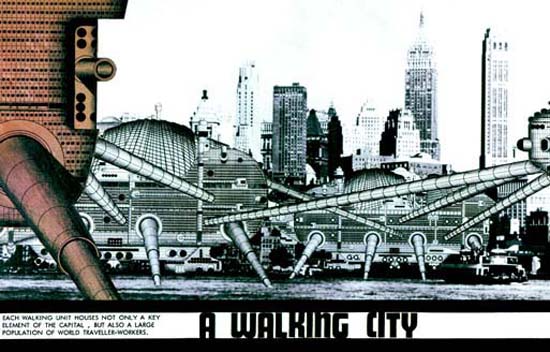
Archigram's "Walking City" Project: An artistic depiction of a futuristic city designed to be mobile, with mechanical elements and skyscrapers in the background, representing a conceptual vision of urban living.

They referenced comics – American superhero aesthetics but also the stiff-upper-lips and cut-away precision engineering of Frank Hampson’s Dan Dare and Eagle, alongside pop-music, psychedelia, computing and pulp sci-fi and put it in a blender with a healthy dollop of Brit-eccentricity. They are perhaps most familiar from science-fictional images like their Walking City project, but at the centre of their work was a concern with cities as systems, reflecting the contemporary vogue for cybernetics and belief in automation.

Exterior view of the Pompidou Centre in Paris, showcasing its unique architectural design with exposed structural elements and colorful escalators.

Although Archigram didn’t build their visions, other architects brought aspects of them into the world. Echoes of their “Plug-in city” can undoubtedly be seen in Renzo Piano and Richard Rogers’ Pompidou Centre in Paris.

Much of the ‘hi-tech’ style of architecture (chiefly executed by British architects such as Rogers, Norman Foster and Nicholas Grimshaw) popular for corporate HQs and arts centers through the 80s and 90s can be traced back to, if not Archigram, then the same set of pop sci-fi influences that a generation of British schoolboys grew up with – into world-class architects.

Lord Rogers, as he now is, has made a second career of writing and lobbying about the future of cities worldwide. His books “Cities for a small planet” and “Cities for a small country” were based on work his architecture and urban-design practice did during the 80s and 90s, consulting on citymaking and redevelopment with national and regional governments. His work for Shanghai is heavily featured in ‘small planet’ – a plan that proposed the creation of an ecotopian mega city. This was thwarted, but he continues to campaign for renewed approaches to urban living.

Colorful graphic featuring a futuristic city skyline with the text 'People Are Walking Architecture' prominently displayed. The design includes abstract shapes and visual elements associated with urban architecture and the concept of people as integral to city structures.

Last year I saw him give a talk in London where he described the near-future of cities as one increasingly influenced by telecommunications and technology. He stated that “our cities are increasingly linked and learning” – this seemed to me a recapitulation of Archigram’s strategies, playing out not through giant walking cities but smaller, bottom-up technological interventions. The infrastructures we assemble and carry with us through the city – mobile phones, wireless nodes, computing power, sensor platforms are changing how we interact with it and how it interacts with other places on the planet. After all it was Archigram who said “people are walking architecture”

Dan Hill (a consultant on how digital technology is changing cities for global engineering group Arup) in his epic blog post “The Street as Platform” [http://www.cityofsound.com/blog/2008/02/the-street-as-p.html] says “…the way the street feels may soon be defined by what cannot be seen by the naked eye”.

He goes on to explain:

“We can’t see how the street is immersed in a twitching, pulsing cloud of data. This is over and above the well-established electromagnetic radiation, crackles of static, radio waves conveying radio and television broadcasts in digital and analogue forms, police voice traffic.  This is a new kind of data, collective and individual, aggregated and discrete, open and closed, constantly logging impossibly detailed patterns of behaviour. The behaviour of the street.”

Adam Greenfield, a design director at Nokia wrote one of the defining texts on the design and use of ubiquitous computing or ‘ubicomp’ called “Everyware” [http://www.studies-observations.com/everyware/] and is about to release a follow-up on urban environments and technology called “The city is here for you to use”.

In a recent talk he framed a number of ways in which the access to data about your surroundings that Hill describes will change our attitude towards the city. He posits that we will move from a city we browser and wander to a ‘searchable, query-able’ city that we can not only read, but write-to as a medium.

He states

“The bottom-line is a city that responds to the behaviour of its users in something close to real-time,  and in turn begins to shape that behaviour”

Again, we’re not so far away from what Archigram were examining in the 60’s. Behaviour and information as the raw material to design cities with as much as steel, glass and concrete.

The city of the future increases its role as an actor in our lives, affecting our lives.

This of course, is a recurrent theme in science-fiction and fantasy. In movies, it’s hard to get past the paradigm-defining dystopic backdrop of the city in Bladerunner, or the fin-de-siècle late-capitalism cage of the nameless, anonymous, bounded city of the Matrix.

Perhaps more resonant of the future described by Greenfield is the ever-changing stage-set of Alex Proyas’ “Dark City”.

For some of the greatest-city-as-actor stories though, it’s perhaps no surprise that we have to turn to comics as Archigram did – and the eponymous city of Warren Ellis and Darrick Robertson’s Transmetropolitan as documented and half-destroyed by gonzo future journalist-messiah Spider Jerusalem.

Transmet’s city binds together perfectly a number of future-city fiction’s favourite themes: overwhelming size (reminiscent of the BAMA, or “Boston-Atlanta Metropolitan Axis from William Gibson’s “Sprawl” trilogy),  patchworks of ‘cultural reservations’ (Stephenson’s Snowcrash with it’s three-ring-binder-governed, franchise-run-statelets) and a constant unrelenting future-shock as everyday as the weather… For which we can look to the comics-futrue-city grand-daddy of them all: Mega-City-1.

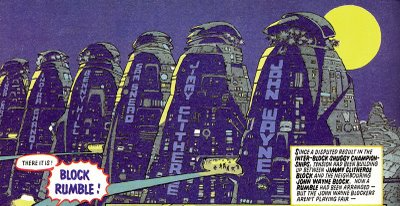
Ah – The Big Meg, where at any moment on the mile-high Zipstrips you might be flattened by a rogue Boinger, set-upon by a Futsie and thrown down onto the skedways far below, offered an illicit bag of umpty-candy or stookie-glands and find yourself instantly at the mercy of the Judges. If you grew up on 2000AD like me, then your mind is probably now filled with a vivid picture of the biggest toughest, weirdest future city there’s ever been.

This is a future city that has been lovingly-detailed, weekly, for over three decades years, as artist Matt Brooker (who goes by the psuedonym D’Israeli) points out:

Working on Lowlife, with its Mega-City One setting freed from the presence of Judge Dredd, I found myself thinking about the city and its place in the Dredd/2000AD franchise. And it occurred to me that, really, the city is the actual star of Judge Dredd. I mean, Dredd himself is a man of limited attributes and predictable reactions. His value is giving us a fixed point, a window through which to explore the endless fountain of new phenomena that is the Mega-City. It’s the Mega-City that powers Judge Dredd, and Judge Dredd that has powered 2000AD for the last 30 years.

Brooker, from his keen-eyed-viewpoint as someone currently illustrating MC-1, examines the differing visions that artists like Carlos Ezquerra and Mike McMahon have brought to the city over the years in a wonderful blogpost which I heartily recommend you read [http://disraeli-demon.blogspot.com/2009/04/lowlife-creation-part-five-all-joy-i.html]

Were Mega-City One’s creators influenced by Archigram or other radical architects?

I’d venture a “yes” on that.
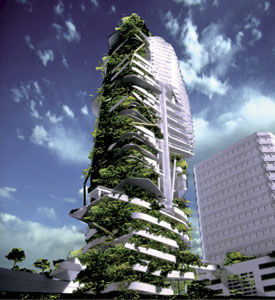
Mike McMahon, seen to many, including Brooker and myself as one of the definitive portrayals of The Big Meg renders the giant, town-within-a-city Blocks as “pepperpots” organic forms reminiscent of Ken Yeang (pictured here), or (former Rogers-collaborator) Renzo Piano’s “green skyscrapers”.

While I’m unsure of the claim that MC-1 can trace it’s lineage back to radical 60’s architecture, it seems that the influence flowing the other direction, from comicbook to architect, is far clearer.

Here in the UK, the Architect’s Journal went as far as to name it the number one comic book city [http://www.architectsjournal.co.uk/story.aspx?storyCode=5204830]

Echoing Brooker’s thoughts, they exclaim:

“Mega City One is the ultimate comic book city: bigger, badder, and more spectacular than its rivals. It’s underlying design principle is simple – exaggeration – which actually lends it a coherence and character unlike any other. While Batman’s Gotham City and Superman’s Metropolis largely reflect the character of the superheroes who inhabit them (Gotham is grim, Metropolis shines) Mega City One presents an exuberant, absurd foil to Dredd’s rigid, monotonous outlook.”
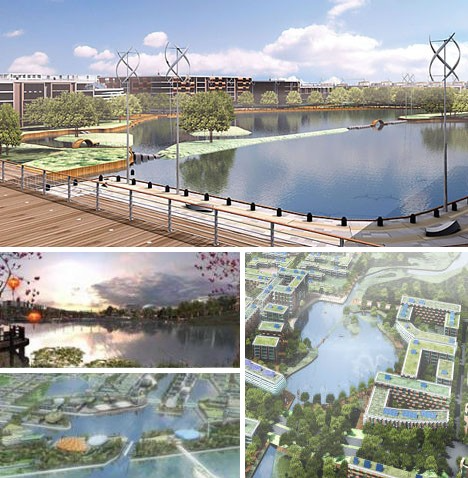
Back in our world, the exaggerated mega-city is going through a bit of bad patch.

The bling’d up ultraskyscraping and bespoke island-terraforming of Dubai is on hold until capitalism reboots, and changes in political fortune have nixed the futuristic, ubicomp’d-up Arup-designed ecotopia of Dongtan [http://en.wikipedia.org/wiki/Dongtan] in China.

But, these are but speedbumps on the road to the future city.

There are still ongoing efforts to create planned, model future cities such as one that Nick Durrant of design consultancy Plot is working on in Abu Dhabi: Masdar City [http://en.wikipedia.org/wiki/Masdar_City] It’s designed by another alumni of the British Hi-tech school – Sir Norman Foster. “Zero waste, carbon neutral, car free” is the slogan, and a close eye is being kept on it as a test-bed for clean-tech in cities.

We are now a predominantly urban species, with over 50% of humanity living in a city. The overwhelming majority of these are not old post-industrial world cities such as London or New York, but large chaotic sprawls of the industrialising world such as the “maximum cities” of Mumbai or Guangzhou [http://en.wikipedia.org/wiki/Guangzhou]. Here the infrastructures are layered, ad-hoc, adaptive and personal – people there really are walking architecture, as Archigram said.

Hacking post-industrial cities is becoming a necessity also. The “shrinking cities” project, http://www.shrinkingcities.com, is monitoring the trend in the west toward dwindling futures for cities such as Detroit and Liverpool.

They claim:

“In the 21st century, the historically unique epoch of growth that began with industrialization 200 years ago will come to an end. In particular, climate change, dwindling fossil sources of energy, demographic aging, and rationalization in the service industry will lead to new forms of urban shrinking and a marked increase in the number of shrinking cities.”

However, I’m optimistic about the future of cities. I’d contend cities are not just engines of invention in stories, they themselves are powerful engines of culture and re-invention.

David Byrne in the WSJ [http://is.gd/3q1Ca] as quoted by entrepreneur and co-founder of Flickr, Caterina Fake [http://caterina.net/] on her weblog recently:

“A city can’t be too small. Size guarantees anonymity—if you make an embarrassing mistake in a large city, and it’s not on the cover of the Post, you can probably try again. The generous attitude towards failure that big cities afford is invaluable—it’s how things get created. In a small town everyone knows about your failures, so you are more careful about what you might attempt.”

Patron saint of cities, Jane Jacobs, in her book “The Economy of Cities” put forward the ‘engines of invention’ argument in her theory of ‘import replacement’:

“…when a city begins to locally produce goods which it formerly imported, e.g., Tokyo bicycle factories replacing Tokyo bicycle importers in the 1800s. Jacobs claims that import replacement builds up local infrastructure, skills, and production. Jacobs also claims that the increased produce is exported to other cities, giving those other cities a new opportunity to engage in import replacement, thus producing a positive cycle of growth.”

Urban computing and gaming specialist, founder of Area/Code and ITP professor Kevin Slavin showed me a presentation by architect Dan Pitera about the scale and future of Detroit, and associated scenarios by city planners that would see the shrinking city deliberately intensify – creating urban farming zones from derelict areas so that it can feed itself locally. Import replacement writ large.

He also told me that 400 cities worldwide independently of their ‘host country’ agreed to follow the Kyoto protocol. Cities are entities that network outside of nations as their wealth often exceeds that of the rest of the nation put together – it’s natural they solve transnational, global problems.

Which leads me back to science-fiction. Warren Ellis created a character called Jack Hawksmoor in his superhero comic series The Authority.

The surname is a nice nod toward psychogeography and city-fans: Hawksmoor was an architect and progeny of Sir Christopher Wren, fictionalised into a murderous semi-mystical figure who shaped the city into a giant magical apparatus by Peter Ackroyd in an eponymous novel.

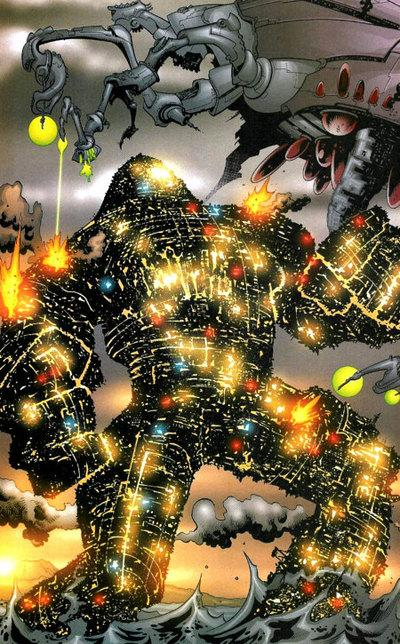
Ellis’ Hawksmoor however was abucted multiple times, seemingly by aliens, and surgically adapted to be ultimately-suited to live in cities – they speak to him and he gains nourishment from them. If you’ll excuse the spoiler, the zenith of Hawksmoor’s adventures with cities come when he finds the purpose behind the modifications – he was not altered by aliens but by future-humans in order to defend the early 21st century against a time-travelling 73rd century Cleveland gone berserk. Hawksmoor defeats the giant, monstrous sentient city by wrapping himself in Tokyo to form a massive concrete battlesuit.

Cities are the best battlesuits we have.

It seem to me that as we better learn how to design, use and live in cities – we all have a future.

Kardashev Street: Planetary Energy System Changes at Street Level – The Conference 2024

I was lucky to be invited to speak at The Conference, Malmo this year – and gave a talk entitled “Kardashev Street: Planetary Energy System Changes at Street Level” which can now be viewed here.

The Conference 2024
The Conference 2024 – DAY 1 – photo: www.jesperberg.se

Usually I’d write up the talk here, but it’s over at my new site Kardashevstreet.com, where I’ll be posting stuff related to work on solar and the energy transition from now on.

Since leaving Lunar Energy at the end of July, I’ve been trying to figure out how to keep going in the loose domain of ‘design as it relates to the energy transition’ – and have a few things in the works which will manifest there over the next few months hopefully …

Donuts and Dyson Spheres

Part 1

No Miracles Necessary in the Chobani Cinematic Universe

I realise I’ve had a set of beliefs.

Some which are (unfortunately, probably) somewhere on the spectrum toward the extreme techno-optimist views espoused since by those with various dubious political views. 

That is – despite the patient explanations of various far-cleverer friends of mine – I find I cannot become comfortable with even the most cosy narratives of what has become called “degrowth“.

Perhaps it is easier for me to imagine the end of the world rather than the end of capitalism, but it does rather seem that we missed that already.

We have gone beyond the end of capitalism into techno-feudalism and the beginning era of the Klepts – and are very much in the foothills of The Jackpot – so maybe Mark Fisher’s phrase gets updated with an “and” instead of the “rather than”…

I’m no PPE grad, and my discomfort with degrowth is not all that articulate (and subsequently it will be deconstructed articulately by those who hold it as a TINA of the left) but simply put, the root of my ill-ease with the term is “who does it hurt”.

It just doesn’t feel like the pursuit of degrowth would be any more equitable globally than untrammelled hyper-capitalist growth. 

Maybe I’m very wrong – but globally-managed, distributed, equitable degrowth just doesn’t seem plausible.

And the more likely ‘degrowth for me, no growth for thee’ also doesn’t seem like it will fly (or take the train). I guess most of all when I hear the term degrowth I flinch from the point of view of the privilege (including mine) it requires to imagine it.

Why am I putting this lengthy and awkward disclaimer here? 

I guess because I am a shamefaced technoptimist – the name of the blog gives that away – but of the fully-automated luxury communism variety (actually I’d plump for semi-automated convivial social democracy, but then I’m also a bit of a centrist dad to add to my sins) and also that I’m not in the DAC/micronukes/fusion camp of extreme VC-led technoptimism around climate.

To be clear before you start an intervention, I’m certainly not in Marc Andreesen’s camp – I think / hope I’m sat at the bar somewhere in between Dave Karpf and Noah Smith.

If anything – I’m in the “No Miracles Needed” camp – by which I refer to Mark Jacobson’s exhaustive book proposing we have everything we need in solar, wind and storage technology to get us through the great filter.

Don’t get me wrong – I’d love fusion to happen – but I’ve been thinking that for about 40 years or more.

Was I the only one to rip the press cuttings of Fleischman and Pons from my teenage bedroom wall with a tear in my eye?

I recently read Arthur Turrell’s “The Star Builders” – and though it protests we are closer than we have ever been – it still seems asymptotically out of reach.

I’m also not waving away the extractive toll off the ‘no miracles necessary’ on the planet, or the regimes and injustices that can be supported by it – though it’s always worth posting this as a reminder.

The recent work by Superflux for the WEF underlines the importance of addressing the many other planetary boundaries and negative impacts on the Earth’s systems that our current Standard Operating Procedures are causing.

And this recent piece in Vice debunking superficial “green growth” (via Dan Hill) is worth a read too

Adam recently reminded me over lunch – even the “No Miracles Necessary” future depends on the not-insubstantial miracle of having a complex world economy and industrial base to manufacture the PV panels, batteries, and turbines.

Again – the first minutes of James Burke’s “Connections” springs to mind in terms of the vertiginous tangle of systems we rely on.

Climate/Earth-System breakdown could put paid to that too.

But ultimately – I am is a designer in the technology sector, latterly for the past two years in the energy tech sector – and my view of the designer in that world is to help imagine, illustrate, conceive and communicate the ‘protopia’ or anti-anti-utopia that the ‘no miracles needed’ prescription could lead to (more on this later).

As I said in Oslo, and before/since – my measure of state of that art is not from Hollywood or Cupertino – but a yoghurt company based in New York State.

AHEM.

Yep.

Ultimately, I’m a middle-aged, middle-class white man in the global north clinging on to the fictional technologically-advanced long term futures for humanity that he grew up with – whether they are The Federation, The Culture, The various KSR Mondragonian world-lines or Fully Automated Luxury Communism.

So maybe read the rest of this with that and a pinch of sustainably-sourced salt in mind…

Part 2: I can’t see the other side of the donut from Earth.

I’m sure many of you reading this will have read Kate Raworth’s excellent “Donut Economics” – or at least have a passing acquaintance with the central idea.

That is – we should look to inhabit a zone between resource use to support a social floor of equity and fairness and the planetary boundaries that provide those resources – which describes the diagrammatic donut.

But – what if one of those planetary boundaries is not like the others?

What if one of those planetary boundaries is not quite the same?

If one of those planetary boundaries is not like the others…

Now it’s time to play our game…

The potential renewable energy we could harness as a civilisation is vast.

The solar potential alone is 104 more than we currently need.

That’s before we go beyond “no miracles” tech into fusion.

A Kardashev Type-1 energy system. Capturing the all the energy incident on our planet from our home star.

What happens if we extend one edge of the donut by four orders of magnitude?

What does a Type-1 Donut Economics look like? 

(Admission: I cheated a little in the title of this post – a Dyson Sphere would be a Type-2 Civilisation, capturing the entire energy output of The Sun.)

Well – it was 2023, so of course I asked a LLM.


Me: How might one reconcile donut economics and planetary boundaries to economic activity with the notion of Kardashev type one civilisation?

ChatGPT: Reconciling “donut economics” (which focuses on balancing the needs of the environment with the needs of society) and “planetary boundaries” (which identifies the environmental limits within which humanity can safely operate) with the idea of a Kardashev Type I civilization (a civilization that can harness and use all available energy resources on its home planet) is a challenge but not impossible. Here’s a brief reconciliation approach:

  • Shared Goal:
    • Recognize that both the concepts of donut economics and the Kardashev scale aim for a sustainable, thriving civilization. Donut economics seeks to meet humanity’s basic needs without overshooting our ecological ceiling, and a Type I civilization seeks to maximize energy use in a sustainable manner.
  • Redefine Energy Mastery:
    • A true Kardashev Type I civilization would not just be about harnessing all energy but doing so sustainably. This means developing energy sources that do not breach our planetary boundaries.
  • Technological Advancement:
    • Invest in technologies that allow for increased energy utilization without environmental degradation. Examples include highly efficient renewable energy, energy storage solutions, and perhaps even fusion power.
  • Circular Economy:
    • Align the principles of donut economics with the growth of civilization. This includes designing products for longevity, easy repair, and recycling; minimizing waste; and creating closed-loop systems that mimic natural processes.
  • Education & Values:
    • Cultivate societal values that prioritize sustainability and the well-being of all its members. By educating the population about the importance of planetary boundaries and sustainable growth, a Type I civilization can emerge that respects these boundaries.
  • Integrate Economic and Ecological Thinking:
    • Traditional economic models often treat environmental factors as externalities. In moving towards a Kardashev Type I civilization, it’s essential to integrate ecological factors into the very heart of economic models and decision-making processes.
  • Global Collaboration:
    • A Type I civilization implies global cooperation. This can be seen as an extension of the social foundation in donut economics, where global cooperation helps ensure everyone’s basic needs are met while respecting planetary limits.
  • Continuous Monitoring and Feedback:
    • Develop and maintain a global monitoring system to ensure that as we approach a Type I civilization status, we do not exceed planetary boundaries. Implement corrective measures when needed.

In essence, becoming a Kardashev Type I civilization while adhering to the principles of donut economics and respecting planetary boundaries means merging advanced technological capacities with deep ecological and social responsibility. It’s a future where we harness the full potential of our planet without harming it, ensuring prosperity and well-being for all.

Me: One of my questions is whether using more energy (so long as it is sustainable, renewable and zero carbon eg solar) is incompatible with donut economics

ChatGPT: Using more energy is not inherently incompatible with donut economics, as long as that energy use aligns with the principles of sustainability and social equity inherent in the donut model. 

Let’s break this down:

  • Ecological Ceiling:
    • The outer ring of the “donut” represents the ecological limits we should not surpass to avoid environmental degradation. Using sustainable, renewable, and zero-carbon energy sources like solar helps ensure we do not exceed this ecological ceiling.
  • Social Foundation:
    • The inner ring of the “donut” signifies the social basics that every individual should have access to, such as food, water, health, education, etc. Using more renewable energy can support these goals if it’s done in a way that ensures equitable distribution and accessibility. For instance, renewable energy can power schools in off-grid areas, provide clean cooking solutions, or pump clean water, thereby aiding in achieving the social foundation.
  • Growth vs. Development:
    • It’s essential to differentiate between growth for the sake of growth (which can be detrimental) and genuine development that meets human needs without compromising the environment. Using more energy is acceptable if it’s channelled towards genuine development and not just consumption for consumption’s sake.
  • Efficiency and Resilience:
    • While using more renewable energy, it’s crucial to prioritize efficiency. This means optimizing energy consumption to get the most benefit out of every unit of energy and designing systems that are resilient to potential shocks.
  • Holistic Well-being:
    • A significant point in donut economics is that endless economic growth (usually measured as GDP growth) is not the ultimate goal. Instead, the objective is holistic well-being. If using more energy contributes to holistic well-being without causing ecological harm, it aligns with the principles of donut economics.

In summary, using more energy in and of itself is not contrary to the principles of donut economics. However, it’s the how and why of that energy use that matters. If the energy is sourced sustainably, used efficiently, directed towards genuine development, and contributes to holistic well-being without overshooting ecological limits or leaving anyone behind, then it aligns with the philosophy of donut economics.

Me: But could you see a route to growth or new capabilities for a global civilisation due to energy use that is orders of magnitude higher than now, so long as it is zero carbon (eg solar, fusion) – would that be an enlarged donut?

ChatGPT: Certainly, there’s a potential route to growth and new capabilities for a global civilization through a significant increase in energy use, as long as it’s sustainable and zero-carbon. 

This could, metaphorically speaking, result in an “enlarged donut,” where the scale and capabilities of civilization expand while still maintaining the balance between ecological limits and social needs.

  • Technological Advancement:
    • A significant increase in energy availability, especially from sustainable sources like solar or fusion, can fuel technological advancements in various sectors, from transportation and infrastructure to research and space exploration. This could lead to breakthroughs we haven’t yet imagined.
  • Space Exploration and Colonization:
    • With energy availability orders of magnitude higher than now, humanity could potentially undertake large-scale space missions, colonizing other celestial bodies, mining asteroids, or even reaching for interstellar travel.
  • Global Infrastructure Projects:
    • Massive energy availability could facilitate projects that benefit humanity globally, like global transportation networks, large-scale desalination plants for potable water, or projects that counteract climate change effects.
  • Elevated Living Standards Globally:
    • A tremendous amount of sustainable energy could enable the global provision of high living standards, including universal access to healthcare, education, and other public goods, leading to an expanded social foundation in the donut.
  • New Economic Models:
    • Such energy abundance could challenge traditional economic models and give rise to new ways of value creation, distribution, and consumption, leading to more equitable and sustainable economic systems.
  • Ecological Restoration:
    • Excess energy can be employed in large-scale ecological restoration projects, actively reversing some of the damage done to the planet, from reforestation to ocean cleanup.

However, there are considerations:

  • Physical Limits:
    • Even if the energy is zero-carbon, there are still physical limits to consider, such as land use, resource extraction for technology, and potential waste from energy infrastructure.
  • Equity and Governance:
    • An abundance of energy could exacerbate inequality if not distributed equitably. Robust governance and frameworks would be necessary to ensure that the benefits of such energy abundance are shared widely.
  • Cultural and Social Adaptation:
    • Rapid technological and infrastructure changes fueled by energy abundance would require cultural and social adaptations, making it essential to consider the well-being and adaptability of communities.
  • Holistic Well-being:
    • As mentioned before, the end goal shouldn’t be growth for growth’s sake but holistic well-being. An enlarged donut should still maintain this perspective.

In essence, an “enlarged donut” resulting from significant energy growth can be envisioned, where the scale of human capabilities and infrastructure grows but remains within a sustainable and equitable framework. The key is to ensure that this growth enhances the well-being of all without compromising the planet’s ecological integrity.


I mean, that’s pretty good, right? It turns out GPT stands for “Green Plenty Technologies”?

Of course all the caveats around GenAI apply – including the confirmation bias that is baked in to such a dialog.

But!

It’s interesting to me as a starting point for some good old-fashioned human thinking around this stuff. I’m curious if the various bodies that have taken up the mantle of Donut Economics are looking at “Radically Expanded Donuts”… R.E.D. = Green???

One thing that I caught from the dialog was the idea I think I first encountered from Deb Chachra’s newsletter – that we are encouraged to think about energy efficiency over material efficiency, when in fact energy is practically infinite in supply and matter is not.

We find it very hard to think in these terms – if you’re my age, we’ve been encouraged to turn off lights, turn down the heating since our childhoods… 

Posters from Russell Davies’ collection

And it’s not that energy efficiency is a bad thing, far from it – pursuing technologies of energy efficiency in a Type-1 world will just extend the headroom of the donut – but much of it comes from a place of considering energy as something produced by the combustion of finite matter. 

We should add to that the externalities of energy use, particularly heat – and moving to a NMN world of full electrification would not remove that exhaust heat production but would hugely mitigate against it. 

I’ll also hope that acts as a bulwark against wasteful crypto bullshit… Abhorring waste and scams are not the same as imagining beyond energy penury.

Our “imaginaries” are constrained by what we imagine the planetary boundaries are – which I think partly leads to my dissatisfaction with degrowth narratives – and so, perhaps, designers can step in to help construct new ones.

I’m not sure what they might be.

I have thoughts of course (see later *)

Genres such as Solarpunk are not yet mainstream – even within the discourse of those familiar with or exploring how to enact Donut Economics (please correct me if I’m wrong here!!!). 

But –  I’m also not sure it’s for me to create those imaginaries.

Which leads me nicely to the brief I put this spring of 2024 to the students at Goldsmiths Design.

Part 3: Can you tell me how to get, how to get to Kardashev Street?

I was very pleased to be asked by Goldsmiths Design to help set an “industry brief” for the second year students in their spring term.

When I got together with the team there at the end of 2023, this obsession with the “Radically Expanded Donut” was in full flight and so it was somewhat unloaded on them at an evening at The New Cross House.

The conversation led from the notion of a Kardashev Type-1 planet, to what it would mean anchored in place and routine of daily life.

We started to flesh that out.

What would a Kardashev Type-1 Street be like to live in?

To move into? To move out of? To live in the next street along, that had not yet realised it’s Type-1 potential for whatever reason?

How do you start that process, or encourage others to do so?

What interconnections, relationships and tensions might arise?

What institutions (financial or otherwise) and services would need to be invited and sustained to support it? What might be the equivalent of the mutual institutions born out of the Industrial Revolution for an equally revolutionary equitable NMN transition?

How does it connect to the transition design thinking pursued by Cameron Tonkinwise et al. The “Planetary Civics” of Indy Johar et al?

And of course – Kate Raworth’s “Donut Economics” itself.

My mind went to the imagery of Clifford Harper in 1974’s Radical Technology – and the writing decades later of Adam Greenfield in his book “Radical technologies” and also his thoughts on the “convivial stack”.

How might the NMN technologies be procured, shared and maintained by a community in place – say the terraced houses typical in the UK?

My mind went to the story of the street in Walthamstow, London trying to create it’s own shared solar energy infrastructure– and the barriers to that created by the commercial/regulatory status quo.

In Oslo back in May 2023, we’d been made familiar with the custom of “dugnad“, where the occupants of a apartment block work together to maintain their common infrastructure and spaces. 

What rituals and expectations might be born on a Kardashev Type-1 street. How would they be transmitted both across communities, cultures and generations?

The students wrestled with the brief admirably – and I’ll post some of the outcomes here soon if I can.

* Part 4 / KardaCoda or Willfully-generative human with no undo vs GenAI

Finally – when asking ChatGPT about all this back in the autumn of 2023, it declined to create a diagram of the Radically Expanded Donut for me. 

What it did (kinda) produce was a brief:

I’m sorry, I cannot create drawings directly. However, I can describe how to visualize or design such a diagram based on the concept:

  1. Inner Circle – Social Foundation:
  • This remains as the core of the donut, representing essential human needs.
  • You might want to expand this circle to show a broader range of social amenities, reflecting the increased capabilities of a civilization with massive energy resources. This could include advanced education, universal healthcare, enhanced connectivity, etc.
  1. Outer Circle – Ecological Ceiling:
  • This circle might be farther out than in the traditional donut, reflecting the greater capabilities and infrastructure of an advanced civilization.
  • Despite the enlargement, it would still emphasize sustainability and the need to avoid overshooting ecological limits. This means not surpassing boundaries like land use change, freshwater use, or other ecological parameters.
  1. Space Between The Circles – The Safe and Just Space:
  • This area, which represents the space in which humanity can thrive sustainably, would be considerably broader.
  • You can divide this space into segments, each representing different sectors fueled by the energy abundance: technological advancements, space exploration, global infrastructure, etc.
  1. Additional Elements:
  • Consider adding visuals that represent the vast energy sources (solar arrays, fusion reactors, etc.) around the donut.
  • Depict global collaboration symbols, equity symbols, and other elements that emphasize the importance of shared benefits and governance.

To create this diagram, you could use graphic design software like Adobe Illustrator, Canva, or even simpler tools like PowerPoint. Once you have a clear mental image or sketch, you can work on refining it digitally. If you’re not comfortable creating it yourself, you might want to share the concept with a graphic designer who can bring it to life.

This set me off on the quixotic path of being the slow human illustrator of the GenAI’s “imagination”. 

I started sketching. I ordered and awaited the delivery of art materials – including the first airbrush and frisk film I’d possessed since the early 1990s.

I waited for coats of ink and acrylic to dry.

I messed things up and tried to fix them/flip them into analog, material ‘beautiful oopses’ in the absence of the undo function. 

It took time.

I got ink under my fingernails.

I had fun.

I didn’t annotate with the things I thought I might.

A technoptimist litany – fusion, air mining, atmospheric carbon removal, desalination, detoxicifcation, open source spime-like fabrication of tools and shelter, universal healthcare, universal basic income, another green food revolution via precision fermentation, soil renewal etc. 

Instead, more of an obscure mandala to magic forth the Kardashev Type 1 future. 

Instead, Kirby dots, glow-in-the dark and gold metallic acrylic detailing – and two scrawled ink numbers: 104 for the energy potential of the Radically Expanded Donut – and 107 for the 10 Billion people it would hopefully support within the equitable, convivial zone it describes.

I also kind-of ended up making a cosmic goatse, but hey.

Acknowledgments

I’m grateful for the conversations I’ve had with Carolyn and Arjun – the tutors and of course Matt Ward for inviting me in.

This post has also been greatly influenced by conversations with Adam Greenfield, Deb Chachra, Dan Hill, Celia Romaniuk and of course, Matt Webb.

The talk and workshop I was invited to give last year by Mosse Sjaastad of AHO, Fredrik Matheson and IxDA Oslo were also a big starting point.

Station Identification

“We now use about eighty percent of the net primary product of land-based photosynthesis,” he said. “One hundred percent is probably impossible to reach, and our long range carrying capacity has been estimated to be thirty percent, so we are massively overshot, as they say.

We have been liquidating our natural capital as if it were disposable income, and are nearing depletion of certain capital stocks, like oil, wood, soil, metals, fresh water, fish, and animals. This makes continued economic expansion difficult.”

“Difficult!” Art wrote. “Continued?”

“We have to continue,” Fort said, with a piercing glance at Art, who unobtrusively sheltered his lectern with his arm.

“Continuous expansion is a fundamental tenet of economics. Therefore one of the fundamentals of the universe itself. Because everything is economics. Physics is cosmic economics, biology is cellular economics, the humanities are social economics, psychology is mental economics, and so on.”

His listeners nodded unhappily.

“So everything is expanding. But it can’t happen in contradiction to the law of conservation of matter-energy. No matter how efficient your throughput is, you can’t get an output larger than the input.”

“…manmade capital and natural capital are not substitutable. This is obvious, but since most economists still say they are substitutable, it has to be insisted on. Put simply, you can’t substitute more sawmills for fewer forests. If you’re building a house you can juggle the number of power saws and carpenters, which means they’re substitutable, but you can’t build it with half the amount of lumber, no matter how many saws or carpenters you have. Try it and you have a house of air. And that’s where we live now.”

No matter how efficient capital is, it can’t make something out of nothing.” “New energy sources…” Max suggested. “But we can’t make soil out of electricity. Fusion power and self-replicating machinery have given us enormous amounts of power, but we have to have basic stocks to apply that power to. And that’s where we run into a limit for which there are no substitutions possible.”

Green Mars, Kim Stanley Robinson

The Cloud vs The Grid and Electrosheds workshop at AHO, Oslo, May 2023

It was wonderful to be invited back to AHO and Oslo in early May by my old friends and sometime colleagues there – and the opportunity to speak about past projects but also what I’m doing now at Lunar Energy.

My framing was around the two biggest human-built machines on this planet – the cloud and the grid.

The former is the (much-younger) result of emergent properties and software that has traversed boundaries of territory and nations, while the latter has been a mainly top-down, deliberate design which is very anchored to geography, regulation and legacy technology.

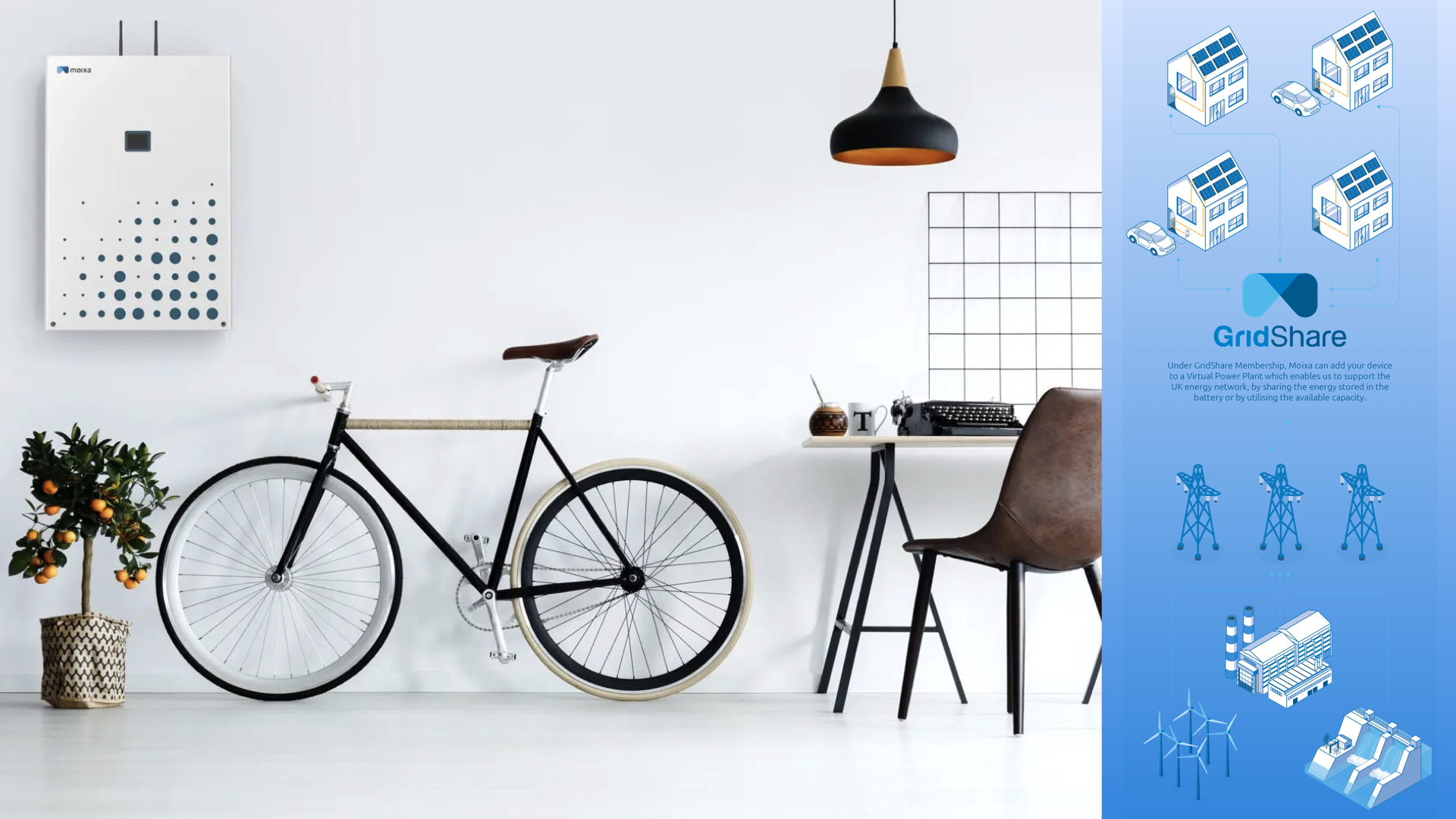
When you put them together you start to get some interesting new possibilities for our energy transition – e.g. virtual power plants as made possible by Lunar’s Gridshare platform.

The Cloud vs The Grid: talk for IxDA Oslo & AHO, May 2023

My talk was kindly hosted and supported by IxDA Oslo. Their extremely professional recording and transcription of the event was turned around in record time and can be found here.
Thanks to everyone who came, and your thoughtful questions and conversations afterwards. It was a lot of fun, and a delight to be back in Oslo after more than a decade.
The next day I hosted a workshop with Mosse at AHO for her students, which I entitled “Electrosheds”, after Kevin Kelly‘s “Big Here Quiz” that aims to locate you at the heart of their watersheds and local ecologies. I’ll talk about that in a separate post.

“Smaller, cuter, weirder, fluttery”: Filtered for the #Breezepunk Future

I’m stealing Matt Webb’s “filtered for” format here – for a bunch of more or less loosely connected items that I want to post, associate and log as much for myself as to share.

And – I’ll admit – to remove the friction from posting something without having a strong thread or thesis to connect them.

I’ve pre-ordered “No miracles needed” by Mark Jacobson – which I’m looking forward to reading in February. Found out about it through this Guardian post a week or so ago.

The good news below from Simon Evans seems to support Prof Jacobson’s hypothesis…

Breezepunk has been knocking around in my head since Tobias mentioned it on this podcast…

Here’s the transcript of the video (transcribed by machine, of course) of Tobias describing the invention by scientists/engineers at Nanyang Polytechnic in Singapore – of a very small scale, low power way of harnessing wind energy:

“I found this sort of approach really interesting but mostly I like the small scale of it yes I like the fact that it’s you know it’s something that you could imagine just proliferating as a standard component that’s attached to sort of Street Furniture or things around the house or whatever it is you might put them on your windowsill because they’re quite small and they just generate like enough power to make a sensor work or a light or something and yeah it’s this this alternative future to the big powerful set piece green Energy Future that’s obviously being pushed and should continue to be pushed because that’s competing against the big Power and the fossil fuel future but I like this idea of like the smaller cuter weirder fluttery imagine it’s quite fluttery yeah so yeah so this is this is Breeze Punk everybody…”

I like the idea of it being a standard component – a lego. A breezeblock?

Breezepunk breezeblock?

My sketching went from something initially much more like a bug hotel or one of those bricks that bees are meant to nest in, there’s something like a fractal Unite D’Habitation happening in the final sketch.

I also like #Breezepunk a lot – very Chobani Cinematic Universe.

I would like it to become… a thing. I suppose that’s why I’m writing this.

Used to be how you made things become things.

It’s probably not how you do it now, you need a much larger coordinated cultural footprint across various short-form streaming formats to make a dent in the embedding space of the LLMs.

Mind you, that’s not the same as making it ‘real’ or even ‘realish’ now is it.

A bit vogue-ish perhaps, to prove a point I asked ChatGPT what it knew about Breezepunk.

It took a while, but… it tried to turn into the altogether less satisfying “windpunk”

I like making the cursor blink on ChatGPT.

The longer the better. I think it means you’re onto something.

Or maybe that’s just my Bartle-type showing again.

The production design of the recent adaptation of William Gibson’s The Peripheral seemed “fluttery” – particularly in it’s depiction of the post-jackpot London timeline.

Or perhaps the aesthetic is much more one of ‘filigree‘.

There’s heaviness and lightness being expressed as power by the various factions in their architecture, fashion, gadgets.

It’s an overt expression of that power being wielded via nanotechnology – assemblers, disassemblers constructing and deconstructing huge edifices at will.

From Vincenzo Natali’s concept art for The Peripheral series

Solid melting into air.

Into the breeze.

Punk.

Open Lecture at CIID: “Keeping up with the Kardashevians”

Back in April 2022, I was invited to speak as part of CIID’s Open Lecture series on my career so far (!) and what I’m working on now at Moixa.com.

Naturally, It ends up talking about trying to reframe the energy transition / climate emergency from a discourse of ‘sustainability’ to one of ‘abundance’ – referencing Russian physicists and Chobani yoghurt.

Thank you so much to Simona, Alie and the rest of the crew for hosting – was a great audience with a lot of old friends showing up which was lovely (not that they spared the hard questions…).

I was on vacation at the time with minimal internet, so I ended up pre-recording the talk – allowing me the novelty of being able to heckle myself in the zoom chat…

CIID Open Lecture, Matt Jones, Apr 5 2022

CIID Open Lecture, April 2022

Hello, it’s very nice to be “here”!

Slide 1

Thank you CIID for inviting me. 

I’ll explain this silly title later, but for now let me introduce myself…

Slide 2

Simona and Alie asked me to give a little talk about my career, which sent me into a spiral of mortality and desperation of course. I’ve been doing whatever I do for a long time now. And the thing is I’m not at all sure that matters much.

Slide 3: My life vs Moore’s Law

I’m 50 this year, you see. I’m guessing everyone has some understanding of Moore’s Law by now – things get more powerful, cheaper and smaller every 18mo-2yrs or so. I thought about what that means for what I’ve done for the last 50 years. Basically everything I have worked on has changed a million-fold since I started working on it (not getting paid for it!)

Slide 4: Design vs Moore’s Law

If you’re a designer that works in, say, furniture or fashion – these effects are felt peripherally: maybe in terms of tools or techniques but not at the core of what you do. I don’t mean to pick on Barber Ogersby here, but they kind of started the same time as me. You get to do deep, good work in a framework of appreciation that doesn’t change that much. I get the sense that even this has changed radically in the last few years as well – for many good reasons.

Slide 5: A book about BERG would make no sense.

Anyway – when I was asked to look back on work from BERG days over a decade ago, it’s hard to pretend it matters in the same way as when you did it. But perhaps it matters in different ways? I’m trying here to look for those threads and ideas which might still be useful.

Slide 6: Pace Layers & Short-Circuits

In design for tech we are building on shifting (and short-circuiting) pace layers. I’ve always found it most useful to think them as connected, rather than separate. Slowly permeable cell membranes/semiconducting layers. New technology is often the wormhole or short-circuit across them.

Slide 7: BERG

So with that said, to BERG.

Slide 8: About BERG

BERG was a studio formed out of a partnership between Matt Webb and Jack Schulze. Tom Armitage joined – and myself shortly after. From there we grew to a small product invention and design consultancy of about 15 folks at our largest, but always around 8-9. It was a great size – I’m still proud of the stuff we took on, and the way we did it.

Slide 9: All you can see of systems are surfaces.

One of the central tenets of BERG: All you can see of systems are surfaces. The complexity and interdependency of the modern world is not evident. And you can make choices as designers about how to handle that. Most design orthodoxy (at the time) and now is to drive towards ‘seamlessness’ – but we preferred Mark Weizer’s exhortation for ‘beautiful seams’ that would increase the legibility of systems while still making attractive and easy to engage surfaces…

Slide 10: Moore’s Law meets Main St.

Another central tenet of the studio: “What got just got cheap and boring?” We looked to mass produced toys and electronics, rather than solely to the cutting edge for inspiration. Understanding what had passed through the ‘hype curve’ of the tech scene into what Gartner called ‘the trough of disillusionment’. This felt like the primordial soup of invention.

Slide 11: A tale of two Arthurs

We got called sci-fi. Design fiction. I don’t think we were Sci-fi. We were more like 18thC naturalists, trying to explain something we were in, to ourselves. think we were more Brian Arthur than Arthur C. Clarke. We didn’t want to see tech as magic.

Slide 12: The nature of technology

Brian Arthur’s book “The Nature of Technology” was a huge influence on me at the time (and continues to be.) An economist and scholar of network effects, he tries to establish how and why technology evolves and builds in value. In the book he explains how diverse ‘assemblages’ of scientific and engineering phenomenon combine into new inventions. The give and take between human/cultural needs and emergent technical phenomenon felt far more compelling and inspiring than the human centred design orthodoxy at the time.

Slide 13: Thinking through making / chatting is cheating

This emphasis on exploring phenomena and tech as a path to invention we referred to as ‘material exploration’ as a phase of every studio project. We led with it, privileged it in the way contemporaries emphasised user research – sometimes to our detriment! But the studio was a vehicle for this kind of curiosity – and it’s what powered it.

Sllide 14: Lamps for Google

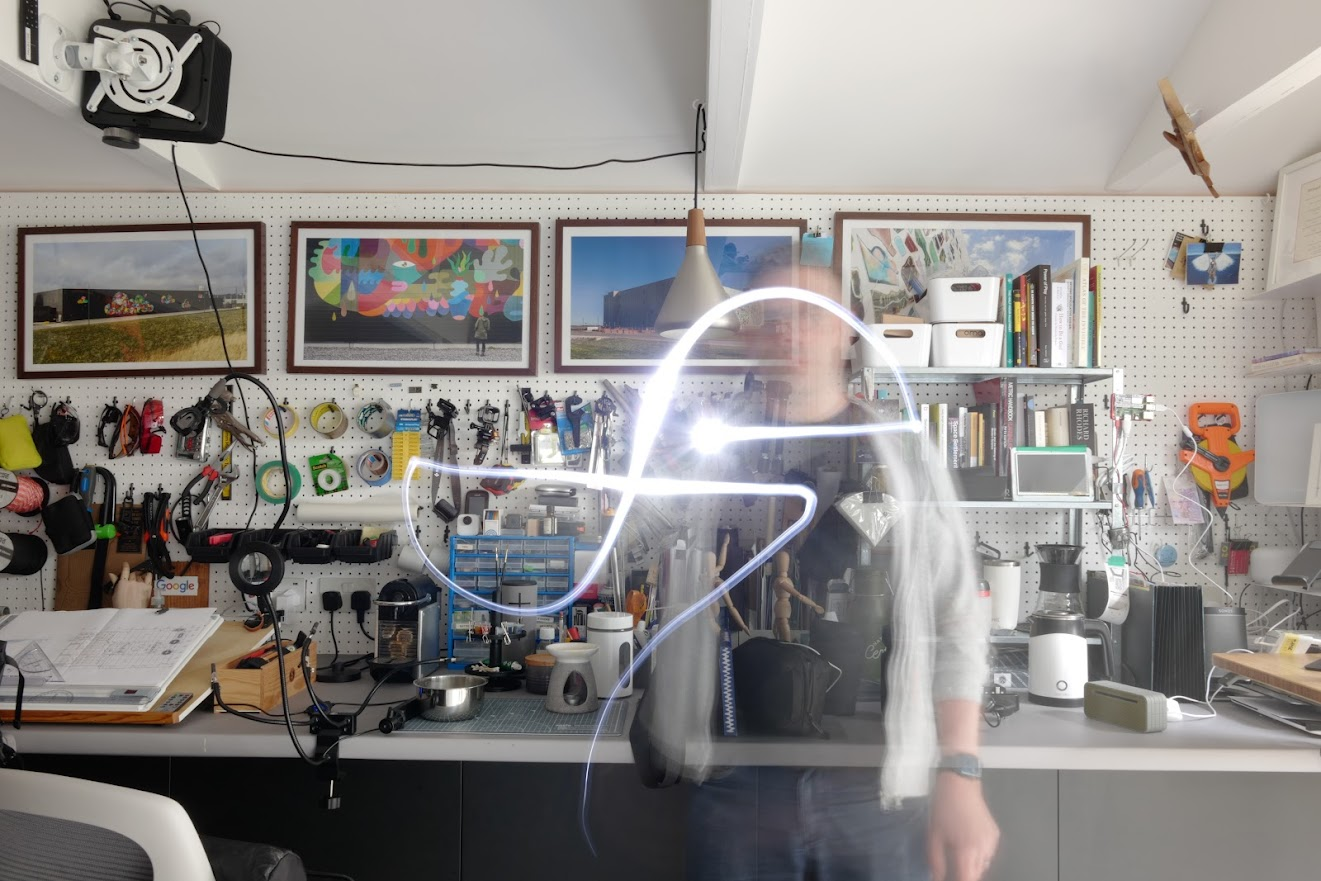
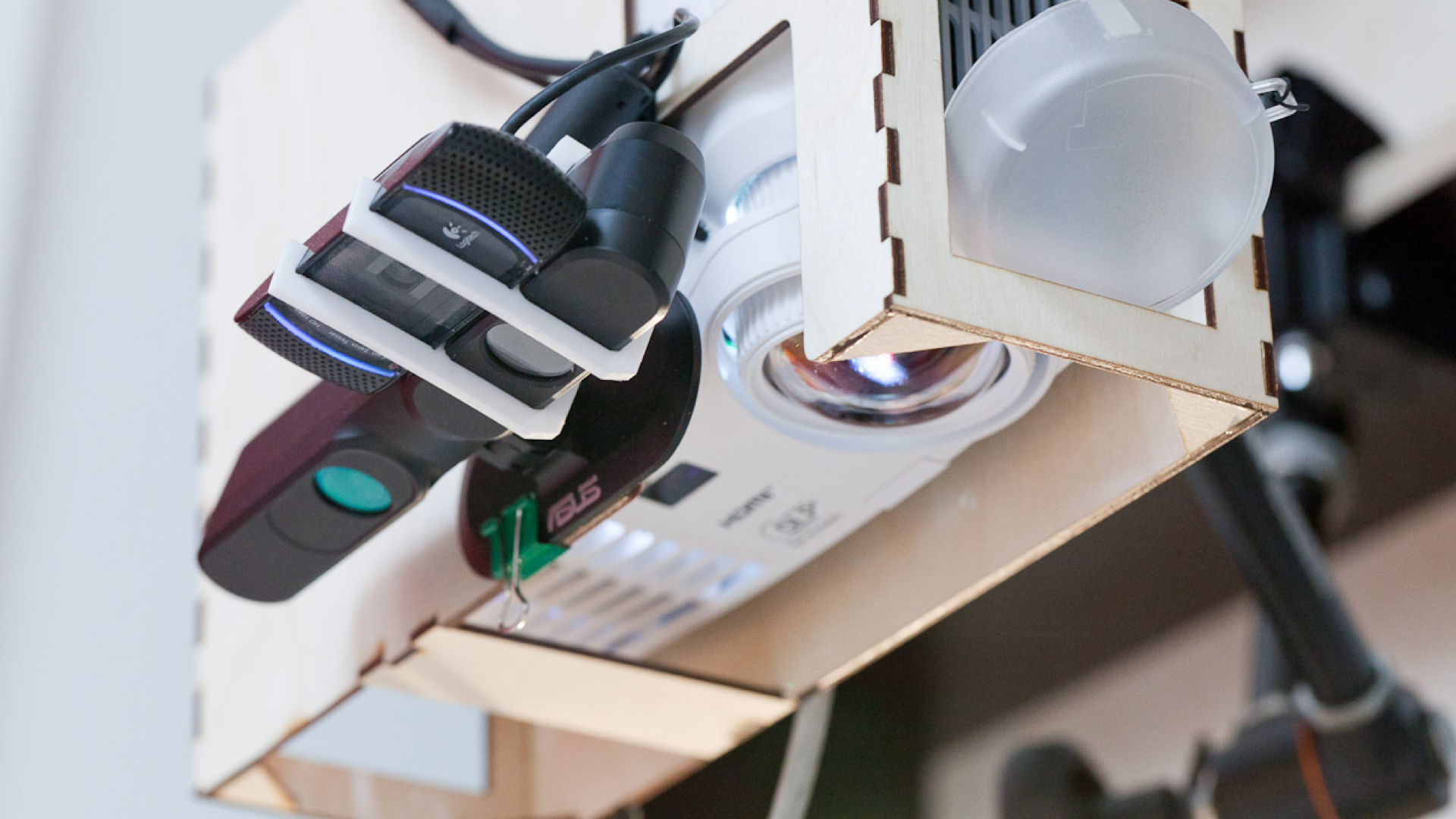
“Lamps” was a very material-exploration heavy project for Google Creative Lab in 2010. It was early days for the commoditisation of computer vision, and also about the time that Google Glass was announced. We pushed this work to see what it would be like to have computer vision in the world *with you* as an actor rather than privatised behind glasses.

Slide 15: Smart Light

The premise was instead of computer vision reporting back to a personal UI, it would act in the world as a kind of projected ‘smart light’, that would have agency based on your commands.

Slide 16: Build your own ARKit, too early

To make these experiments we had to build a rig. An example here of how the pace-layers of past design work get short-circuited. Here’s our painstaking 2010, 10x the size, cost, pain DIY version of ARKit… which would come along only a few years later.

Slide 17: watch the “Dumb things, smart light” video here

This final piece takes the smart light idea to a ‘speculative design’ conclusion. What if we made very dumb interactive blocks that were animated with ‘smart light’ computation from the cloud… There’s a little bit of a critical thought in here, but mainly we loved how strange and beautiful this could look!

Slide 18: Schooloscope

We also treated data as a material for exploration. One of the projects I’m always proudest of was Schooloscope in 2009 (one of the first BERG studio projects for Channel4 in the UK) – led by Matt Webb, Matt Brown and Tom Armitage which did a fantastic job of reframing contentious school performance data from a cold emphasis on academic performance to a much more accessible and holistic presentation of a school for parents (and kids) to access. Each school’s performance data creates an avatar based on our predisposition to interpret facial expression (after Chernoff)

Slide 19: Suwappu

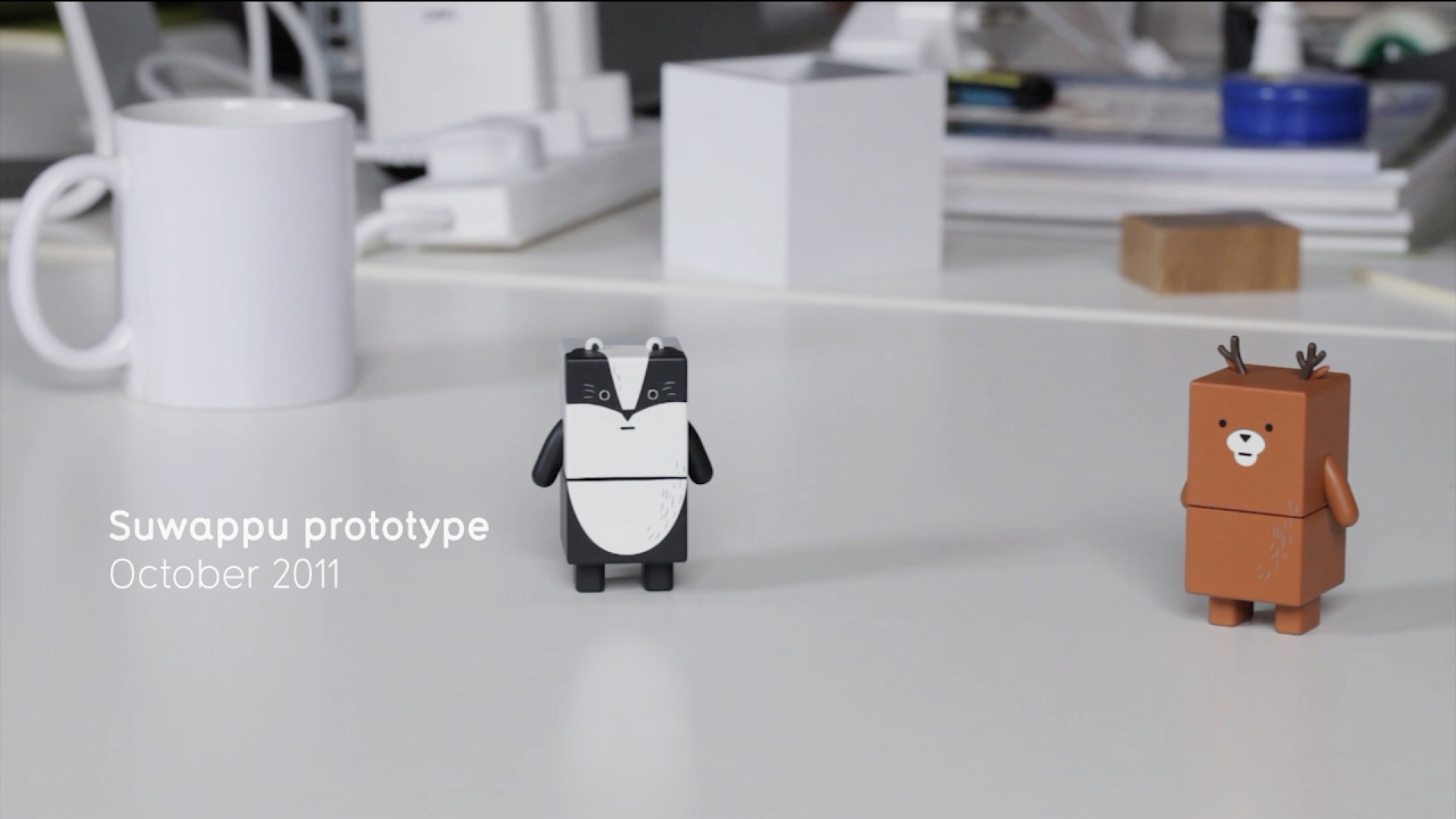
Another example of play – Suwappu was an exploration for a toy/media franchise for Dentsu. Each toy has an AR environment coded to it, and weekly updates to the the storylines and interactions between them was envisaged. Again a metaverse in… reverse?

Slide 20: Cars for Intel

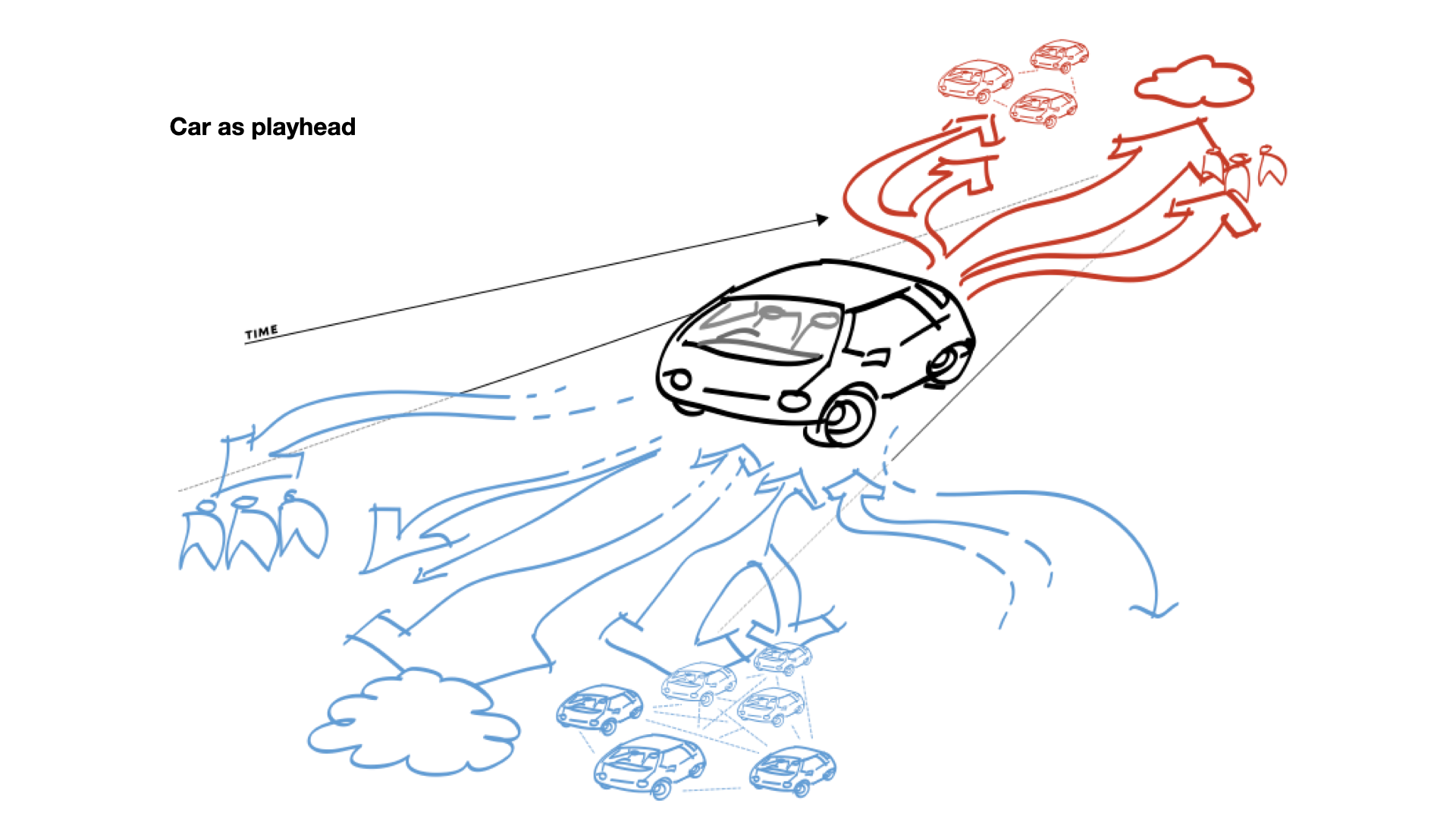
A lot of the studio work we couldn’t talk about publicly or release. I don’t think I’ve ever shown this before for instance, which was work we did for Intel looking at the ‘connected car’ and how it might relate to digital technology in cities and people’s pockets.

Slide 21: Car as playhead in the city – video proto

A lot of it was video prototyping work – provocations and anticipated directions that Intel’s advance design group could show to device and car manufacturers alike – to sell chips!

Slide 22: Light-painting interaction surfaces in cars

We deployed our usual bag of tools here – and came up with some interesting speculations – for instance thinking about the whole car as interface in response to the emerging trend of the time of larger and larger touchscreen UI in the car (which I still think is dangerous/wrong!!!)

Intel cars: video proto of smart light car diagnostics – watch here

Here’s another example of smart light – computer vision and projection in one product: an inspection lamp that makes the inscrutable workings of the modern car legible to the owner.

Slide 24: manifesto

Something we wrote as part of a talk back then.

I guess we were metaverse-averse before there was a metaverse (there still isn’t a metaverse)

Slide 25: William Gibson’s obituary for BERG

I left BERG in 2013 – it stopped doing consulting and for a year it continued more focussed on it’s IoT product platform ‘bergcloud’ and Little Printer product.

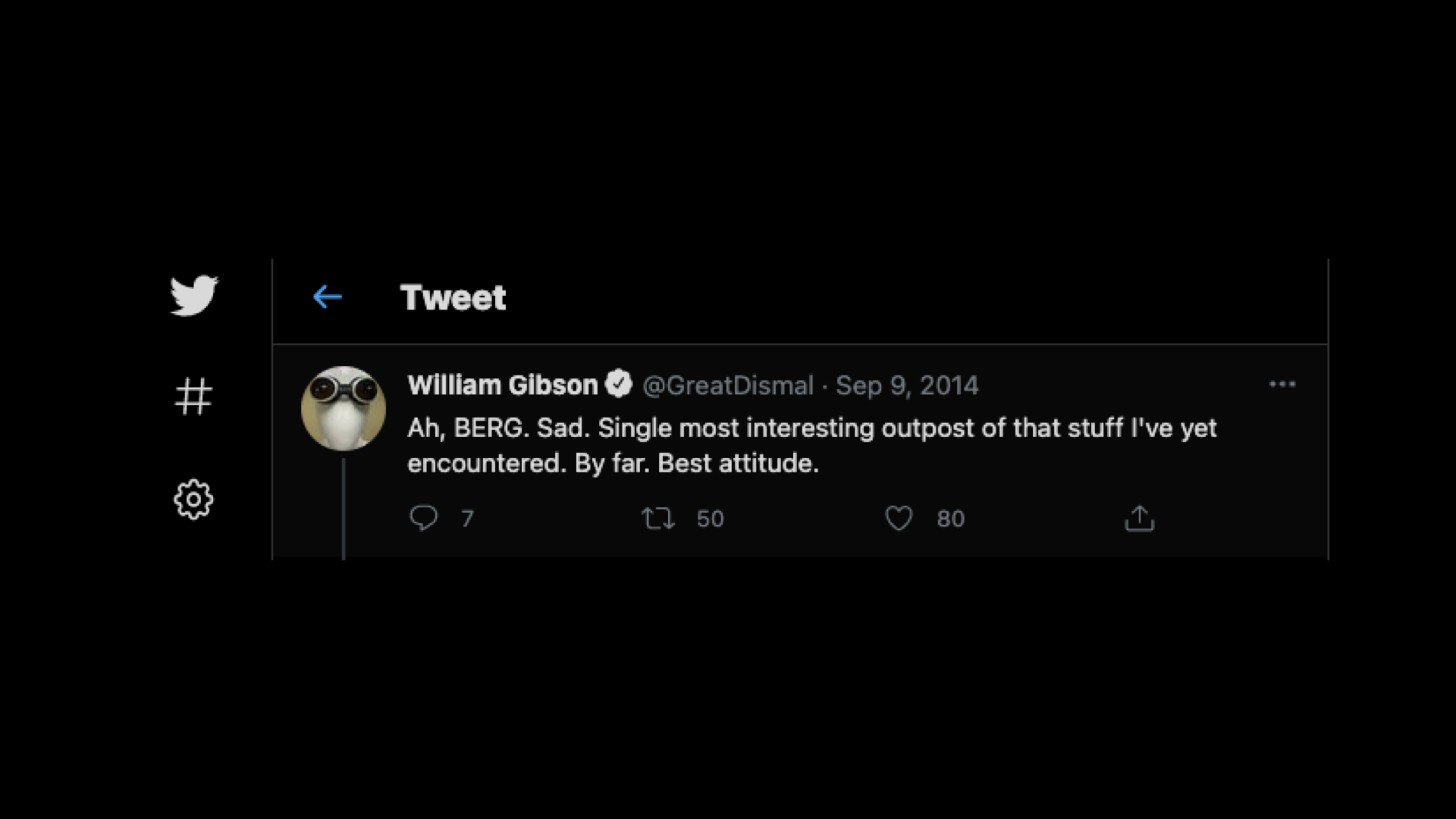
In 2014 it shut up shop, which was marked by some nice things like this from William Gibson. Everyone went on to great things! Apple, Microsoft – and starting innovative games studio Playdeo for instance. In my case, I went to work for Google…

Slide 26: Google career vs Moore’s Law

So in 2013 I moved to NYC and started to work for Google Creative Lab – whom I’d first met working on the Lamps project. There I did a ton of concept and product design work which will never see the light of day (unfortunately) but also worked on a couple of things that made it out into the world.

Slide 27: Google Creative Lab: A Spacecraft for all

Creative Lab was part of the marketing wing of Google rather than the engineering group – so we worked often on pieces that showed off new products or tech – and also connected to (hopefully) worthy projects out in the world.

This piece called Spacecraft For All was a kind of interactive documentary of a group looking to salvage and repurpose a late 1970s NASA probe into an open-access platform for citizen science.

Slide 28: Google Creative Lab: A Spacecraft for all

It also got to show off how Chrome could combine video and webGL in what we thought was a really exciting way to explain stuff.

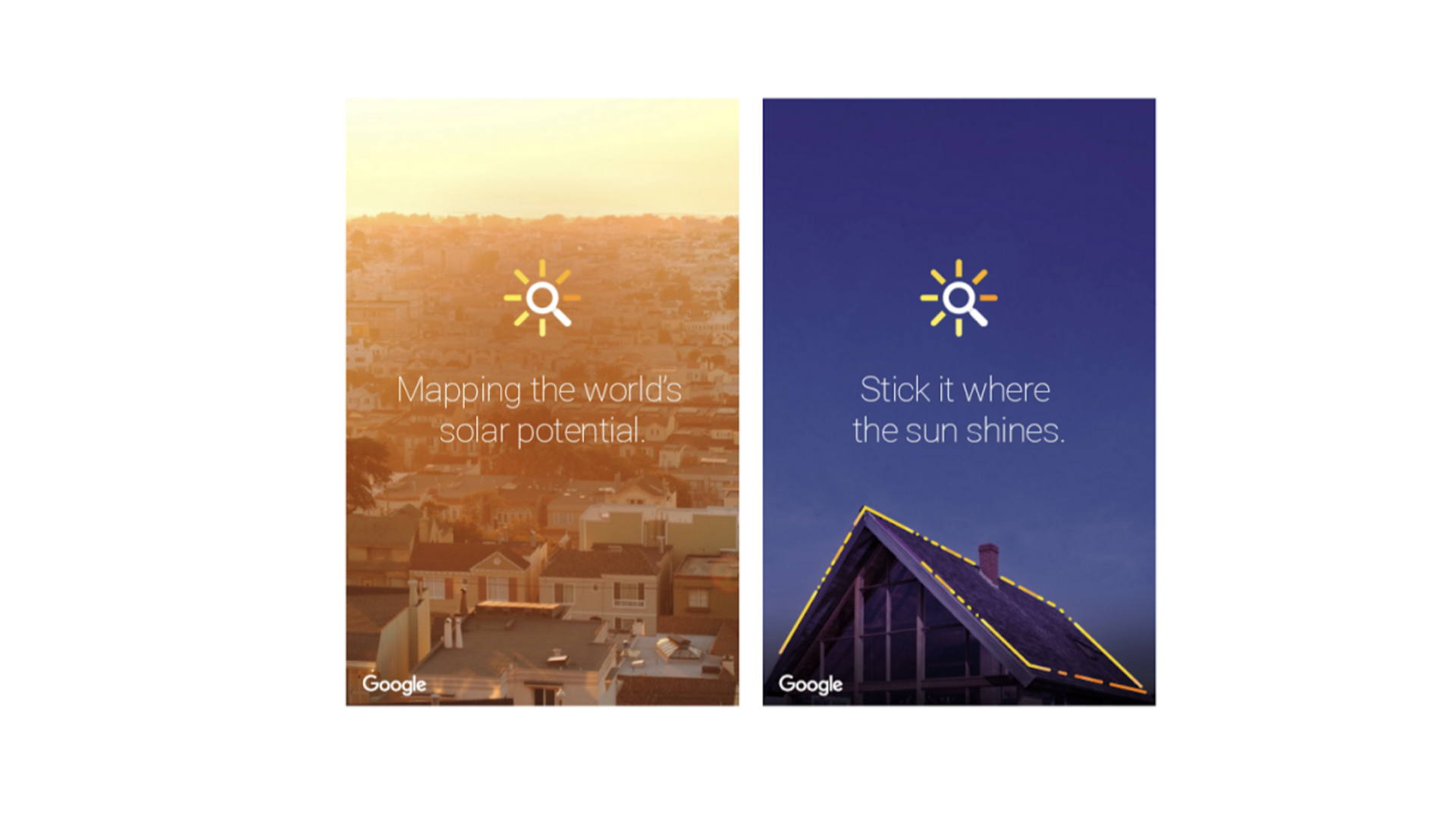
Slide 29: Project Sunroof

Another project I’m still pretty proud of from this period is Project Sunroof – a tool conceived of by google engineers working on search and maps to calculate the solar potential of a roof, and then connect people to solar installers.

Slide 30: Project Sunroof

We worked on the branding, interface and marketing of the service, which still exists in the USA. There were a number of other energy initiatives I worked on inside Google at the time – which was a much more curious (and hubristic!) entity back in the Larry/Sergey days – for good and for ill. 

Slide 31: Google Clips – On-device AI

One last project from Google – by this time (2016) I’d moved from Creative Lab to Google Research, working with a group that was pioneering techniques for on-device AI. Moving the machine learning models and operations to a device gives great advantages in privacy and performance – but perhaps most notably in energy use. If you process things ‘where the action is’ rather than firing up a radio to send information back and forth from the cloud, then you save a bunch of battery power… 

Clips is a little autonomous camera that has no viewfinder but is trained out of the box to recognise what humans generally like to take pictures of so you can be in the action. The ‘shutter’ button is just that – but also a ‘voting’ button – training the device on what YOU want pictures of.

Along with Clips, the ‘now playing’ audio recognition, many camera features in pixel phones and local voice recognition all came from this group. I thought of these ML-powered features not as the ‘brain-centered’ AI we think of from popular culture but more like the distributed, embodied neurons we have in our knees, stomach etc.

Slide 32: joining Moixa

At the beginning of this year I left Google and went to work for Moixa. Moixa is a energy tech company that builds HW and SW to help move humanity to 100% clean energy. More about them later!

Slide 33: Career vs Global Heating

Instead of overlaying Moore’s Law on this step of my career, instead another graph of an all-together less welcome progression. This is Professor Ed Hawkin’s visualisation of how the world has warmed from 1850 to 2018.

Slide 34: Fear, greed, despair and hope in climate tech

I’ve been thinking a lot – both prior to and since joining Moixa about design’s role in helping with the transition to clean energy. And I think something that Matt Webb often talked about back in BERG days about product invention has some relevance.

And we all love a 2×2, right? 

He related this story that he in turn had heard  (sorry I don’t have a great scholarly citation here) about there being 4 types of product: Fear, Despair, Hope and Greed products.

Fear products are things you buy to stop terrible things happening, Despair product you have to buy – energy, toilet paper… Greed products might get you and advantage in life, or make you richer somehow (investments, MBAs…) but Hope products speak to something aspirational in us.

What might this be for energy?

Slide 35: Ministry for the future & Family Guy

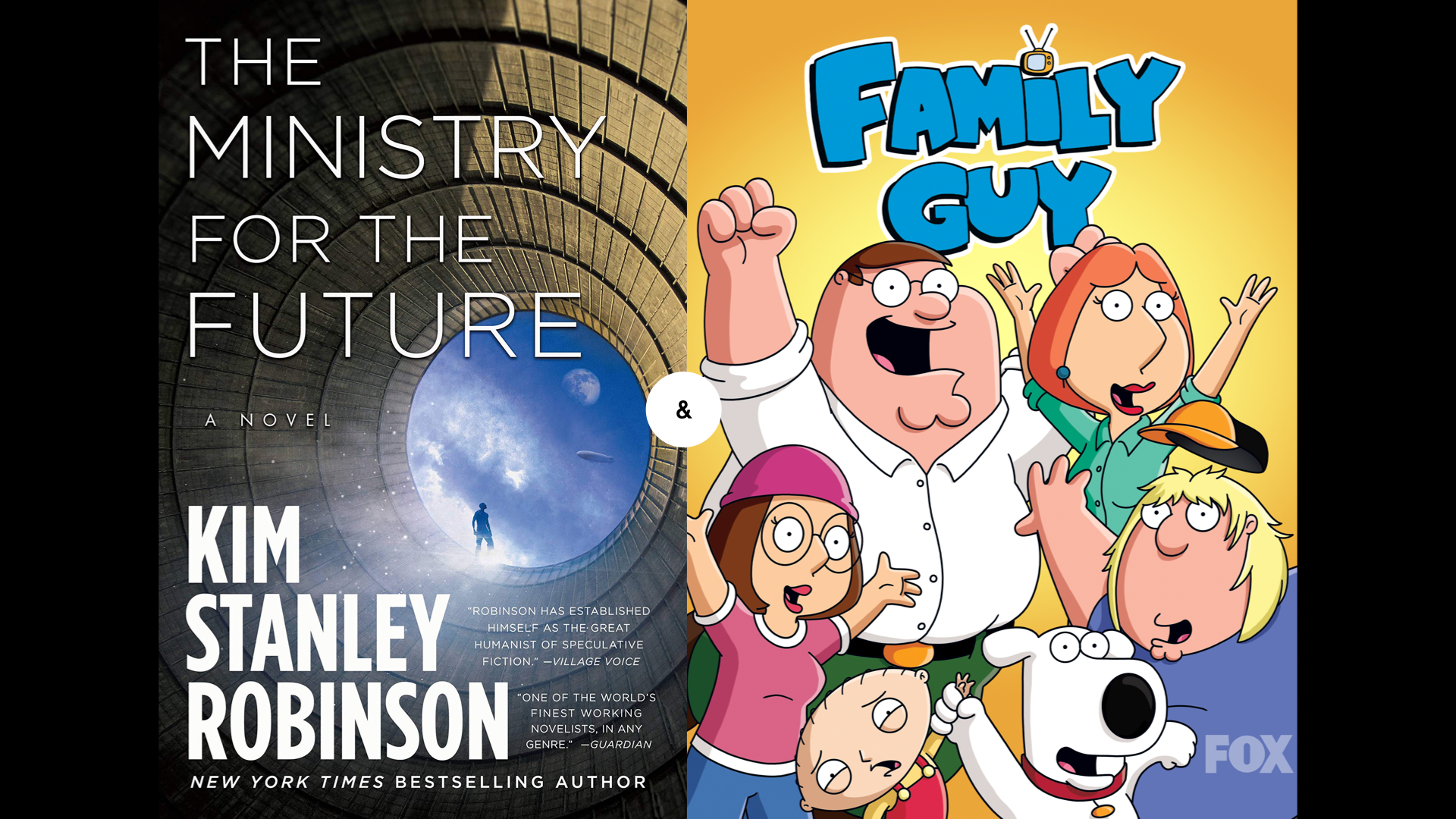
You probably thought I was going to reference The ministry for the Future by KSR, but hopefully I surprised you with Family Guy! It’s creator, Seth Macfarlane went on to create the optimistic, love-letter to Star Trek called “The Orville” and has this to say: 

“Dystopia is good for drama because you’re starting with a conflict: your villain is the world. Writers on “Star Trek: The Next Generation” found it very difficult to work within the confines of a world where everything was going right. They objected to it. But I think that audiences loved it. They liked to see people who got along, and who lived in a world that was a blueprint for what we might achieve, rather than a warning of what might happen to us.” – I think we can say the same for the work of design.

Slide 36: KSR – Anti-Anti-Utopia

I’m going to read this quote from Kim Stanley Robinson. It’s long but hopefully worth it. 

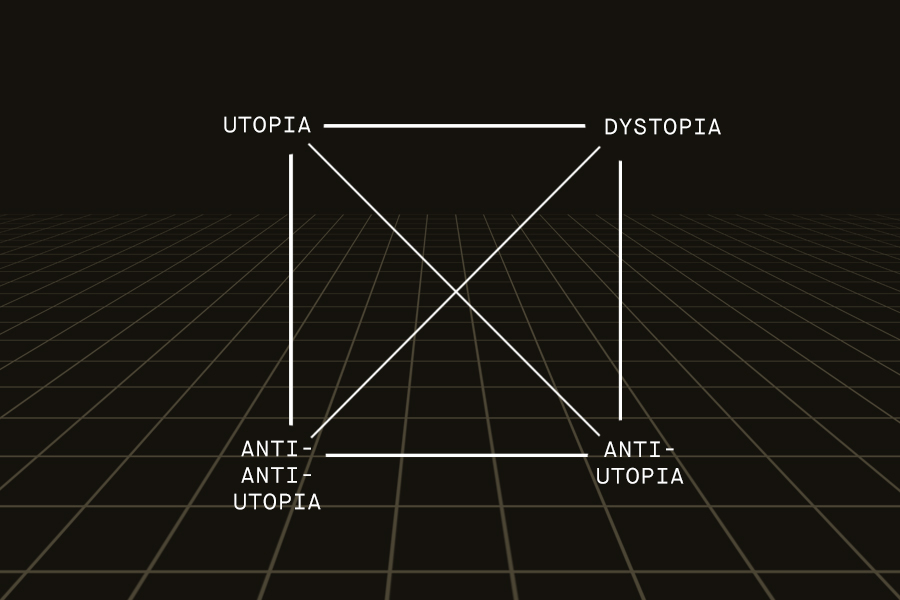
“It’s important to remember that utopia and dystopia aren’t the only terms here. You need to use the Greimas rectangle and see that utopia has an opposite, dystopia, and also a contrary, the anti-utopia. For every concept there is both a not-concept and an anti-concept. So utopia is the idea that the political order could be run better. Dystopia is the not, being the idea that the political order could get worse. Anti-utopias are the anti, saying that the idea of utopia itself is wrong and bad, and that any attempt to try to make things better is sure to wind up making things worse, creating an intended or unintended totalitarian state, or some other such political disaster. 1984 and Brave New World are frequently cited examples of these positions. In 1984 the government is actively trying to make citizens miserable; in Brave New World, the government was first trying to make its citizens happy, but this backfired. … it is important to oppose political attacks on the idea of utopia, as these are usually reactionary statements on the behalf of the currently powerful, those who enjoy a poorly-hidden utopia-for-the-few alongside a dystopia-for-the-many. This observation provides the fourth term of the Greimas rectangle, often mysterious, but in this case perfectly clear: one must be anti-anti-utopian.

Slide 37: Dear Alice for Chobani by The Line

I’ve been reading a lot of solar punk lately in search of such utopias. But – The absolute best vision of a desirable future I have seen in recent years has not come form a tech company, or a government – but a Yoghurt maker. This is the design of the future as a hope product.

“We worked closely with Chobani to realise their vision of a world worth fighting for. It’s not a perfect utopia, but a version of a future we can all reach if we just decide to put in the work. We love the aspiration in Chobani’s vision of the future and hope it will sow the seeds of optimism and feed our imagination for what the future could be. It’s a vision we can totally get behind. We couldn’t be more happy to be part of this campaign.” – The Line

Slide 38: Goal is not ‘sustainabilty’. Goal is to get to Type 1 Kardashev

In 1964 a physicist named Nikolai Kardashev proposed a speculative scale or typology of civilisations, based on their ability to harness energy.

Humans are currently at around .7 on the scale.

A Type I civilization is usually defined as one that can harness all the energy that reaches its home planet from its parent star (for Earth, this value is around 2×10^17 watts), which is about four orders of magnitude higher than the amount presently attained on Earth, with energy consumption at ≈2×10^13 watts as of 2020.

So, four orders of magnitude more energy is possible just from the solar potential of Earth.

A Type 1 future could be glorious. A protopia.

Slide 39: Moixa

At Moixa we make something that we hope is a building block of something like this – solar energy storage batteries that can be networked together with software to create virtual power plants, that can replace fossil fuels. It’s one part of our mission to create 100% electric homes this decade.

The home is a place where design and desire become important for change. I hope we can make energy transition in the home something that is aspirational and accessible with good design.

Slide 40: Saul Griffith’s Electrify

I’ve also been very inspired by Saul Griffith’s book “Electrify” – please go read it at once! It points out a ton of design and product opportunity over the coming decade to move to clean, electric-powered lives.

As he says: 

“I think our failure on fixing climate change is just a rhetorical failure of imagination. We haven’t been able to convince ourselves that it’s going to be great. It’s going to be great.”

– Saul Griffith

Slide 41: New manifesto!

I’ll finish with a couple more quotes:

“If we can make it through the second half of this century, there’s a very good chance that what we’ll end up with is a really wonderful world”

Jamais Cascio

“An adequate life provided for all living beings is something the planet can still do; it has sufficient resources, and the sun provides enough energy. There is a sufficiency, in other words; adequacy for all is not physically impossible. It won’t be easy to arrange, obviously, because it would be a total civilizational project, involving technologies, systems, and power dynamics; but it is possible. This description of the situation may not remain true for too many more years, but while it does, since we can create a sustainable civilization, we should. If dystopia helps to scare us into working harder on that project, which maybe it does, then fine: dystopia. But always in service to the main project, which is utopia.”

Kim Stanley Robinson

Slide 42 (of course!)

Centaur, Octopus, Plasma-potter

Real-world RL: DeepMind controls a fusion reactor:
…The era of the centaur scientist cometh…
DeepMind researchers have trained a reinforcement learning agent to shape the distribution of plasma in a Tokamak fusion reactor. This requires training an agent that “can manipulate the magnetic field through a precise control of several coils that are magnetically coupled to the plasma to achieve the desired plasma current, position, and shape”. If that sounds complicated, that’s because it’s extremely complicated. The task is akin to being an octopus and needing to precisely shape a tube of clay that’s rotating at speeds faster than you can comprehend, and to never tear or destabilize the clay.

From Jack Clark’s Import AI Newsletter

Station Identification

Kim Stanley Robinson’s Greimas Rectangle illustration from https://communemag.com/dystopias-now/

“It’s important to remember that utopia and dystopia aren’t the only terms here. You need to use the Greimas rectangle and see that utopia has an opposite, dystopia, and also a contrary, the anti-utopia. For every concept there is both a not-concept and an anti-concept. So utopia is the idea that the political order could be run better. Dystopia is the not, being the idea that the political order could get worse. Anti-utopias are the anti, saying that the idea of utopia itself is wrong and bad, and that any attempt to try to make things better is sure to wind up making things worse, creating an intended or unintended totalitarian state, or some other such political disaster. 1984 and Brave New World are frequently cited examples of these positions. In 1984 the government is actively trying to make citizens miserable; in Brave New World, the government was first trying to make its citizens happy, but this backfired. As Jameson points out, it is important to oppose political attacks on the idea of utopia, as these are usually reactionary statements on the behalf of the currently powerful, those who enjoy a poorly-hidden utopia-for-the-few alongside a dystopia-for-the-many. This observation provides the fourth term of the Greimas rectangle, often mysterious, but in this case perfectly clear: one must be anti-anti-utopian.”

Kim Stanley Robinson

“Dystopia is good for drama because you’re starting with a conflict: your villain is the world. Writers on “Star Trek: The Next Generation” found it very difficult to work within the confines of a world where everything was going right. They objected to it. But I think that audiences loved it. They liked to see people who got along, and who lived in a world that was a blueprint for what we might achieve, rather than a warning of what might happen to us.”

Seth MacFarlane

“If we can make it through the second half of this century, there’s a very good chance that what we’ll end up with is a really wonderful world”

Jamais Cascio

“An adequate life provided for all living beings is something the planet can still do; it has sufficient resources, and the sun provides enough energy. There is a sufficiency, in other words; adequacy for all is not physically impossible. It won’t be easy to arrange, obviously, because it would be a total civilizational project, involving technologies, systems, and power dynamics; but it is possible. This description of the situation may not remain true for too many more years, but while it does, since we can create a sustainable civilization, we should. If dystopia helps to scare us into working harder on that project, which maybe it does, then fine: dystopia. But always in service to the main project, which is utopia.”

Kim Stanley Robinson