
“…put your shoulder to whatever wheel you have at hand, whatever moment you’re in, and push too! Push like Galileo pushed! And together we may crab sideways toward the good.:
– Galileo’s Dream, Kim Stanley Robinson
“…put your shoulder to whatever wheel you have at hand, whatever moment you’re in, and push too! Push like Galileo pushed! And together we may crab sideways toward the good.:
– Galileo’s Dream, Kim Stanley Robinson

Pat Kane reflects on 10 years of The Play Ethic
The very energies of play – not exclusively our own as a species, but something we uniquely retain right to the end of our lives – shows that we are a radical animal. Play gives us the capacity to flexibly respond to almost any situation that our environment throws at us.
Pat’s thinking and book (and the other thinkers and books it led to) was pretty defining for me over the last half of the decade we’re saying goodbye to this evening. I’m sure the thoughts at the core of his passage above will only become more important in the next ten years.
Thanks Pat.
…is a quote attributed to Alasdair Gray
Below, a quote from Charlie Stross’ latest blog post – “Utopia”.
“…we badly need more utopian speculation. The consensus future we read about in the media and that we’re driving towards is a roiling, turbulent fogbank beset by half-glimpsed demons: climate change, resource depletion, peak oil, mass extinction, collapse of the oceanic food chain, overpopulation, terrorism, foreigners who want to come here and steal our
womenjobs. It’s not a nice place to be; if the past is another country, the consensus view of the future currently looks like a favela with raw sewage running in the streets. Conservativism — standing on the brake pedal — is a natural reaction to this vision; but it’s a maladaptive one, because it makes it harder to respond effectively to new and unprecedented problems. We can’t stop, we can only go forward; so it is up to us to choose a direction.”
I like the Scots.
John Thackara writes in his always-excellent Doors Of Perception newsletter, that he may have finally squared-the-circle of the environmental impact of travelling to events to speak about environmental impacts…
After years traveling the world in airplanes to speak at sustainability events, my low-emission online alternative is now available. In recent weeks I was compelled by a family matter to substitute my physical presence with a virtual one in Austria, China, Canada, the USA, and Brazil (Curitiba and Rio). These online encounters have a simple format: I make a customized-for-you 20 minute pre-recorded talk, which is downloaded in advance; this film is then shown at an event; this is followed by a live conversation between me and your group via Skype or POTS (Plain Old Telephone Service). The films are neither fancy nor glossy, but this simple combination seems to work well.
It occurs to me though, that part of the pleasure – and reward – of travel to conferences (apart from the well-documented serendipity of what happens outside of the scheduled sessions) is the chance to visit a new city and experience it’s culture.
Often, if you are lucky, this is in the company of locals that you have met at the conference, who will show you ‘their’ city rather than the official version.
I wonder if John has considered asking the those locals at the conferences he will ‘attend’ via video, to send him back a 20 minute customised-for-him film of their city or town?
Might work nicely, no?

Many have done this already. Here’s 5 of mine (sort-of). Bit of a scratchpad as don’t have much time for writing in length these days. Half-formed thoughts. But that’s the point. Right? No?
Oh well.
If I could cheat and have six things I’m thinking about I’d say turning tablet computers into The Primer. But, then, I’m always thinking about the Primer, and Maneki Neko. So they don’t count.
Also, I just finished Anathem and it blew my mind. Between it, “Galileo’s Dream” and Ted Chiang’s “Story of your life” there’s something brewing I’m a bit scared to think about to hard in case I end up rocking and drooling. So. Yeah. A mess of things.

Pretty near the BERG studio, on the edge of the City of London, is this structure. It’s a golf driving range, with astroturf, a wooden faux-bavarian wurst shack, a bar, a golf store and a few other things I think.
It’s based on some waste ground that I imagine was destined to be redeveloped into shiny-new late-capitalist office accommodation, much like the adjacent glass spires of outer-Broadgate and hinter-Hoxton.
Every time I see it out of the corner of my eye it makes me think of Cedric Price’s “Fun Palace”…
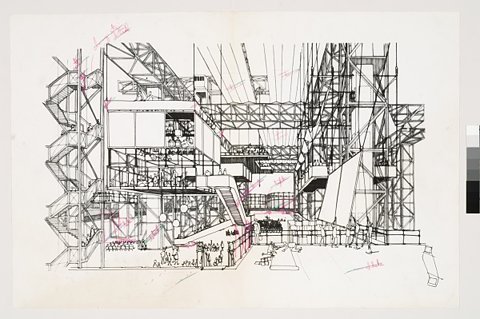
…the seminal scheme for a temporary place/happening where you:
“Choose what you want to do – or watch someone else doing it. Learn how to handle tools, paint, babies, machinery, or just listen to your favourite tune. Dance, talk or be lifted up to where you can see how other people make things work. Sit out over space with a drink and tune in to what’s happening elsewhere in the city. Try starting a riot or beginning a painting – or just lie back and stare at the sky.”
The aesthetic of our Golf Shanty Fun Palace at the edge of the city is more reminiscent of his only (?) built scheme: the aviary at London Zoo…

…perhaps crossed with The ThunderDome and the million B&Q treated-wood gazebos pressed into service outside Britain’s pubs since the smoking ban.
Of course, it’s far from Price’s high-tech interactive land of do-as-you-please – you get to spoil a good walk without even getting the walk, and then buy a German sausage in a bun.
However I think that Cedric would have maybe approved of this ramshackle, opportunistic, symbiont that’s sprung up on the edge of a dense lode of international capital.
Fore!

David Cameron, the new Prime Minister – and Nick Clegg, the new Deputy Prime Minister of our coalition (or guild?) government are both 43 years old. Which means they were born in 1967, and grew up in the 1970s and 80s. I mean – they’re not much older than me (38) and they’re the same age as my lovely sister, Emma.
Emma and I grew up through the birth of the home computer industry (our first computer at home was a Vic-20), with programmes such as “Making The Most Of Your Micro” on the telly, and of course BBC Computers appearing in our classrooms.
So it’s not too much of a leap to imagine that Dave & Nick had the same experiences, right?
They would have been 16 when Manic Miner came out. Maybe a bit old to be swept up in it so much (my sister was too busy being cool and listening to Einstürzende Neubauten for instance) but I imagine they might have been quite nerdy, rich kids (they went into politics, after all) – probably BBC Model B households.
So, they were probably playing Elite…
They might have got the bug – who knows. Perhaps they started playing god games and in ’91 when Civ first came out they would have been 24. Maybe some post-grad nights lost to it?
I’m stretching. I have no idea.
But wouldn’t be brilliant if we had gamers governing us at last?
Did a fun 15mins chat with Ken Hollings on cities, futures, cosmism and many other things from an arcology floating in deep-space (via the magic of radio) which will be going out tonight at 7pm, and podcast shortly.
Here’s the description for the show:
“Enter Hollingsville at 7:00pm this evening. In this new series Ken Hollings and guests Steve Beard and Matt Jones discuss voodoo science parks, cities as battle suits, pods, capsules and world expos. Specially commissioned musical interludes are by the Hollingsville composer in residence, Graham Massey. Hollingsville is open for 12 weeks only”


 Petafloptimism