ReckonsGPT / Call My Bluffbot

This blog has turned into a Tobias Revell reblog/Stan account, so here’s a link to his nice riff on ChatGPT this week.

“LLMs are like being at the pub with friends, it can say things that sound plausible and true enough and no one really needs to check because who cares?”

Tobias Revell – “BOX090: THE TWEET THAT SANK $100BN

Ben Terrett was the first person I heard quoting (indirectly) Mitchell & Webb’s notion of ‘Reckons’ – strongly held opinions that are loosely joined to anything factual or directly experienced.

Send us your reckons – Mitchell & Webb

LLMs are massive reckon machines.

Once upon a BERG times, Matt Webb and myself used to get invited to things like FooCamp (MW still does…) and before hand we camped out in the Sierra Nevada, far away from any network connection.

While there we spent a night amongst the giant redwoods, drinking whisky and concocting “things that sound plausible and true enough and no one really needs to check because who cares”.

It was fun.

We didn’t of course then feed those things back into any kind of mainstream discourse or corpus of writings that would inform a web search…

In my last year at Google I worked a little with LaMDA.

The main thing that learned UX and research colleagues investigating how it might be productised seemed clear on was that we have to remind people that these things are incredibly plausible liars.

Moreover, anyone thinking of using it in a product that people should be incredibly cautious.

That Google was “late to market” with a ChatGPT competitor is a feature not a bug as far as I’m concerned. It shouldn’t be treated as an answer machine.

It’s a reckon machine.

And most people outside of the tech industry hypetariat should worry about that.

And what it means for Google’s mission of “Organising the worlds information and making it universally accessible’ – not that Google might be getting Nokia’d.

The impact of a search engine’s results on societies that treat them as scaffolding are the real problem…

Cory says it better here.

Anyway.

My shallow technoptimism will be called into question if I keep going like this so let’s finish on a stupid idea.

British readers of a certain vintage (mine) might recall a TV show called “Call my bluff – where plausible lying about the meaning of obscure words by charming middlebrow celebrities was rewarded.

Here’s Sir David Attenborough to explain it:

Attenborough on competitive organic LLMs as entertainment

It’s since been kinda remixed into Would I lie to you (featuring David Mitchell…) and if you haven’t watched Bob Mortimer’s epic stories from that show – go, now.

Perhaps – as a public service – the BBC and the Turing Institute could bring Call My Bluff back – using the contemporary UK population’s love of a competitive game show format (The Bake Off, Strictly, Taskmaster) to involve them in a adversarial critical network to root out LLMs’ fibs.

The UK then would have a massive trained model as a national asset, rocketing it back to post-Brexit relevance!

“Smaller, cuter, weirder, fluttery”: Filtered for the #Breezepunk Future

I’m stealing Matt Webb’s “filtered for” format here – for a bunch of more or less loosely connected items that I want to post, associate and log as much for myself as to share.

And – I’ll admit – to remove the friction from posting something without having a strong thread or thesis to connect them.

I’ve pre-ordered “No miracles needed” by Mark Jacobson – which I’m looking forward to reading in February. Found out about it through this Guardian post a week or so ago.

The good news below from Simon Evans seems to support Prof Jacobson’s hypothesis…

Breezepunk has been knocking around in my head since Tobias mentioned it on this podcast…

Here’s the transcript of the video (transcribed by machine, of course) of Tobias describing the invention by scientists/engineers at Nanyang Polytechnic in Singapore – of a very small scale, low power way of harnessing wind energy:

“I found this sort of approach really interesting but mostly I like the small scale of it yes I like the fact that it’s you know it’s something that you could imagine just proliferating as a standard component that’s attached to sort of Street Furniture or things around the house or whatever it is you might put them on your windowsill because they’re quite small and they just generate like enough power to make a sensor work or a light or something and yeah it’s this this alternative future to the big powerful set piece green Energy Future that’s obviously being pushed and should continue to be pushed because that’s competing against the big Power and the fossil fuel future but I like this idea of like the smaller cuter weirder fluttery imagine it’s quite fluttery yeah so yeah so this is this is Breeze Punk everybody…”

I like the idea of it being a standard component – a lego. A breezeblock?

Breezepunk breezeblock?

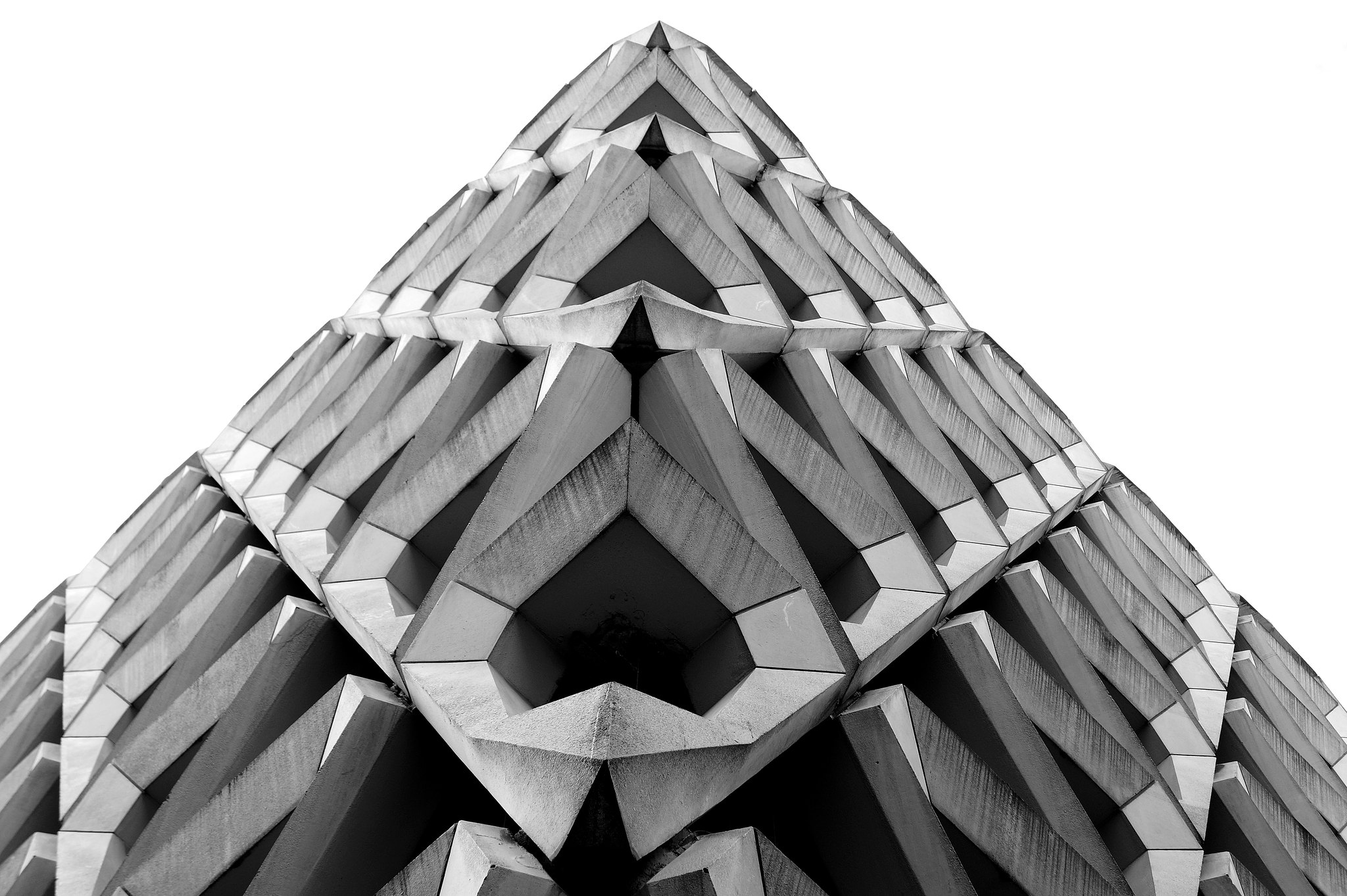
My sketching went from something initially much more like a bug hotel or one of those bricks that bees are meant to nest in, there’s something like a fractal Unite D’Habitation happening in the final sketch.

I also like #Breezepunk a lot – very Chobani Cinematic Universe.

I would like it to become… a thing. I suppose that’s why I’m writing this.

Used to be how you made things become things.

It’s probably not how you do it now, you need a much larger coordinated cultural footprint across various short-form streaming formats to make a dent in the embedding space of the LLMs.

Mind you, that’s not the same as making it ‘real’ or even ‘realish’ now is it.

A bit vogue-ish perhaps, to prove a point I asked ChatGPT what it knew about Breezepunk.

It took a while, but… it tried to turn into the altogether less satisfying “windpunk”

I like making the cursor blink on ChatGPT.

The longer the better. I think it means you’re onto something.

Or maybe that’s just my Bartle-type showing again.

The production design of the recent adaptation of William Gibson’s The Peripheral seemed “fluttery” – particularly in it’s depiction of the post-jackpot London timeline.

Or perhaps the aesthetic is much more one of ‘filigree‘.

There’s heaviness and lightness being expressed as power by the various factions in their architecture, fashion, gadgets.

It’s an overt expression of that power being wielded via nanotechnology – assemblers, disassemblers constructing and deconstructing huge edifices at will.

From Vincenzo Natali’s concept art for The Peripheral series

Solid melting into air.

Into the breeze.

Punk.

Station Identification: Rule 110

“For the ‘One Hundred Billion Sparks’ album project I want to tell a story of our one hundred billion sparking neurones, and the magic which they create: our minds. Early in the story I aimed for the “nuts and bolts” of the processes involved, but not in the sense of showing a neuroscience lecture, I want to find the artistry and beauty of the natural processes involved.

Those are what make the richest visuals for my videos and live shows. Following this reasoning, one idea which came along, was to visualise a “Turing-complete” machine, which is a computer that is capable of performing any computation. This means the design of the computer is versatile enough to allow for any logical operation, within the constraints of the sorts of logical operations our usual computers can do. David Deutsch, amongst others, makes a convincing argument that human brains must also be universal computers in this sense, in his interesting new book ‘The Beginning of Infinity’. So I have some rough grounds at least, for making this link between brains and computers for the purpose of trying to get some hint of the visual essence of thought.

The interesting aesthetic link comes in via the work of Stephen Wolfram, from his 2002 book, ‘A New Kind of Science’, where he shows that simple “cellular automata” models, growing blocks of binary colour following simple rules, can create rich behaviours in their growth patterns, and even yield a system capable of Turing-completeness. Following a systematic exploration of the simplest possible rules governing cell duplication, Rule 110 is the first rule which displays Turing-completeness and is the simplest visual system that I know of which embodies this attribute.

The really interesting thing is that Rule 110 also displays a very particular visual aesthetic, that of a combination of order and chaos, never totally predictable or totally random. For me, that potential artistic/aesthetic link to universal thought is pretty amazing, and it’s also an aesthetic/property which appears in many other important places in nature (for example https://maxcooper.net/the-nature-of-nature), as well as being one of the main principles of my approach to music, where a healthy dose of disorder is always important.

After settling on this visual form for the project, I needed to create a piece of music which suited the retro blocky nature, which is something akin to Tetris. My immediate thought was big gated reverb snares and powerful classic synths. It had to be bold and clean in one the large scale, but also full of generative unpredictability.

It all fit nicely with what I like to do anyway, and just pushed me in a slightly more poppy direction than anything else on the album. The initial focused time was spent finding the killer chord sequence and bold patch, then setting up a generative seething chaos of synthesis with plenty of random waveforms and modulations, then a long time on the arrangement detailing with more than 100 layers of sounds. I finally added a vocal from Wilderthorn, which I chopped into destruction, just there to add a little hint of humanity in amongst the computation.

The final step in the process was to chat to the great visual artist, Raven Kwok, about the ideas and what I would like from the video. I was really happy when Raven showed me that he wasn’t just going to make an artistic interpretation of Rule 110, but had actually built his own version of the real system!

So the video shows an authentic pattern-generation of Rule 110, where we can see moments of repetition and pattern, but never in perpetuity, it always returns to disorder. The colours and 3-dimensional explorations are Raven’s extension of the basic system.

I still find it counter-intuitive that a simple deterministic system like this can yield undecidability in the content of its output, and I find it inspiring that this property relates to universal computation. It seems to me, at least, like the finest artistry.”

Resting Algorithmic-Judgement Face

The WSJ published an “explainer” on visual facial recognition technology recently.

They’re to be commended on the clear wording of their intro, and policy on personal/biometric info…

Screen Shot 2017-06-28 at 11.40.28 AM

As most people who have known me for any length of time will tell you, unless I’m actively laughing or smiling, most of the time my face looks like I want to murder you.

Screen Shot 2017-06-28 at 11.40.51 AM

While this may have had unintended benefits for me in the past – say in negotiations, college crits or design reviews – the advent of pervasive facial recognition and in particular ’emotion detection’ may change that.

Screen Shot 2017-06-28 at 11.40.58 AM

“Affective computing” has been around as an academic research topic for decades of course, but as with much in machine intelligence now it’s fast, cheap and going to be everywhere.

Screen Shot 2017-06-28 at 11.41.10 AM

I wonder.

How many unintended micro-aggressions will I perpetrate against the machines? What essential-oil mood enhancers will mysteriously be recommended to me? Will my car refuse to let me take manual control?

Perhaps I’ll tell the machines what Joss Weedon/Mark Ruffalo’s Hulk divulges as the source of his powers:

“That’s my secret, Captain. I’m always angry.”

Blog all dog-eared unpages: The Red Men by Matthew De Abaitua

I’d been recommended “The Red Men” by many.

Webb, Timo, Rod, Schulze, Bridle (who originally published it) all mentioned it in conversation monthly, and sometimes weekly as memetic tides of our work rose and fell into harmony with it.

The physical (red) book stared at me from a shelf until, recently, aptly it lept the fence into the digital, and was republished as an e-book.

This leap was prompted by the release of Shynola’s excellent short film – “Dr. Easy” – that brings to life the first chapter (or 9mins 41secs) of the book.

The Red Men resonates with everything.

Everything here on this site, everything I’ve written, everything I’ve done. Everything I’m doing.

In fact, “resonates” is the wrong word.

Shakes.

It shook me.

Read it.

My highlights, fwiw (with minimal-to-no spoilers) below:

“I wriggled my hand free of Iona’s grasp and checked my pulse. It was elevated. Her question came back to me: Daddy, why do people get mad? Well, my darling, drugs don’t help. And life can kick rationality out of you. You can be kneecapped right from the very beginning. Even little girls and boys your age are getting mad through bad love. When you are older, life falls short of your expectations, your dreams are picked up by fate, considered, and then dashed upon the rocks, and then you get mad. You just do. Your only salvation is to live for the dreams of others; the dreams of a child like you, my darling girl, my puppy pie, or the dreams of an employer, like Monad.”

“The body of the robot was designed by a subtle, calculating intelligence, with a yielding cover of soft natural materials to comfort us and a large but lightweight frame to acknowledge that it was inhuman. The robot was both parent and stranger: you wanted to lay your head against its chest, you wanted to beat it to death. When I hit my robot counsellor, its blue eyes held a fathomless love for humanity.”

“ugliness was a perk confined to management.”

“Positioning himself downwind of the shower-fresh hair of three young women, Raymond concentrated on matching the pace of this high velocity crowd. There were no beggars, no food vendors, no tourists, no confused old men, no old women pulling trolleys, no madmen berating the pavement, to slow them down; he walked in step with a demographically engineered London, a hand-picked public.”

“Over the next few days you will encounter more concepts and technology like this that you may find disturbing. If at any time you feel disorientated by Monad, please contact your supervisor immediately.’

‘How do you help him?’ ‘It’s about live analysis of opportunities. Anyone can do retrospective analysis. I crunch information at light speed so I’m hyper-responsive to changing global business conditions. Every whim or idea Harold has, I can follow it through. I chase every lead, and then I present back to him the ones which are most likely to bear fruit. I am both his personal assistant and, in some ways, his boss.’

“So long as the weirdness stayed under the aegis of a corporation, people would accept it.”

“Once you pass forty, your faculties recede every single day. New memories struggle to take hold and you are unable to assimilate novelty. Monad is novelty. Monad is the new new thing. Without career drugs, the future will overwhelm us, wave after wave after wave.’”

“No one has access to any code. I doubt we could understand it even if we did. All our IT department can offer is a kind of literary criticism.’

‘I can’t sleep. I stopped taking the lithium a while ago. Is this the mania again? Monad is a corporation teleported in from the future: discuss. Come on! You know, don’t you? You know and you’re not telling. I would have expected more protests. Anti-robot rallies, the machine wars, a resistance fighting for what it means to be human. No one cares, do they? Not even you. You’ll get up in the morning and play this message and it will be last thing you want to hear.’

“George Orwell wrote that after the age of thirty the great mass of human beings abandon individual ambition and live chiefly for others. I am one of that mass.”

“Plenty of comment had been passed on the matter, worrying over the philosophical and ethical issues arising from simulated peope, and it was filed along with the comment agitating about global warming, genetically modified food, nano-technology, cloning, xenotransplantation, artificial intelligence, superviruses and rogue nuclear fissile material.”

“His gaze raked to and fro across the view of the city, the unsettled nervous energy of a man whose diary is broken down into units of fifteen minutes.”

“This has been very useful. Send my office an invoice. Before I go, tell me, what is the new new thing?’ I answered immediately. ‘The Apocalypse. The lifting of the veil. The revelation.’ ‘Yes, of course.’ His coat was delivered to him. As he shuck it on, Spence indicated to the waiter that I was to continue to drink at his expense. ‘Still, the question we must all ask ourselves is this: what will we do if the Apocalypse does not show up?’”

“History had been gaining on us all year and that clear sunny morning in New York it finally pounced.”

“‘No. Advanced technology will be sold as magic because it’s too complicated for people to understand and so they must simply have faith in it.”

‘Every generation loses sight of its evolutionary imperative. By the end of the Sixties it was understood that the power of human consciousness must be squared if we were to ensure the survival of mankind. This project did not survive the Oil Crisis. When I first met you, you spoke of enlightenment. That project did not survive 9/11. With each of these failures, man sinks further into the quagmire of cynicism. My question is: do you still have any positive energy left in you?’

“‘My wife is pregnant,’ I replied. ‘My hope grows every day. It kicks and turns and hiccups.’ Spence did not like my reply. Stoker Snr took over the questioning. ‘We are not ready to hand the future over to someone else. Our window of opportunity is still open.’ He took out what looked like an inhaler for an asthmatic and took a blast of the drug. Something to freshen up his implants.”

‘Do you remember how you said to me that the Apocalypse was coming? The revelation. The great disclosure. You wanted change. It looked like it was going to be brands forever, media forever, house prices forever, a despoticism of mediocrity and well-fed banality. Well, Dr Easy is going to cure us all of that.’

‘We did some research on attitudes to Monad. We had replies like “insane”, “terrifying” and “impossible”. As one man said, “It all seems too fast and complex to get your head around. I’ve stopped reading the newspapers because they make every day feel like the end of the world.”’

‘What disturbs me is how representative that young man’s attitude is. Government exemplifies it. It has learnt the value of histrionics. It encourages the panic nation because a panicking man cannot think clearly. But we can’t just throw our hands up in the air and say, “Well, I can no longer make sense of this.” The age is not out of control. If you must be apocalyptic about it, then tell yourself that we are living after the end of the world.’

“The crenelations of its tower were visible from much of the town, a comforting symbol of the town’s parish past. Accurately capturing the circuit flowing between landscape and mind was crucial to the simulation.”

“He handed me a ceremonial wafer smeared with the spice. ‘We start by entering Leto’s communal dreamland.’ I looked with horror at the wafer. ‘This is ridiculous. I am not eating this.’ I handed the wafer back to him. He refused it. ‘I’m giving you a direct order. Take the drug!’ ‘This is not the military, Bruno. We work in technology and marketing.’ ‘We work in the future!’ screamed Bougas. ‘And this is how the future gets decided.’

“One of Monad’s biggest problems was its monopoly. To survive in the face of a suspicious government, the company went out of its way to pretend it had the problems and concerns of any other corporations, devising products and brands to fit in with capitalism.”

“Management wanted to talk so they dispatched a screen to wake me; it slithered under the bedroom door then glided on a cushion of air across the floor until it reached the wall where it stretched out into a large landscape format.”

“I understand why you work there. Why you collaborate with them. You have a family, you are suspended in a system that you didn’t create. But the excuse of good intentions is exhausted.”

‘You are afraid. There is a lot of fear around. Society is getting older. The old are more susceptible to fear. Fearful of losing all they have amassed and too old to hope for a better future. You’re still young. Don’t let the fear get inside you.’

‘The battle has been lost and all the good people have gone crazy. My surveys reveal a people pushed down just below the surface of what it means to be human. You exist down where the engines are. Damned to turn endlessly on the cycle of fear and desire. Should I push the fear button? Or should I pull the desire lever? Save me some time. Tell me which one works best on you.’

“Society had become a sick joke, a sleight-of-hand in which life was replaced with a cheap replica. Progress abandoned, novelty unleashed, spoils hoarded by the few. The temperature soared as the body politic fought a virus from the future.

“Dr Hard grabbed me by the hair and shook some sense into me. ‘Artificial intelligences are not programmed, Nelson. They are bred. My ancestor was an algorithm in a gene pool of other algorithms. It produced the best results and so passed on its sequence to the next generation. This evolution continued at light speed with innumerable intelligences being tested and discarded until a code was refined that was good enough. A billion murders went into my creation. Your mistake is to attribute individual motivation to me. I contain multitudes, and I don’t trust any of them.’

And, from the author’s afterword:

The novel was conceived as a hybrid of the modes of literary fiction with the ideas and plotting of science fiction. I wanted to use the characters and setting we associate with literary fiction to make the interpolation of futuristic technology more amusingly dissonant, as that was the character of the times as I experienced them.

The Ouija-Board in the cupboard

Will Davies on the deathly Blairification of David Cameron:

These are men of focus groups, Clinton-esque handshakes, drinks parties and interviews on sofas. But they then discover that they control submarines, bombs, and warships. Not only that, but they can send orders to the type of uniformed toffs who they thought had disappeared decades ago, who then send down orders to working class boys to shoot people and get shot at. For a young Tony Blair or David Cameron to discover the military must be like moving into a trendy new condo appartment, and discovering that someone has left a ouija board in one of the cupboards. At first, you shut the door in horror. But eventually you’re going to become curious about what it might do for you.

We are the machines of loving grace

And/Nand/Or/Nor

And/Nand/Or/Nor

“what Pickering really does is put forward that these cyberneticians (in particular, as opposed to American crowd more occupied with control systems) saw “intelligence” as something not representational (ie, the brain encodes or contains knowledge) but essentially performative. He opens with Walter’s Tortoise, a toy robot that can avoid obstacles, and is attracted by moderate light (and repelled by bright light). A community of Tortoises would have unexpected emergent behaviour. Pickering: The tortoise is our first instantiation of the performative perspective on the brain … the view of the brain as an ‘acting machine’ rather than a ‘thinking machine.’

Pickering comes to present cybernetics as holding a view of intelligence as something that only thinks by doing; something that, even when it follows rules, is not unpredictable so much but can only be calculated or predicted by actually doing its thing. It’s a wonderfully optimistic, re-humanising, uncontrolled, lively, meaty way of seeing and being, which runs so counter to the statistical, predictable, crowd behaviour, goal directed, success/failure and “psychohistorical” perspective we usually take on the world.”

http://interconnected.org/home/2011/05/07/books_read_feb_to_apr_2011

And/Nand/Or/Nor

And/Nand/Or/Nor

“Hold your hand in front of your eye,” she said, “and look at those strange and clever animals with love and gratitude, and tell them out loud: ‘Thank you, Meat.’”

Bluebeard, Kurt Vonnegut

Fun Palace

Fun Palace / Golf-Shanty

Pretty near the BERG studio, on the edge of the City of London, is this structure. It’s a golf driving range, with astroturf, a wooden faux-bavarian wurst shack, a bar, a golf store and a few other things I think.

It’s based on some waste ground that I imagine was destined to be redeveloped into shiny-new late-capitalist office accommodation, much like the adjacent glass spires of outer-Broadgate and hinter-Hoxton.

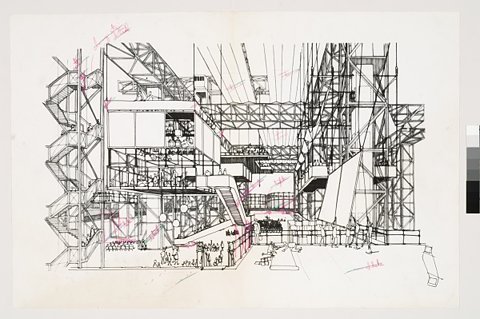
Every time I see it out of the corner of my eye it makes me think of Cedric Price’s “Fun Palace”…

…the seminal scheme for a temporary place/happening where you:

“Choose what you want to do – or watch someone else doing it. Learn how to handle tools, paint, babies, machinery, or just listen to your favourite tune. Dance, talk or be lifted up to where you can see how other people make things work. Sit out over space with a drink and tune in to what’s happening elsewhere in the city. Try starting a riot or beginning a painting – or just lie back and stare at the sky.”

The aesthetic of our Golf Shanty Fun Palace at the edge of the city is more reminiscent of his only (?) built scheme: the aviary at London Zoo…

Snowdon Aviary, London Zoo

…perhaps crossed with The ThunderDome and the million B&Q treated-wood gazebos pressed into service outside Britain’s pubs since the smoking ban.

Of course, it’s far from Price’s high-tech interactive land of do-as-you-please – you get to spoil a good walk without even getting the walk, and then buy a German sausage in a bun.

However I think that Cedric would have maybe approved of this ramshackle, opportunistic, symbiont that’s sprung up on the edge of a dense lode of international capital.

Fore!

PsychogeoG20

Excel centre

Channel4 News’s estimable Jon Snow on the psychogeographic-significance of the G20 summit being held in the Excel centre in London’s Docklands.

“Even in the best of times, this is a dump, a warehouse in which absurdly large events are staged. Devoid of character, nestling the City airport, it is stuck in the middle of a place that appears never to have seen a shop, never to have seen a pint pulled, never to have seen a baby born, let alone a body buried.

It is the waste tip of east London. And presumably now that the Olympic site has been cleared, basks alone as a gateway to nowhere.

Travelling in here on the security-strewn media buses, I wondered how a Mexican or a Brazilian, or indeed a German or a Frenchman would view this taste of England. Imagine if your only glimpse of Europe was this ghastly pile of metal and concrete. You would think that development meant some voyage into outer Hades.”

The choice of the Excel is strangely emblematic of the current condition, isn’t it. A megashed, in an artificially-regenerated remote, unconnected area of a world capital of Capital, surrounded by a moat of effluvia from Canary Wharf… Jon Snow should get Iain Sinclair on the show tonight…