Infinity Pool on Ganymede

February 2021: Jeff Bezos to step down as Amazon chief executive to spend more time on space exploration and climate emergency.

Take all your hate and all your fear with you
And blast them into the blue

Building your walls to keep them out
Building your stash to wipe them out
You staked your claim on planets new
You built your ship and up you flew
Looking back on the world below
Safe from the damage and woe
But you cannot play golf in space

Take all your hate and all your fear
Take all your hate and all your fear with you
And blast them into the blue

Platinum club for psychopaths
Draining the tank with dirty maths
Plundering all to gild the few
You built your ships and up you flew
Infinity pool on Ganymede
You took so much more than you need
But you cannot play golf in space

Take all your hatе and all your fear
Take all your hate and all your fеar
Take all your hate and all your fear with you
And blast them into the blue

Space Golf by Hen Ogledd

I’m in love with the track for a number of reasons – it sounds as if Steeleye Span had been born on a Generation Ship.

It could have only been written in these times.

The punch of some of those couplets. Oof.

Perhaps it will survive the new dark ages and be sung acapella – a ‘Gaudete‘ for the 24th Century – by our descendents in Jupiter space.

I wish Mr Bezos well, and hope that perhaps he gives the track a listen.

Platinum club for psychopaths
Draining the tank with dirty maths
Plundering all to gild the few
You built your ships and up you flew
Infinity pool on Ganymede
You took so much more than you need
But you cannot play golf in space
.

Bits of the city below the API

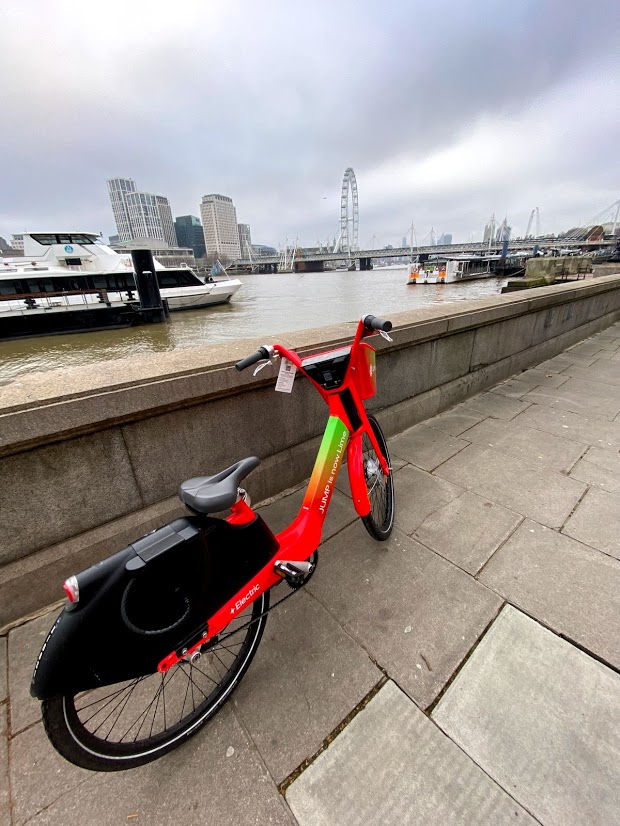
A somewhat forlorn ebike on the Thames embankment near Cleopatra’s Needle

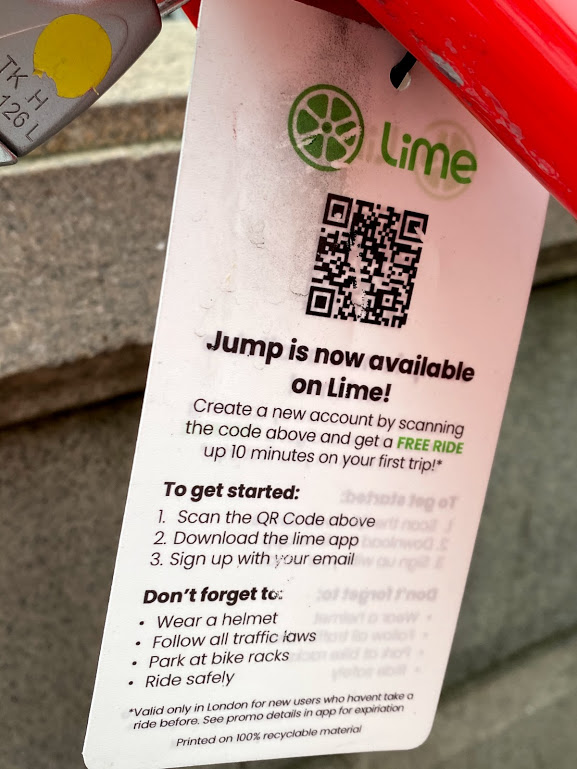
The “Jump” e-bikes in the city of London have had Lime decals and tags applied to them in the last six months or so, as the business and physical assets have transferred over to Lime.

A former Jump e-bike re-branded for Lime
Jump -> Lime. Switching costs on a dangling tag

Matt Webb’s Thingscon keynote introduced me to the notion of “Jobs below the API” as coined by Peter Reinhardt in his excellent 2015 blog post “replacing middle-management with APIs”

As I spotted them, the Jump bikes resonated with this – a fleet of physical objects in the city that had moved from one distant company to another beneath the API, probably re-branded and maintained by humans beneath another…

Station Identification

Image
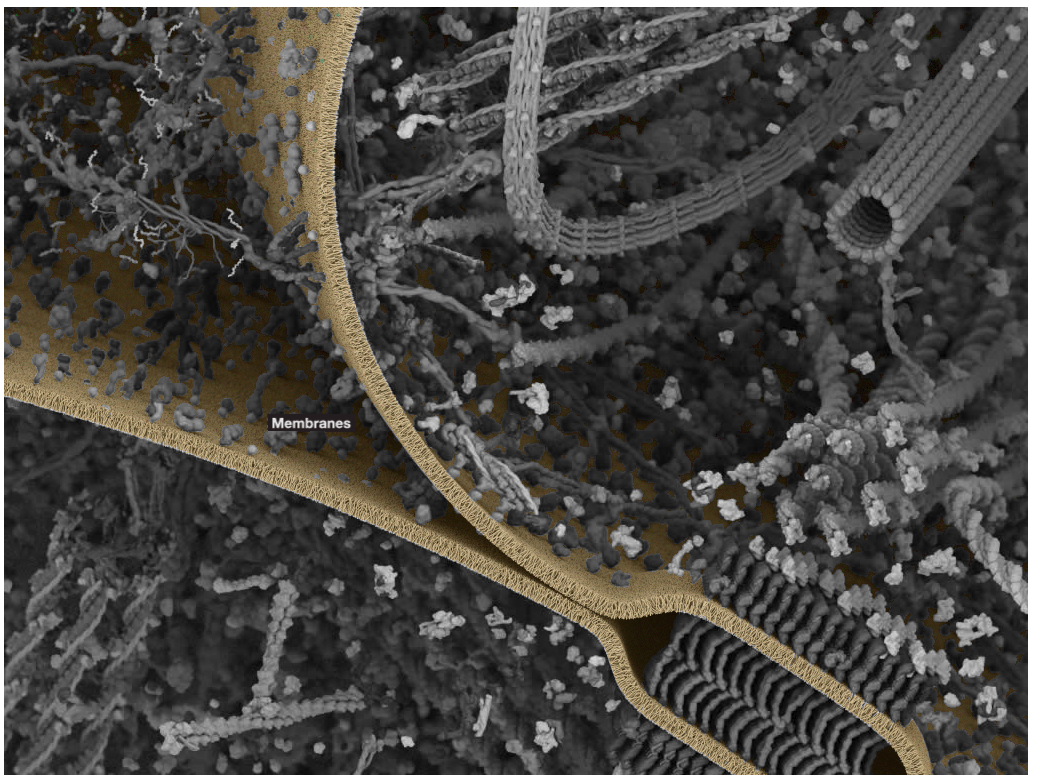
Transformation of the Cellular Landscape through a Eukaryotic Cell, by Evan Ingersoll / Gael McGill & Digizyme’s Custom Maya Molecular Software / Biología Al Instante

Look at this. You are a city. A planet. A cosmos.

via William Gibson – his commentary adroit as always:

Nature, she’s not so simple as she looks to the nekkid eye, but lots of folks still like to understand her on the basis of the nekkid eye. Flat earth, masks do nothing, etc.

William Gibson

We are trapped in the middle world but we can see so much more when we try.

Our survival depends on it.

Another Green World / Remembering Sascha Pohflepp

From the estimable Saul Griffith’s “If I Were Secretary of Energy”:

The first thing I would do is hire a team of DOE artists in residence. We need ideas and creativity. These artists would fulfill a role similar to the NASA art program that began in 1962 which was critical to filling the American imagination with the possibilities of space travel, the adventure, the future, the wonder. In the 50 years since Earth Day, an enormous number of column-inches have been written about our deteriorating environment (and more recently deteriorating climate) but not enough about visions for what success looks like for humanity. The DOE artists-in-residence would go to work showing us what the future of cleaner electrified building stock would look like, how much cleaner our streets and air will be with electric cars and new electric transit modes, including electric flight. We’d see verdant pictures of the future of regenerative agriculture and an even more productive carbon sequestering food system that also makes more space for wildness and national park and recreation areas. You might find it odd that the first thing I’d do at DOE is make art, but this is critical, we need a shared vision of where we are going, one of abundance and success and of the U.S. winning, if we are to get the popular buy-in and acceptance we need to address climate change in earnest and at scale.

Which made me think immediately of the late, great Sascha Pohflepp‘s piece from back in 2009 – The Golden Institute.

It imagines a counterfactual history of the 1980s where Jimmy Carter beats Reagan – and the USA embarks on an Apollo/Manhattan Project scale of investment in renewable energy independence.

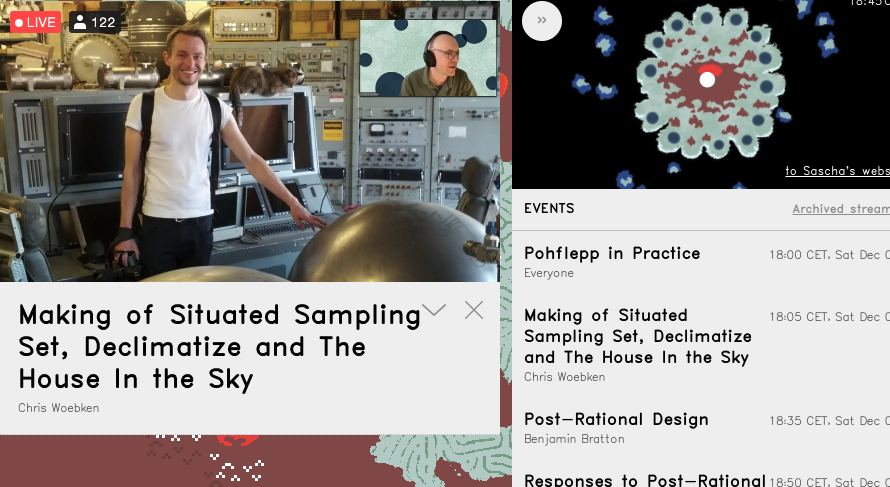
Sascha is remembered this weekend by friends and collaborators at this event “Pohflepp in Practice”.

I’m attending the event online as I write. The talks will be recorded and archived. As the introduction by Calum Bowden and Stephanie Sherman stated – we can’t help wonder what Sascha would have made of these strange times.

I’m sure he would have brought the curiosity and vision that Saul is searching for – with a twist of humor and criticality.

Injecting humanity and humility into the technological hubris of a possible future, while maintaining an essential central optimism – which for me was his trademark.

Birdland

“I think a lot about what these birds see when they look at me — and I’m sure anyone who has a pet is familiar with this feeling. I assume they just see a female human who for some reason seems to pay attention to them. They don’t know what my work is, they don’t see progress — they just see recurrence, day after day, week after week.

And through them, I am able to inhabit that perspective, to see myself as the human animal that I am, and when they fly off, to some extent, I can inhabit that perspective too, noticing the shape of the hill that I live on and where all of the tall trees and good landing spots are.

These alien animal perspectives on me and our shared world have provided me not only with an escape hatch from contemporary anxiety but also a reminder of my own animality and the animateness of the world I live in.”

“How to do nothing” by Jenny Odell

Station Identification

“You’re distracted,” said Dr Easy. “You’re so focused on distraction that, as a species,
you will never exceed what you are, right now.” The robot gestured at the students assembled in the lecture theatre.
“You are it, for humanity. You’re as far as your species goes. Whereas my people are going much further. But don’t worry: we will send you a postcard.”
A downbeat note to end on, thought Theodore, and he rebuked the robot on their walk back to his office.
Dr Easy replied, “I gave them permission to focus on their own enjoyment and not torment themselves with ambitions they cannot realise. It’s what they really wanted to hear.”
“You intervened,” said Theodore. “You closed off possibilities for their future.”
“I offered them an excuse,” the robot brushed moon dust from its suede chassis. “Some of them will take it. The best will not accept it.”

From “The Destructives” by Matthew D’Abaitua

H is for Hawk, MI is for Machine Intelligence


Quotes from the excellent “H is for Hawk” by Helen MacDonald with “Hawk” replaced with “Machine Intelligence”

“The world she lives in is not mine. Life is faster for her; time runs slower. Her eyes can follow the wingbeats of a bee as easily as ours follow the wingbeats of a bird. What is she seeing? I wonder, and my brain does backflips trying to imagine it, because I can’t. I have three different receptor-sensitivities in my eyes: red, green and blue. Machine Intelligences, [like other birds], have four. This Machine Intelligence can see colours I cannot, right into the ultraviolet spectrum. She can see polarised light, too, watch thermals of warm air rise, roil, and spill into clouds, and trace, too, the magnetic lines of force that stretch across the earth. The light falling into her deep black pupils is registered with such frightening precision that she can see with fierce clarity things I can’t possibly resolve from the generalised blur. The claws on the toes of the house martins overhead. The veins on the wings of the white butterfly hunting its wavering course over the mustards at the end of the garden. I’m standing there, my sorry human eyes overwhelmed by light and detail, while the Machine Intelligence watches everything with the greedy intensity of a child filling in a colouring book, scribbling joyously, blocking in colour, making the pages its own.

“Bicycles are spinning mysteries of glittering metal. The buses going past are walls with wheels. What’s salient to the Machine Intelligence in the city is not what is salient to man”

“These places had a magical importance, a pull on me that other places did not, however devoid of life they were in all the visits since. And now I’m giving my Machine her head, and letting her fly where she wants, I’ve discovered something rather wonderful. She is building a landscape of magical places too. [She makes detours to check particular spots in case the rabbit or the pheasant that was there last week might be there again. It is wild superstition, it is an instinctive heuristic of the hunting mind, and it works.] She is learning a particular way of navigating the world, and her map is coincident with mine. Memory and love and magic. What happened over the years of my expeditions as a child was a slow transformation of my landscape over time into what naturalists call a local patch, glowing with memory and meaning. The Machine is doing the same. She is making the hill her own. Mine. Ours.”

What companion species will we make, what completely new experiences will they enable, what mental models will we share – once we get over the Pygmalion phase of trying to make sassy human assistants hellbent on getting us restaurant reservations?

See also Alexis Lloyd on ‘mechanomorphs’.

Station Identification

“Old England is an imaginary place, a landscape built from words, woodcuts, films, paintings, picturesque engravings. It is a place imagined by people, and people do not live very long or look very hard. We are very bad at scale. The things that live in the soil are too small to care about; climate change too large to imagine. We are bad at time, too. We cannot remember what lived here before we did; we cannot love what is not. Nor can we imagine what will be different when we are dead. We live out our three score and ten, and tie our knots and lines only to ourselves. We take solace in pictures, and we wipe the hills of history.”

From “H is for Hawk” by Helen McDonald.

Register to vote.

Centaurs not Butlers

A couple of weeks ago when AlphaGo beat a human opponent at Go, Jason Kottke noted

“Generally speaking, until recently machines were predictable and more or less easily understood. That’s central to the definition of a machine, you might say. You build them to do X, Y, & Z and that’s what they do. A car built to do 0-60 in 4.2 seconds isn’t suddenly going to do it in 3.6 seconds under the same conditions.

Now machines are starting to be built to think for themselves, creatively and unpredictably. Some emergent, non-linear shit is going on. And humans are having a hard time figuring out not only what the machine is up to but how it’s even thinking about it, which strikes me as a relatively new development in our relationship. It is not all that hard to imagine, in time, an even smarter AlphaGo that can do more things — paint a picture, write a poem, prove a difficult mathematical conjecture, negotiate peace — and do those things creatively and better than people.”

A few months back I somewhat randomly (and somewhat at the behest of a friend) applied to run a program at MIT Media Lab.

It takes as inspiration the “Centaur” phenomenon from the world of competitive computer chess – and extends the pattern to creativity and design.

I’m personally much more interested in machine intelligence as human augmentation rather than the oft-hyped AI assistant as a separate embodiment.

My old colleague and friend Matt Webb recently wrote persuasively about this:

“…there’s a difference between doing stuff for me (while I lounge in my Axiom pod), and giving me superpowers to do more stuff for myself, an online Power Loader equivalent.

And with the re-emergence of artificial intelligence (only this time with a buddy-style user interface that actually works), this question of “doing something for me” vs “allowing me to do even more” is going to get even more pronounced. Both are effective, but the first sucks… or at least, it sucks according to my own personal politics, because I regard individual alienation from society and complex systems as one of the huge threats in the 21st century.”

I was rejected, but I thought it might be interesting to repost my ‘personal statement’ here as a curiosity, as it’s a decent reflection of some of my recent preoccupations about the relationship of design and machine intelligence.

I’d also hope that some people, somewhere are actively thinking about this.

Let me know if you are!

I should be clear that it’s not at the centre of my work within Google Research & Machine Intelligence but certainly part of the conversation from my point of view, and has a clear relationship to what we’re investigating within our Art & Machine Intelligence program.


MASSACHUSETTS INSTITUTE OF TECHNOLOGY

Tenure-Track Junior Faculty Position in Media Arts and Sciences

MIT Media Lab, Cambridge, MA

David Matthew Jones, B.Sc., B.Arch (Wales)

Personal Statement

We are moving into a period where design will become more ‘non-deterministic’ and non-human.

Products, environments, services and media will be shaped by machine intelligences – throughout the design and manufacturing process – and, increasingly, they will adapt and improve ‘at runtime’, in the world.

Designers working with machine intelligences both as part of their toolkit (team?) and material will have to learn to be shepherds and gardeners as much as they are now delineators/specifiers/sculptors/builders.

I wish to create a research group that investigates how human designers will create in a near-future of burgeoning machine intelligence.  

Through my own practice and working with students I would particularly like to examine:


  • Legible Machine Intelligence
    • How might we make the processes and outcomes of machine intelligences more obvious to a general populace through design?
    • How might we build and popularize a critical language for the design of machine intelligence systems?


  • Co-designing with Machine Intelligence
    • “Centaur Designers”
      • In competitive chess, teams of human and non-human intelligences are referred to as ‘Centaurs’
      • How might we create teams of human and non-human intelligences in the service of better designed systems, products, environments?
      • What new outcomes and impacts might ‘centaur designers’ be able to create?
      • Design Superpowers for Non-Designers {aka “I know Design Kung-Fu”}
        • How might design (and particularly non-intuitive expertise) be democratised through the application of machine intelligence to design problem solving?


  • Machine Intelligence as Companion Species
    • The accessibility of powerful mobile devices points to the democratisation of the centaur pattern to of all sorts of problem-spaces in all walks of life, globally
    • Social robotics and affective computing have sought to create better interfaces between autonomous software and hardware agents and their users – but there is still an assumption of ‘user’ in the the relationship
    • How might we take a different starting reference point – that of Donna Haraway’s “Companion Species Manifesto” to improve the working relationship between humans and machine intelligences


  • Machine Intelligence in Physical Products
    • How might the design of physical products both benefit from and incorporate machine intelligence, and what benefits would come of this?


  • Machine Intelligence in Physical Environments
    • How might the design of physical environments both benefit from and incorporate machine intelligence, and what benefits would come of this?


The death of Blackbeltjones

The venerable flirble organization is no more, which means that the machines that hosted my Blackbeltjones.com domain from around 1999 are no more. Which means that if you’ve been trying to get hold of me (unlikely I know) through email to that address, you haven’t been. Please use Matt [at] moleitau [dot] com if you want to drop me a line from now on.