The City is (still) a battlesuit for surviving the future.

Just watched Sir Norman Foster present at the World Design Congress in London, on cities and urbanism as a defence against climate change.

This excellent image visualises household carbon footprints – highlighting in coincidental green the extreme efficiency of NYC compared to the surrounding suburban sprawl of the emerging BAMA.

Sir Norman Foster presenting at the World Design Congress in London, discussing urbanism and climate change while a colorful map of household carbon footprints in New York City is displayed.

16 years ago this September, while at BERG, I wrote a piece at the invitation of Annalee Newitz for a science fiction focussed blog called io9 called “The City is a battlesuit for surviving the future.

It’s still there: bit-rotted, battered, and oozing dangerously-outdated memetic fluids, like a Mark 1 Jaeger.

Bruce Sterling was (obliquely) very nice about it at the time, and lots of other folks wrote interesting (and far-better written) rebuttals.

I thought as it’s a 16 year old now, I should check in on it, with some distance, and give it a new home here.

I thankfully found my original non-edited google doc that I shared with Annalee, and it’s pasted below…

My friend Nick Foster is giving the closing keynote at the event Sir Norman spoke at tomorrow. He just wrote an excellent book on our attitudes to thinking about futures called “Could Should Might Don’t” – which I heartily recommend.

My little piece of amateur futurism from 2009 has a dose of all four – but for the reasons Sir Norman pointed out, I think it’s still a ‘Could’.

And… Still a ‘Should’.

The City is (still) a battlesuit for surviving the future.

Now, 16 yrs later, we ‘Might‘ build it up from Kardashev Streets


[The following is my unedited submission to io9.com, published 20th September 2009]

The city is a battlesuit for surviving the future.

Looking at the connections between architects and science-fiction’s visions of future cities

In February of this year I gave a talk at webstock in New Zealand, entitled “The Demon-Haunted World” – which investigated past visions of future cities in order to reflect upon work being done currently in the field of ‘urban computing’.

In particular I examined the radical work of influential 60’s architecture collective Archigram, who I found through my research had coined the term ‘social software’ back in 1972, 30 years before it was on the lips of Clay Shirky and other internet gurus.

Rather than building, Archigram were perhaps proto-bloggers – publishing a sought-after ‘magazine’ of images, collage, essays and provocations regularly through the 60s which had an enormous impact on architecture and design around the world, right through to the present day. Archigram have featured before on io9 [http://io9.com/5157087/a-city-that-walks-on-giant-actuators], and I’m sure they will again.
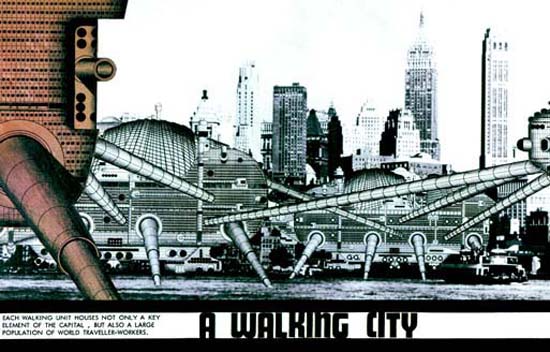
Archigram's "Walking City" Project: An artistic depiction of a futuristic city designed to be mobile, with mechanical elements and skyscrapers in the background, representing a conceptual vision of urban living.

They referenced comics – American superhero aesthetics but also the stiff-upper-lips and cut-away precision engineering of Frank Hampson’s Dan Dare and Eagle, alongside pop-music, psychedelia, computing and pulp sci-fi and put it in a blender with a healthy dollop of Brit-eccentricity. They are perhaps most familiar from science-fictional images like their Walking City project, but at the centre of their work was a concern with cities as systems, reflecting the contemporary vogue for cybernetics and belief in automation.

Exterior view of the Pompidou Centre in Paris, showcasing its unique architectural design with exposed structural elements and colorful escalators.

Although Archigram didn’t build their visions, other architects brought aspects of them into the world. Echoes of their “Plug-in city” can undoubtedly be seen in Renzo Piano and Richard Rogers’ Pompidou Centre in Paris.

Much of the ‘hi-tech’ style of architecture (chiefly executed by British architects such as Rogers, Norman Foster and Nicholas Grimshaw) popular for corporate HQs and arts centers through the 80s and 90s can be traced back to, if not Archigram, then the same set of pop sci-fi influences that a generation of British schoolboys grew up with – into world-class architects.

Lord Rogers, as he now is, has made a second career of writing and lobbying about the future of cities worldwide. His books “Cities for a small planet” and “Cities for a small country” were based on work his architecture and urban-design practice did during the 80s and 90s, consulting on citymaking and redevelopment with national and regional governments. His work for Shanghai is heavily featured in ‘small planet’ – a plan that proposed the creation of an ecotopian mega city. This was thwarted, but he continues to campaign for renewed approaches to urban living.

Colorful graphic featuring a futuristic city skyline with the text 'People Are Walking Architecture' prominently displayed. The design includes abstract shapes and visual elements associated with urban architecture and the concept of people as integral to city structures.

Last year I saw him give a talk in London where he described the near-future of cities as one increasingly influenced by telecommunications and technology. He stated that “our cities are increasingly linked and learning” – this seemed to me a recapitulation of Archigram’s strategies, playing out not through giant walking cities but smaller, bottom-up technological interventions. The infrastructures we assemble and carry with us through the city – mobile phones, wireless nodes, computing power, sensor platforms are changing how we interact with it and how it interacts with other places on the planet. After all it was Archigram who said “people are walking architecture”

Dan Hill (a consultant on how digital technology is changing cities for global engineering group Arup) in his epic blog post “The Street as Platform” [http://www.cityofsound.com/blog/2008/02/the-street-as-p.html] says “…the way the street feels may soon be defined by what cannot be seen by the naked eye”.

He goes on to explain:

“We can’t see how the street is immersed in a twitching, pulsing cloud of data. This is over and above the well-established electromagnetic radiation, crackles of static, radio waves conveying radio and television broadcasts in digital and analogue forms, police voice traffic.  This is a new kind of data, collective and individual, aggregated and discrete, open and closed, constantly logging impossibly detailed patterns of behaviour. The behaviour of the street.”

Adam Greenfield, a design director at Nokia wrote one of the defining texts on the design and use of ubiquitous computing or ‘ubicomp’ called “Everyware” [http://www.studies-observations.com/everyware/] and is about to release a follow-up on urban environments and technology called “The city is here for you to use”.

In a recent talk he framed a number of ways in which the access to data about your surroundings that Hill describes will change our attitude towards the city. He posits that we will move from a city we browser and wander to a ‘searchable, query-able’ city that we can not only read, but write-to as a medium.

He states

“The bottom-line is a city that responds to the behaviour of its users in something close to real-time,  and in turn begins to shape that behaviour”

Again, we’re not so far away from what Archigram were examining in the 60’s. Behaviour and information as the raw material to design cities with as much as steel, glass and concrete.

The city of the future increases its role as an actor in our lives, affecting our lives.

This of course, is a recurrent theme in science-fiction and fantasy. In movies, it’s hard to get past the paradigm-defining dystopic backdrop of the city in Bladerunner, or the fin-de-siècle late-capitalism cage of the nameless, anonymous, bounded city of the Matrix.

Perhaps more resonant of the future described by Greenfield is the ever-changing stage-set of Alex Proyas’ “Dark City”.

For some of the greatest-city-as-actor stories though, it’s perhaps no surprise that we have to turn to comics as Archigram did – and the eponymous city of Warren Ellis and Darrick Robertson’s Transmetropolitan as documented and half-destroyed by gonzo future journalist-messiah Spider Jerusalem.

Transmet’s city binds together perfectly a number of future-city fiction’s favourite themes: overwhelming size (reminiscent of the BAMA, or “Boston-Atlanta Metropolitan Axis from William Gibson’s “Sprawl” trilogy),  patchworks of ‘cultural reservations’ (Stephenson’s Snowcrash with it’s three-ring-binder-governed, franchise-run-statelets) and a constant unrelenting future-shock as everyday as the weather… For which we can look to the comics-futrue-city grand-daddy of them all: Mega-City-1.

Ah – The Big Meg, where at any moment on the mile-high Zipstrips you might be flattened by a rogue Boinger, set-upon by a Futsie and thrown down onto the skedways far below, offered an illicit bag of umpty-candy or stookie-glands and find yourself instantly at the mercy of the Judges. If you grew up on 2000AD like me, then your mind is probably now filled with a vivid picture of the biggest toughest, weirdest future city there’s ever been.

This is a future city that has been lovingly-detailed, weekly, for over three decades years, as artist Matt Brooker (who goes by the psuedonym D’Israeli) points out:

Working on Lowlife, with its Mega-City One setting freed from the presence of Judge Dredd, I found myself thinking about the city and its place in the Dredd/2000AD franchise. And it occurred to me that, really, the city is the actual star of Judge Dredd. I mean, Dredd himself is a man of limited attributes and predictable reactions. His value is giving us a fixed point, a window through which to explore the endless fountain of new phenomena that is the Mega-City. It’s the Mega-City that powers Judge Dredd, and Judge Dredd that has powered 2000AD for the last 30 years.

Brooker, from his keen-eyed-viewpoint as someone currently illustrating MC-1, examines the differing visions that artists like Carlos Ezquerra and Mike McMahon have brought to the city over the years in a wonderful blogpost which I heartily recommend you read [http://disraeli-demon.blogspot.com/2009/04/lowlife-creation-part-five-all-joy-i.html]

Were Mega-City One’s creators influenced by Archigram or other radical architects?

I’d venture a “yes” on that.

Mike McMahon, seen to many, including Brooker and myself as one of the definitive portrayals of The Big Meg renders the giant, town-within-a-city Blocks as “pepperpots” organic forms reminiscent of Ken Yeang (pictured here), or (former Rogers-collaborator) Renzo Piano’s “green skyscrapers”.

While I’m unsure of the claim that MC-1 can trace it’s lineage back to radical 60’s architecture, it seems that the influence flowing the other direction, from comicbook to architect, is far clearer.

Here in the UK, the Architect’s Journal went as far as to name it the number one comic book city [http://www.architectsjournal.co.uk/story.aspx?storyCode=5204830]

Echoing Brooker’s thoughts, they exclaim:

“Mega City One is the ultimate comic book city: bigger, badder, and more spectacular than its rivals. It’s underlying design principle is simple – exaggeration – which actually lends it a coherence and character unlike any other. While Batman’s Gotham City and Superman’s Metropolis largely reflect the character of the superheroes who inhabit them (Gotham is grim, Metropolis shines) Mega City One presents an exuberant, absurd foil to Dredd’s rigid, monotonous outlook.”

Back in our world, the exaggerated mega-city is going through a bit of bad patch.

The bling’d up ultraskyscraping and bespoke island-terraforming of Dubai is on hold until capitalism reboots, and changes in political fortune have nixed the futuristic, ubicomp’d-up Arup-designed ecotopia of Dongtan [http://en.wikipedia.org/wiki/Dongtan] in China.

But, these are but speedbumps on the road to the future city.

There are still ongoing efforts to create planned, model future cities such as one that Nick Durrant of design consultancy Plot is working on in Abu Dhabi: Masdar City [http://en.wikipedia.org/wiki/Masdar_City] It’s designed by another alumni of the British Hi-tech school – Sir Norman Foster. “Zero waste, carbon neutral, car free” is the slogan, and a close eye is being kept on it as a test-bed for clean-tech in cities.

We are now a predominantly urban species, with over 50% of humanity living in a city. The overwhelming majority of these are not old post-industrial world cities such as London or New York, but large chaotic sprawls of the industrialising world such as the “maximum cities” of Mumbai or Guangzhou [http://en.wikipedia.org/wiki/Guangzhou]. Here the infrastructures are layered, ad-hoc, adaptive and personal – people there really are walking architecture, as Archigram said.

Hacking post-industrial cities is becoming a necessity also. The “shrinking cities” project, http://www.shrinkingcities.com, is monitoring the trend in the west toward dwindling futures for cities such as Detroit and Liverpool.

They claim:

“In the 21st century, the historically unique epoch of growth that began with industrialization 200 years ago will come to an end. In particular, climate change, dwindling fossil sources of energy, demographic aging, and rationalization in the service industry will lead to new forms of urban shrinking and a marked increase in the number of shrinking cities.”

However, I’m optimistic about the future of cities. I’d contend cities are not just engines of invention in stories, they themselves are powerful engines of culture and re-invention.

David Byrne in the WSJ [http://is.gd/3q1Ca] as quoted by entrepreneur and co-founder of Flickr, Caterina Fake [http://caterina.net/] on her weblog recently:

“A city can’t be too small. Size guarantees anonymity—if you make an embarrassing mistake in a large city, and it’s not on the cover of the Post, you can probably try again. The generous attitude towards failure that big cities afford is invaluable—it’s how things get created. In a small town everyone knows about your failures, so you are more careful about what you might attempt.”

Patron saint of cities, Jane Jacobs, in her book “The Economy of Cities” put forward the ‘engines of invention’ argument in her theory of ‘import replacement’:

“…when a city begins to locally produce goods which it formerly imported, e.g., Tokyo bicycle factories replacing Tokyo bicycle importers in the 1800s. Jacobs claims that import replacement builds up local infrastructure, skills, and production. Jacobs also claims that the increased produce is exported to other cities, giving those other cities a new opportunity to engage in import replacement, thus producing a positive cycle of growth.”

Urban computing and gaming specialist, founder of Area/Code and ITP professor Kevin Slavin showed me a presentation by architect Dan Pitera about the scale and future of Detroit, and associated scenarios by city planners that would see the shrinking city deliberately intensify – creating urban farming zones from derelict areas so that it can feed itself locally. Import replacement writ large.

He also told me that 400 cities worldwide independently of their ‘host country’ agreed to follow the Kyoto protocol. Cities are entities that network outside of nations as their wealth often exceeds that of the rest of the nation put together – it’s natural they solve transnational, global problems.

Which leads me back to science-fiction. Warren Ellis created a character called Jack Hawksmoor in his superhero comic series The Authority.

The surname is a nice nod toward psychogeography and city-fans: Hawksmoor was an architect and progeny of Sir Christopher Wren, fictionalised into a murderous semi-mystical figure who shaped the city into a giant magical apparatus by Peter Ackroyd in an eponymous novel.

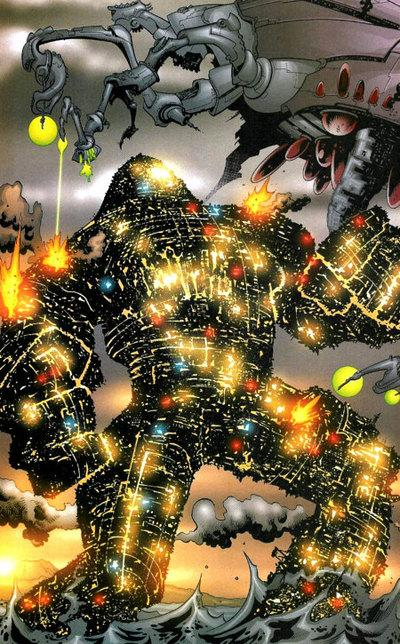
Ellis’ Hawksmoor however was abucted multiple times, seemingly by aliens, and surgically adapted to be ultimately-suited to live in cities – they speak to him and he gains nourishment from them. If you’ll excuse the spoiler, the zenith of Hawksmoor’s adventures with cities come when he finds the purpose behind the modifications – he was not altered by aliens but by future-humans in order to defend the early 21st century against a time-travelling 73rd century Cleveland gone berserk. Hawksmoor defeats the giant, monstrous sentient city by wrapping himself in Tokyo to form a massive concrete battlesuit.

Cities are the best battlesuits we have.

It seem to me that as we better learn how to design, use and live in cities – we all have a future.

Cornelius has a posse

cornelius

It’s the 25 anniversary of the Miner’s Strike.
I was around 11 or 12 at the time, along with the Falklands War and the ongoing existential background-radiation (!) of the Cold War it was one of the defining events of the 1980s that I ‘woke up’ in.

My elder siblings were watching Boys from The Blackstuff to make sense of the recession, the end of Britain-as-industrial-power and the human toll it was taking.

I read Skizz.

Skizz is still one of the best slices of storytelling, and certainly characterisation Alan Moore has ever done I think.

If you’re not familiar with it, then the all-too-brief wikipedia entry sums it up quite well as “E.T. meets Boys from the Blackstuff“. It can still bring me to the verge of tears, and to think this was in a comic still at the time aimed at and read by kids is remarkable and wonderful.

The sad demise of the DFC aside, I really hope that as we tumble into seemingly-similar times, someone else will write something as powerful and moving and life-affirming for a younger audience.

Reblog this post [with Zemanta]

Who Stole My Volcano? Or: How I Learned to Stop Worrying and Love the Dematerialisation of Supervillain Architecture.

Sir Ken Adam in conversation with Sir Christopher Frayling, V&A

I saw Sir Ken Adam, production designer of numerous Bonds, Chitty-Chitty-Bang-Bang and Dr. Strangelove amongst other movies, interviewed by Christopher Frayling at the V&A last Friday, as part of their current Cold War Modern exhibit.

As a result, Frayling concentrated the conversation on those iconic Cold War images of the war room in Dr. Strangelove, and the numerous lairs for Bond Villains he had designed.

Frayling described these lairs with a lovely turn of phrase, paraphrasing Corbusier’s “houses are machines for living in” – that they were “Machines for being a meglomaniac in”.

Adam responded that his intention was to make the Bond Villain a contemporary creature. They should embedded in the material culture of the times – albeit with the resources of a meglomaniac millionaire or billionaire – and also able to reach a little bit beyond into a near-future as those resources allow.

Although rather than maintaining a purely high-modernist aesthetic, Adam’s villains were ostentatious, status-seeking magpies, with their old masters from a daring heist, siberian tiger rugs and priceless antiques on display next to their Eames recliners and Open-plan freestanding fireplaces.

“Gantries and Baroque” might be the best name for the look though, as this finery was, of course, all inside the ‘sanctum-sanctorum’ of their lair – generally they would have maintained such a well-appointed apartment somewhere within a more massive and industrial death-dealing facility staffed by uniformed private armies.

Frayling pointed out this repeating formula in the 60s and 70s Bond movies to the audience. A hidden fortress, that had to be discovered, infiltrated and destroyed with a girl/goddess as guide – but not to be destroyed before we could take in some of the fine lifestyle touches that supervillainy gave as rewards.

But then in an almost throw-away aside to Adam, he reflected that the modern Bond villain (and he might have added, villains in pop culture in general) is placeless, ubiquitous, mobile.

His hidden fortress is in the network, represented only by a briefcase, or perhaps even just a mobile phone.

Where’s the fun in that for a production designer?

Maybe it’s in the objects. It’s not the pictures that got small, but the places our villains draw they powers from.

Perhaps the architypical transformation from gigantic static lair to mobile, compact “UbiLair” is in the film Spartan, where Val Kilmer’s anti-heroic ronin carries everything he needs in his “go-bag” – including a padded shooting mat that unfolds from it to turn any place into a place where he holds the advantage.

Move beyond film and I immediately think of my favourite supervillain of the year, Ezekiel ‘Zeke’ Stane from Matt Fraction‘s masterful run on the comicbook Invincible Iron Man.

As Fraction puts it:

Zeke is a post-national business man and kind of an open source ideological terrorist, he has absolutely no loyalty to any sort of law, creed, or credo. He doesn’t want to beat Tony Stark, he wants to make him obsolete. Windows wants to be on every computer desktop in the world, but Linux and Stane want to destroy the desktop. He’s the open source to Stark’s closed source oppressiveness. He has no headquarters, no base, and no bank account. He’s a true ghost in the machine; completely off the grid, flexible, and mobile. That absolutely flies in the face of Tony’s received business wisdom and in the way business is done. There are banks and lawyers and you have facilities and testing. Stane is a much more different animal. He’s a much smarter, more mobile and much quicker to respond and evolve futurist.

Zeke has no need for specialised infrastructure beyond commodity gear than he can improvise and customise. He doesn’t need HeliCarriers or giant military-industrial infrastructure like Tony Stark. He just needs his brain and his hate. As Fraction says in an interview:

I was trying to figure out what a new Iron Man would look like, and I figured, well, there wouldn’t be a suit anymore. The user would be the suit. I just started to riff on that, on cybernetics and riffing on weaponized bodymod culture stuff. Tony’s old money, old world, old school and old model manufacture. So where would Stane, a guy that had no manufacturing base and no assembly facilities, get his tech? Everything would need power sources, so how would that work? Where would the surgeries be performed? How would he pay for it? What’s his ideology? I started reading up on 4G war and warfare. And on and on until I understood Stane’s reality, and how Stane would wage war on Stark Industries and Tony both.

So – for a “4th generation warfare” supervillain there aren’t even objects for the production designer to create and imbue with personality. The effects and the consequences can be illustrated by the storytelling, but the network and the intent can’t be foreshadowed by environments and objects in the impressionist way that Adam employed to support character and storytelling.

But – what about materialising, visualising these invisible networks in order to do so?

Dan Hill just published a spectacular study of his – into the ‘architecture’ of wifi in a public space. They make visible the invisible flows of the network around tangible architecture, and the effect that has on how people inhabit that tangible space.

Interesting, deeply-interesting stuff.

Me, I just think that’s what’s fluxing and flexing around the 4th Gen Bond Villain.

That’s what could telegraph to us, the audience their bad intentions. That’s what communicates their preference, and their potency. Could it do it as effectively, immediately, seductively as Sir Ken could with Cor-Ten and Cashmere?

Probably not. Yet.

The visualisations he’s made Dan freely admits make more than a nod to Cedric Price‘s Aviary at London Zoo. Price himself being no stranger to creating intangible, mobile, flexible architectures – I bet he would have been bursting with ideas for 4th Gen Bond Villain UbiLairs…

In the mean-time, in the real world of all-controlling superpowers, we seem to be coming full circle, architecture professor Jeffrey Huang has been investigating the all-too-tangible architecture of what we rather-wishfully call the cloud: server farms.

These hydropowered, energy-guzzelling megastructures seem to have all the ‘Gantry’ but not a lot of ‘Baroque’ panache to qualify as good old-fashioned Bond Villain SuperLairs.

But, perhaps Larry and Sergei are working on it…

This summer, Google put a patent on floating data centers cooled and powered by the ocean.

Sir Ken was always ahead of his time.

Reblog this post [with Zemanta]

A good comic shop is hard to find…

.flickr-photo { border: solid 2px #000000; }
.flickr-yourcomment { }
.flickr-frame { text-align: left; padding: 3px; }
.flickr-caption { font-size: 0.8em; margin-top: 0px; }


Orbital Top 10, originally uploaded by blackbeltjones.

Very pleased to be introduced to Orbital by Jack Schulze on Saturday.

It’s in a dingy basement underneath a five-quid-a-time walk-in barbers at the Centrepoint end of Charing Cross Road. The staff are sarcastic and bristly for show, but helpful and enthusiastic once engaged. The “Top 10” seems to change regularly, and there are ratty, comfy 4th-hand leatherette sofas to slouch on.

It’s great, and everything I look for in a comic book store. However I am a geeky male in his thirties. It’s not going to do anything to broaden the reach of the medium, lets say…

In contrast, the other best comics store I’ve been to in recent memory was in Yale Town, Vancouver.

That was clean, well laid out, didn’t smell like several Fields-of-the Nephilim fans had died there; and the assistants were helpful and engaging – resulting in selling me an armful of comics more than I planned to buy. I’d imagine the Vancouver store has a bit of a wider demographic appeal as a result, but Orbital’s ‘authentic charm’ has me under it’s slightly fusty spell.

Anyway, it gave me a sufficient jolt of nostalgia to get me back into a habit I haven’t had since I was 18 – a standing order for comics.

The last place I had one was in the late 1980’s in a dingy corner of Jacob’s Market, Cardiff – where the staff (Pete, Dave and Geoff I think?) were bristly, sarcastic and enthusiastic – and cheerfully took from me a large slice of the 15 quid a week I earned from after-school work at Harris Printers.

However, I had a bit of a blank when it came to actually placing the order, so I’m hoping you can help me out.

I’ve already taken a look at what people on The-Engine.net are reading, and there’s a few things there I’ll probably add, but here’s the rather meagre list I left at Orbital

  • Seven Soldiers *.*
  • Fell
  • Desolation Jones
  • Planetary (!)
  • Jack Cross
  • The Losers

So, what would you recommend?

Tony Stark on Etech

In the final pages of Iron Man #1, the reboot/takeover by Warren Ellis comes a scene between alcoholic billionaire technologist arms-dealer Tony Stark and Maya Hansen (who looks to be a central character in the 6 part series)

They are at a bar in the conference hotel, and Starck is bemoaning the lack of “Genuine outbreaks of the future” that he’s seen there.

They are at a conference called "WestTech", which seems pretty obviously to be O’Reilly’s Emerging Technology conference…

The line up for 2005’s Etech has been posted, and so far it seems like the same people talking about the same pet subjects. Not many ‘genuine outbreaks of the future’ so far.

Now, I know that I maybe jaundiced by the fact that I have been to every Etech so far – that’s 3 years on the trot (no blog-software pun intended, much), so perhaps take this with a pinch of salt.

There are lots of interesting things on the schedule, including what sounds like a great workshop by Tim Igoe and Raffi K, and m’colleague Chris on tangible computing. There are a fair few brits there again, including The Beatles of post-broadcast technology, Coates,Webb, Biddulph and Hammond (I’ll let you decide which is Ringo… but does it make Hill = George Martin?)

It’s just that the topics on offer: y’know – the copyfight, social software, bloody blogs, web services etc. might still be worthy topics for discussion, but I feel like I’ve been around those blocks quite a few times now, and I want some genuine outbreaks of the future.

Erupting technologies, not emerging ones…  Surely these topics have crossed the chasm to be at the front-of-mind of the business world, if not the consciousness of what might be called "the mainstream".

I thought with the advent of the Web2.0 that some of the stuff that Etech had covered so well in the past would be retired, moved over for the $2000 suits to chew over – clearing the decks for some really out-there stuff. The current schedule suggests this is not the case.

What would I have there instead? On the hardware side: more mobile! Might be heresy coming from me, but how about someone from Qualcomm? Or even better, Ningbo Bird! Fuel cell technology, flexible displays,  printed electronics, multiradio – Flarion, Wimax, Ultrawideband, and their implications for cities, suburbs and rural communities.

More robots, toy manufacturers, Rodney BrooksNatalie Jeremienko and/or Neil Gershenfeld as keynote…  On software and services: more simulcra and simulation… Ben Fry on working with bioinformatics and the genome, get Alan Kay again… or David Gelertner … 

What’s going on with agents and distributed computing, autonomic computing – is it on the way after the hype-cycle of the mid 90s? Artficial life and AI – what’s the state of the theoretical art and the practical applications happening right now?

NBIC – the confluence of Neuroscience, Bioengineering, Information Technology and Cognitive Sciences. Bioinformatics, biometrics, and exploring the ethics of engineering in these fields. Get some sociologists in – what are these sciences and the new fields of convergence they bring doing to their domain of study and it’s application to our collective future?

Which leads me to society and technology, the unacknowledged but most interesting part (for me) of etech usually –  some contrarians and tech-inspired creatives to prick the conscience: John Thackara and/or Michael Crichton and/or Warren Ellis.  Lessig and Shirky, much as I love them, aren’t the only ones who can deliver a tubthumper. Patch-ecologists, biologists, cognitive psychologists! Anyone but the same old silicon valley apologists!

I know there are a fair few months for big hitters and game-changers to find their way into the programme, so perhaps this is unfair – but the theme of the next conference is ‘remix’ and at the moment it seems to be much more of a ‘retread’.  Ok, rant over.

If I do go along I guess I’ll be getting pissed in the corner with Tony Stark.

Life imitates Grant Morrison

Via Foe’s del.icio.us, Wired News report on findings by Imperial College:

” Most of the cells in your body are not your own, nor are they even human. They are bacterial. From the invisible strands of fungi waiting to sprout between our toes, to the kilogram of bacterial matter in our guts, we are best viewed as walking “superorganisms,” highly complex conglomerations of human, fungal, bacterial and viral cells.”

I find this kind of awe-inspiring and lovely. We’re all just the filth.

Compression / Decompression

Kieron Gillen writing beautifully about Morrison & Quitely’s “We3”:

“Reading naturally, the page after page of tiny, beautifully rendered frames start to flow past all the quicker as the reader, unhindered by extraneous exposition cuts from second to second in direct parallel at the increased pace of the escape, as security system and tiny lives fall apart. There’s too much to process, so the eyes streams from one to the next in search of meaning. But the faster it goes, the less chance there is of getting a purely logical one. However, as the images pile up, and a sense emerges. Not a strict linear sense – though it is graspable with study – but an understanding of the hurried confusion of the moments, piling up on top of each other until the become unbearable. We’re pushed into the security office, desperate eyes moving between a dozen monitors trying to deal with something that’s happening too fast to possibly contextualise.

Frame after frame hammers against us, and we sprint in turn, trying to reach a point where everything coalesces into something truly coherent.

And then the grids end, and we hit a single double page spread of the animals mid-leap, out the base, out of everything, free of the imposing structure that kept them hemmed tightly in.

And they’re flying.

And so are we.”

I can’t seem to find a comic shop that sells current english-language comicbooks in Helsinki (do tell me if I’m wrong), so We3 will have to wait till my next trip back to London.

Dark knights in London

Dan moblogs the new Batman movie being filmed with Bloomsbury as a backdrop.

“I didn’t see any of the glittering cast (dir. Christopher Nolan, Christian Bale, Michael Caine, Gary Oldman, Katie Holmes, Morgan Freeman, Rutger Hauer etc.) though I did see plenty of replica US police cars with Gotham Police Department insignia on the side. Rather incongruous in genteel Bloomsbury, I can tell you.”

Well, if a Welshman can be Bruce Wayne, why can’t Gotham City be Bloomsbury? Come to think of it, there are some great contenders for Arkham Asylum in Wales… this in my hometown, for instance.