About 15 years ago, I did a little project to make a ‘rosary’ for what is often referred to as a ‘secular prayer’.
Shipping Forecast Rosary – South East Iceland
Each of the forecast’s regions are represented in laser-cut marine plywood, and strung – in the order of the broadcast – to be thumbed through as you listen.
Shipping Forecast Rosary – German Bight
It was a very quick idea but I’ve always loved it – and it seemed to resonate with a few folks.
This attempted to create alternate coastlines from the shipping forecast areas.
I’m less happy with the execution here, but it’s still a fun idea. Might be more satisfying as something playable, generative – perhaps it has a future as a code experiment with an LLM’s assistance…
I left my role as Head of Design at Lunar Energy at the end of July this year after roughly 2.5years. I originally posted this to LinkedIn at the time, but thought I would repost it here where I own the words (a bit) more.
After 2.5 action-packed years, today is my last day as head of design at Lunar Energy
I’m grateful to my colleagues for all I’ve learned during that time, and for Chris Wright, Simon Daniel and Kunal Girotra for hiring me in the first place, after I left Google back in 2021.
It was a fantastic challenge to work hands-on across every aspect of design at a startup again – from the brand identity, to the industrial design, app UX all the way to compliance labels, packaging and installer collateral. Oh and all the fun internal schwag like the ‘mission patch’ stickers you can see here on my laptop as I hand it back.
I’m really proud of the work the team have done so far – elevating great design and experience in the service of their mission to move our homes to be powered by the endless energy of our Sun.
Lunar will continue to deliver on the design and quality of end-user experience – as it ramps up installation of the Lunar System this year. I’ll be cheering them on, but as the 0-to-1 challenges have slowed, it’s time for me to move on.
Well, a bit of a break through August and hanging out with the family – I think it’s the first time in a couple of decades I don’t have something new immediately lined up, so I’m going to enjoy that feeling for now!
I have some speaking and teaching lined up which I’ll be able to speak about soon – but very up for a chat about the near-future if you think that there’s something matt-shaped there I should know about.
Aside from clean energy hardware, software and services – I’m keen to get back into the fray of AI, especially personal AI experiences across hw & sw such as I’d been working on prior to leaving Google.
But for now, deleting slack (phew) from my phone… and onwards!
Well – August is over, and now I’m actively looking around for those Jones-shaped jobs.
Get in touch if you would like to chat to me about teaching, consultancy, project work or even full-time opportunities in the realms of AI across HW&SW, design for the energy transition or anything else that you think my be up my (Kardashev) street.
Back in April 2022, I was invited to speak as part of CIID’s Open Lecture series on my career so far (!) and what I’m working on now at Moixa.com.
Naturally, It ends up talking about trying to reframe the energy transition / climate emergency from a discourse of ‘sustainability’ to one of ‘abundance’ – referencing Russian physicists and Chobani yoghurt.
Thank you so much to Simona, Alie and the rest of the crew for hosting – was a great audience with a lot of old friends showing up which was lovely (not that they spared the hard questions…).
I was on vacation at the time with minimal internet, so I ended up pre-recording the talk – allowing me the novelty of being able to heckle myself in the zoom chat…
CIID Open Lecture, Matt Jones, Apr 5 2022
CIID Open Lecture, April 2022
Hello, it’s very nice to be “here”!
Slide 1
Thank you CIID for inviting me.
I’ll explain this silly title later, but for now let me introduce myself…
Slide 2
Simona and Alie asked me to give a little talk about my career, which sent me into a spiral of mortality and desperation of course. I’ve been doing whatever I do for a long time now. And the thing is I’m not at all sure that matters much.
Slide 3: My life vs Moore’s Law
I’m 50 this year, you see. I’m guessing everyone has some understanding of Moore’s Law by now – things get more powerful, cheaper and smaller every 18mo-2yrs or so. I thought about what that means for what I’ve done for the last 50 years. Basically everything I have worked on has changed a million-fold since I started working on it (not getting paid for it!)
Slide 4: Design vs Moore’s Law
If you’re a designer that works in, say, furniture or fashion – these effects are felt peripherally: maybe in terms of tools or techniques but not at the core of what you do. I don’t mean to pick on Barber Ogersby here, but they kind of started the same time as me. You get to do deep, good work in a framework of appreciation that doesn’t change that much. I get the sense that even this has changed radically in the last few years as well – for many good reasons.
Slide 5: A book about BERG would make no sense.
Anyway – when I was asked to look back on work from BERG days over a decade ago, it’s hard to pretend it matters in the same way as when you did it. But perhaps it matters in different ways? I’m trying here to look for those threads and ideas which might still be useful.
Slide 6: Pace Layers & Short-Circuits
In design for tech we are building on shifting (and short-circuiting) pace layers. I’ve always found it most useful to think them as connected, rather than separate. Slowly permeable cell membranes/semiconducting layers. New technology is often the wormhole or short-circuit across them.
Slide 7: BERG
So with that said, to BERG.
Slide 8: About BERG
BERG was a studio formed out of a partnership between Matt Webb and Jack Schulze. Tom Armitage joined – and myself shortly after. From there we grew to a small product invention and design consultancy of about 15 folks at our largest, but always around 8-9. It was a great size – I’m still proud of the stuff we took on, and the way we did it.
Slide 9: All you can see of systems are surfaces.
One of the central tenets of BERG: All you can see of systems are surfaces. The complexity and interdependency of the modern world is not evident. And you can make choices as designers about how to handle that. Most design orthodoxy (at the time) and now is to drive towards ‘seamlessness’ – but we preferred Mark Weizer’s exhortation for ‘beautiful seams’ that would increase the legibility of systems while still making attractive and easy to engage surfaces…
Slide 10: Moore’s Law meets Main St.
Another central tenet of the studio: “What got just got cheap and boring?” We looked to mass produced toys and electronics, rather than solely to the cutting edge for inspiration. Understanding what had passed through the ‘hype curve’ of the tech scene into what Gartner called ‘the trough of disillusionment’. This felt like the primordial soup of invention.
Slide 11: A tale of two Arthurs
We got called sci-fi. Design fiction. I don’t think we were Sci-fi. We were more like 18thC naturalists, trying to explain something we were in, to ourselves. think we were more Brian Arthur than Arthur C. Clarke. We didn’t want to see tech as magic.
Slide 12: The nature of technology
Brian Arthur’s book “The Nature of Technology” was a huge influence on me at the time (and continues to be.) An economist and scholar of network effects, he tries to establish how and why technology evolves and builds in value. In the book he explains how diverse ‘assemblages’ of scientific and engineering phenomenon combine into new inventions. The give and take between human/cultural needs and emergent technical phenomenon felt far more compelling and inspiring than the human centred design orthodoxy at the time.
Slide 13: Thinking through making / chatting is cheating
This emphasis on exploring phenomena and tech as a path to invention we referred to as ‘material exploration’ as a phase of every studio project. We led with it, privileged it in the way contemporaries emphasised user research – sometimes to our detriment! But the studio was a vehicle for this kind of curiosity – and it’s what powered it.
Sllide 14: Lamps for Google
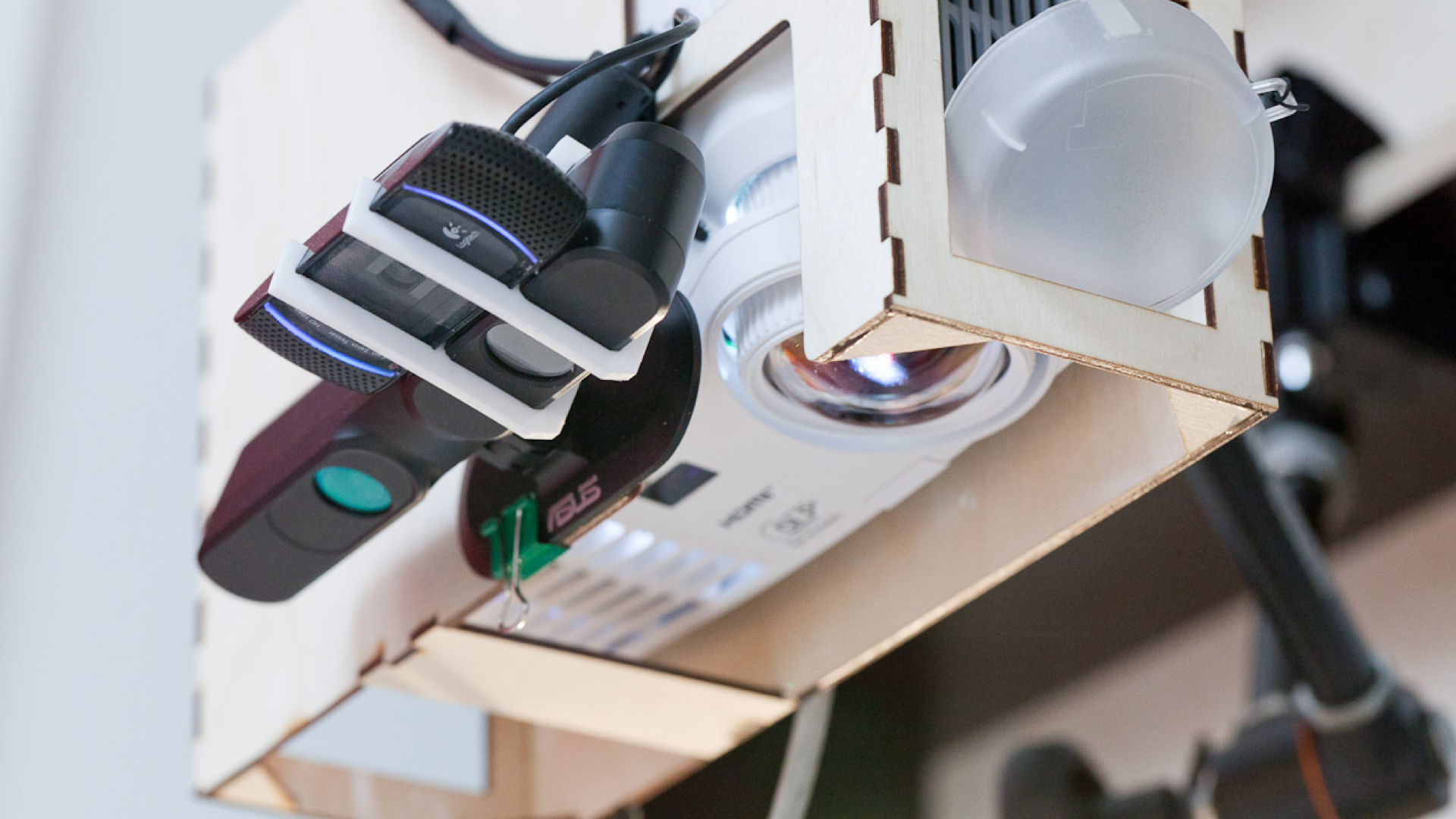
“Lamps” was a very material-exploration heavy project for Google Creative Lab in 2010. It was early days for the commoditisation of computer vision, and also about the time that Google Glass was announced. We pushed this work to see what it would be like to have computer vision in the world *with you* as an actor rather than privatised behind glasses.
Slide 15: Smart Light
The premise was instead of computer vision reporting back to a personal UI, it would act in the world as a kind of projected ‘smart light’, that would have agency based on your commands.
Slide 16: Build your own ARKit, too early
To make these experiments we had to build a rig. An example here of how the pace-layers of past design work get short-circuited. Here’s our painstaking 2010, 10x the size, cost, pain DIY version of ARKit… which would come along only a few years later.
This final piece takes the smart light idea to a ‘speculative design’ conclusion. What if we made very dumb interactive blocks that were animated with ‘smart light’ computation from the cloud… There’s a little bit of a critical thought in here, but mainly we loved how strange and beautiful this could look!
Slide 18: Schooloscope
We also treated data as a material for exploration. One of the projects I’m always proudest of was Schooloscope in 2009 (one of the first BERG studio projects for Channel4 in the UK) – led by Matt Webb, Matt Brown and Tom Armitage which did a fantastic job of reframing contentious school performance data from a cold emphasis on academic performance to a much more accessible and holistic presentation of a school for parents (and kids) to access. Each school’s performance data creates an avatar based on our predisposition to interpret facial expression (after Chernoff)
Slide 19: Suwappu
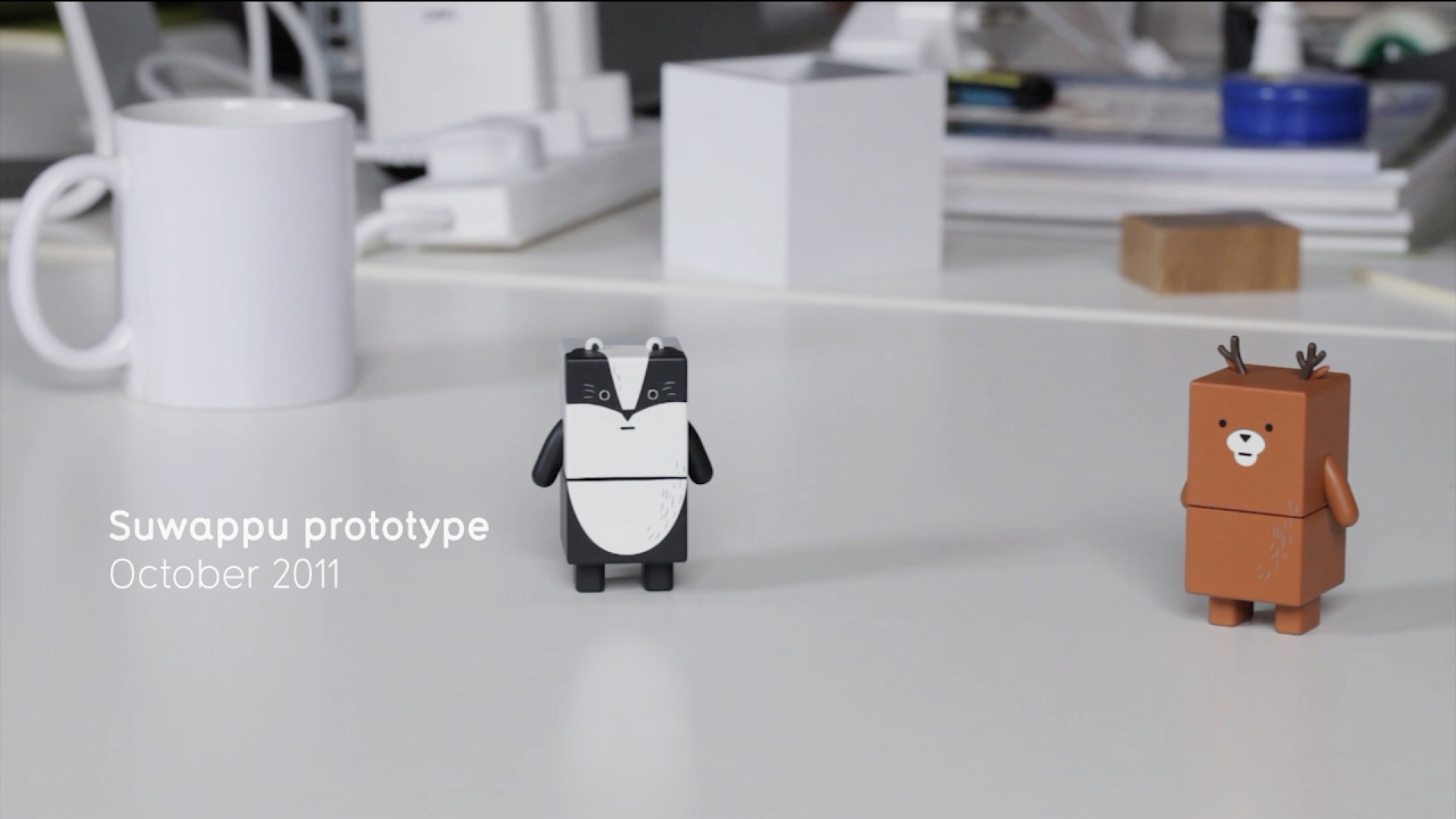
Another example of play – Suwappu was an exploration for a toy/media franchise for Dentsu. Each toy has an AR environment coded to it, and weekly updates to the the storylines and interactions between them was envisaged. Again a metaverse in… reverse?
Slide 20: Cars for Intel
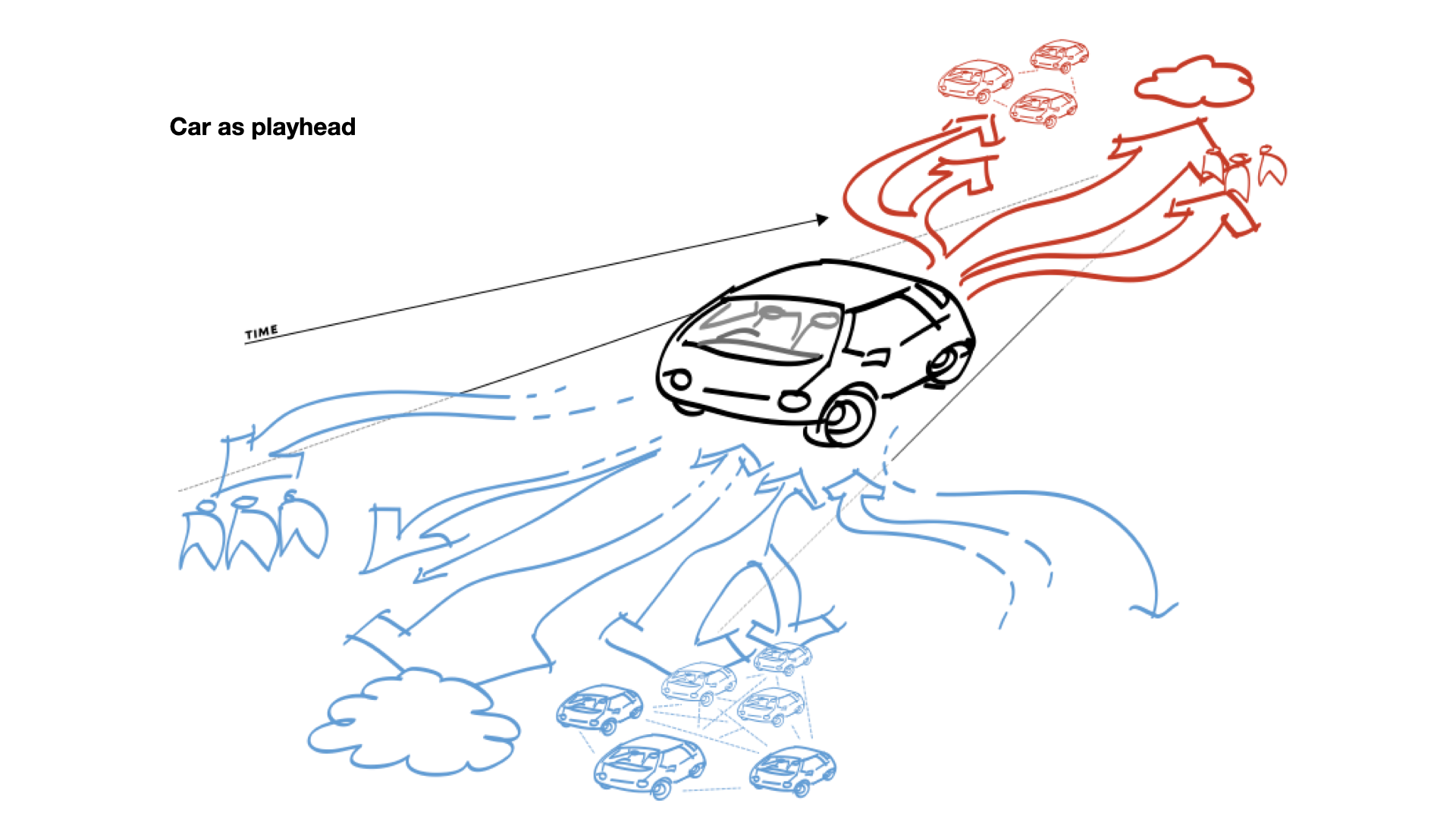
A lot of the studio work we couldn’t talk about publicly or release. I don’t think I’ve ever shown this before for instance, which was work we did for Intel looking at the ‘connected car’ and how it might relate to digital technology in cities and people’s pockets.
Slide 21: Car as playhead in the city – video proto
A lot of it was video prototyping work – provocations and anticipated directions that Intel’s advance design group could show to device and car manufacturers alike – to sell chips!
Slide 22: Light-painting interaction surfaces in cars
We deployed our usual bag of tools here – and came up with some interesting speculations – for instance thinking about the whole car as interface in response to the emerging trend of the time of larger and larger touchscreen UI in the car (which I still think is dangerous/wrong!!!)
Intel cars: video proto of smart light car diagnostics – watch here
Here’s another example of smart light – computer vision and projection in one product: an inspection lamp that makes the inscrutable workings of the modern car legible to the owner.
Slide 24: manifesto
Something we wrote as part of a talk back then.
I guess we were metaverse-averse before there was a metaverse (there still isn’t a metaverse)
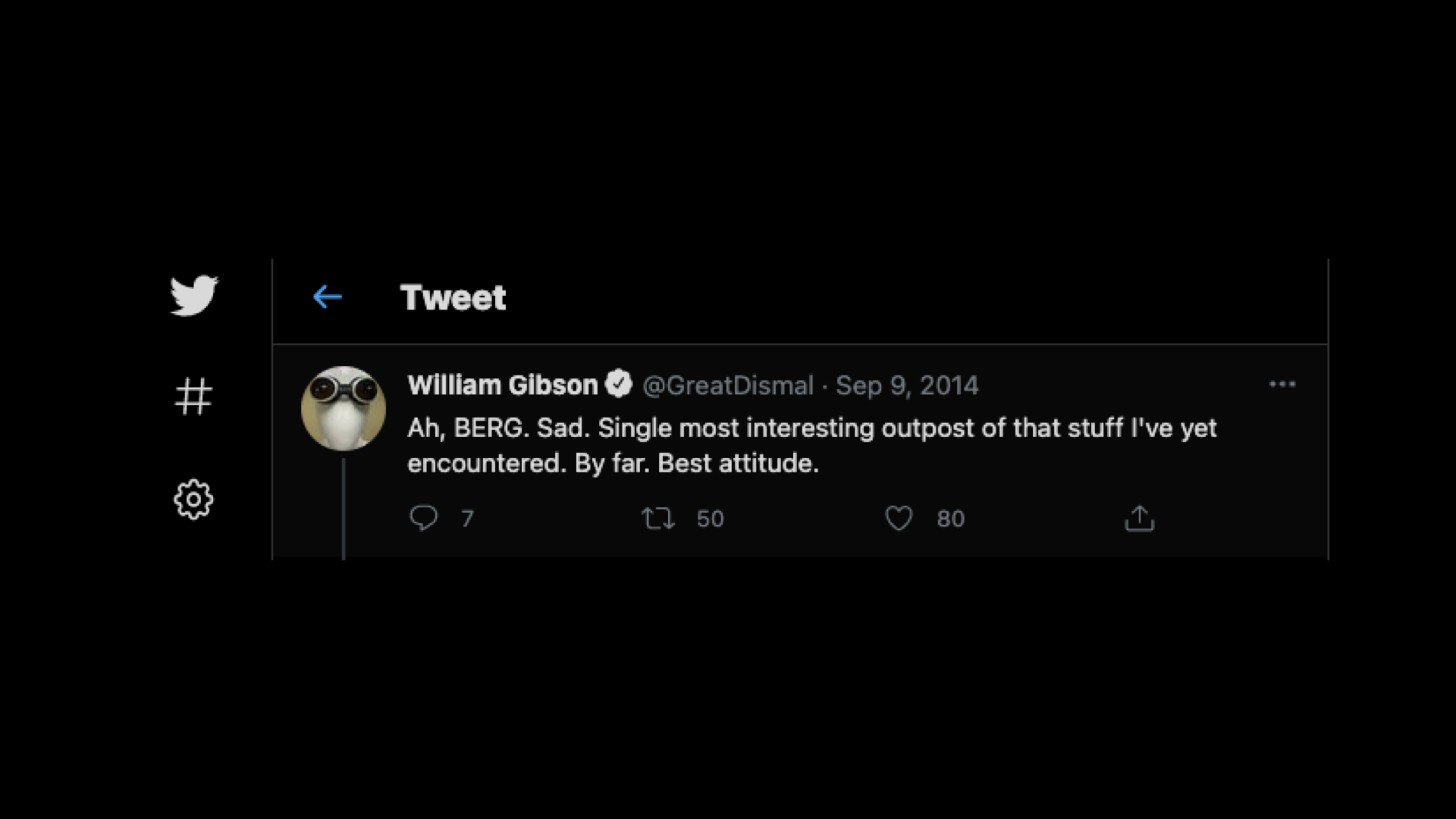
Slide 25: William Gibson’s obituary for BERG
I left BERG in 2013 – it stopped doing consulting and for a year it continued more focussed on it’s IoT product platform ‘bergcloud’ and Little Printer product.
In 2014 it shut up shop, which was marked by some nice things like this from William Gibson. Everyone went on to great things! Apple, Microsoft – and starting innovative games studio Playdeo for instance. In my case, I went to work for Google…
Slide 26: Google career vs Moore’s Law
So in 2013 I moved to NYC and started to work for Google Creative Lab – whom I’d first met working on the Lamps project. There I did a ton of concept and product design work which will never see the light of day (unfortunately) but also worked on a couple of things that made it out into the world.
Slide 27: Google Creative Lab: A Spacecraft for all
Creative Lab was part of the marketing wing of Google rather than the engineering group – so we worked often on pieces that showed off new products or tech – and also connected to (hopefully) worthy projects out in the world.
This piece called Spacecraft For All was a kind of interactive documentary of a group looking to salvage and repurpose a late 1970s NASA probe into an open-access platform for citizen science.
Slide 28: Google Creative Lab: A Spacecraft for all
It also got to show off how Chrome could combine video and webGL in what we thought was a really exciting way to explain stuff.
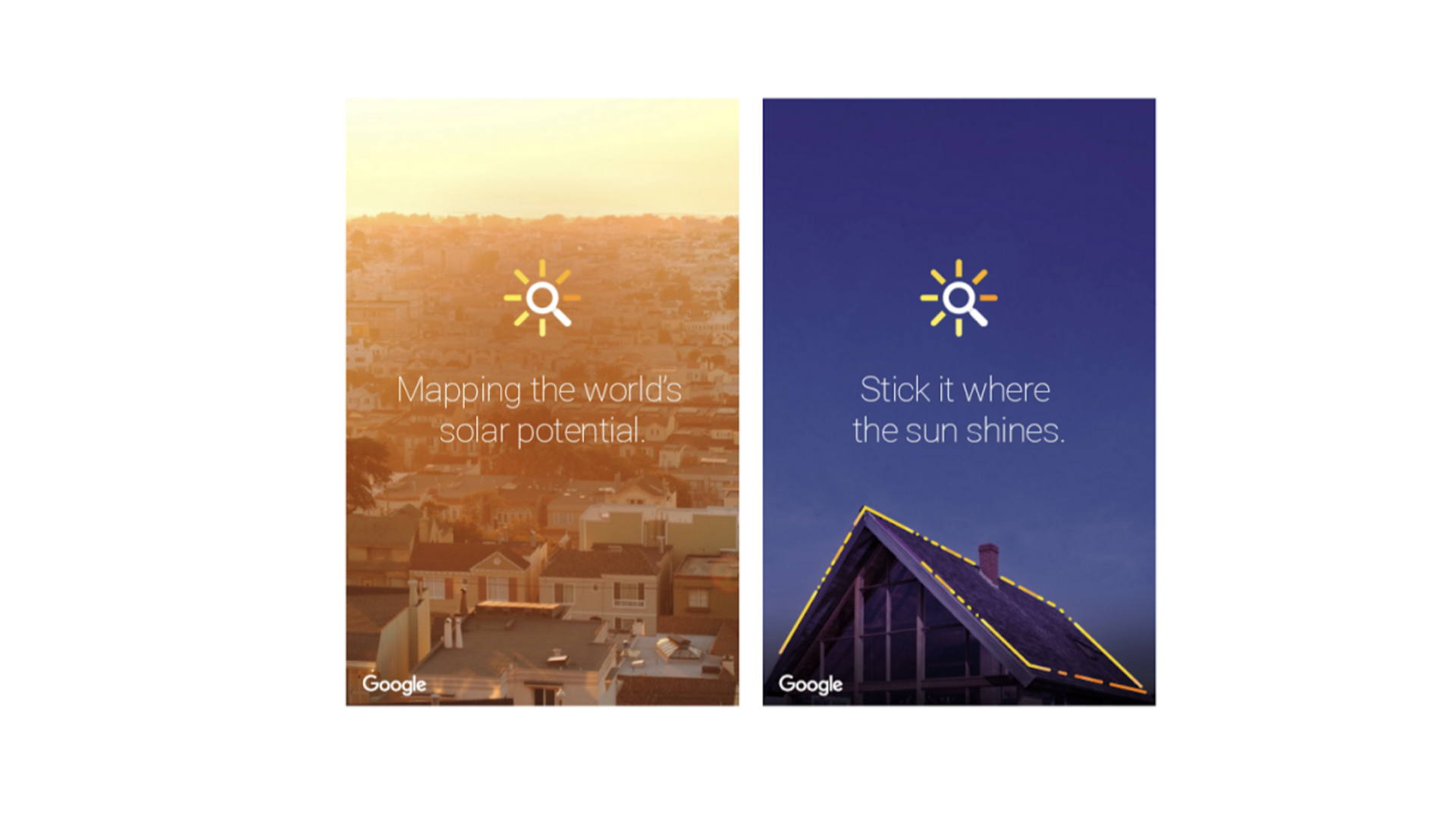
Slide 29: Project Sunroof
Another project I’m still pretty proud of from this period is Project Sunroof – a tool conceived of by google engineers working on search and maps to calculate the solar potential of a roof, and then connect people to solar installers.
Slide 30: Project Sunroof
We worked on the branding, interface and marketing of the service, which still exists in the USA. There were a number of other energy initiatives I worked on inside Google at the time – which was a much more curious (and hubristic!) entity back in the Larry/Sergey days – for good and for ill.
Slide 31: Google Clips – On-device AI
One last project from Google – by this time (2016) I’d moved from Creative Lab to Google Research, working with a group that was pioneering techniques for on-device AI. Moving the machine learning models and operations to a device gives great advantages in privacy and performance – but perhaps most notably in energy use. If you process things ‘where the action is’ rather than firing up a radio to send information back and forth from the cloud, then you save a bunch of battery power…
Clips is a little autonomous camera that has no viewfinder but is trained out of the box to recognise what humans generally like to take pictures of so you can be in the action. The ‘shutter’ button is just that – but also a ‘voting’ button – training the device on what YOU want pictures of.
Along with Clips, the ‘now playing’ audio recognition, many camera features in pixel phones and local voice recognition all came from this group. I thought of these ML-powered features not as the ‘brain-centered’ AI we think of from popular culture but more like the distributed, embodied neurons we have in our knees, stomach etc.
Slide 32: joining Moixa
At the beginning of this year I left Google and went to work for Moixa. Moixa is a energy tech company that builds HW and SW to help move humanity to 100% clean energy. More about them later!
Slide 34: Fear, greed, despair and hope in climate tech
I’ve been thinking a lot – both prior to and since joining Moixa about design’s role in helping with the transition to clean energy. And I think something that Matt Webb often talked about back in BERG days about product invention has some relevance.
And we all love a 2×2, right?
He related this story that he in turn had heard (sorry I don’t have a great scholarly citation here) about there being 4 types of product: Fear, Despair, Hope and Greed products.
Fear products are things you buy to stop terrible things happening, Despair product you have to buy – energy, toilet paper… Greed products might get you and advantage in life, or make you richer somehow (investments, MBAs…) but Hope products speak to something aspirational in us.
What might this be for energy?
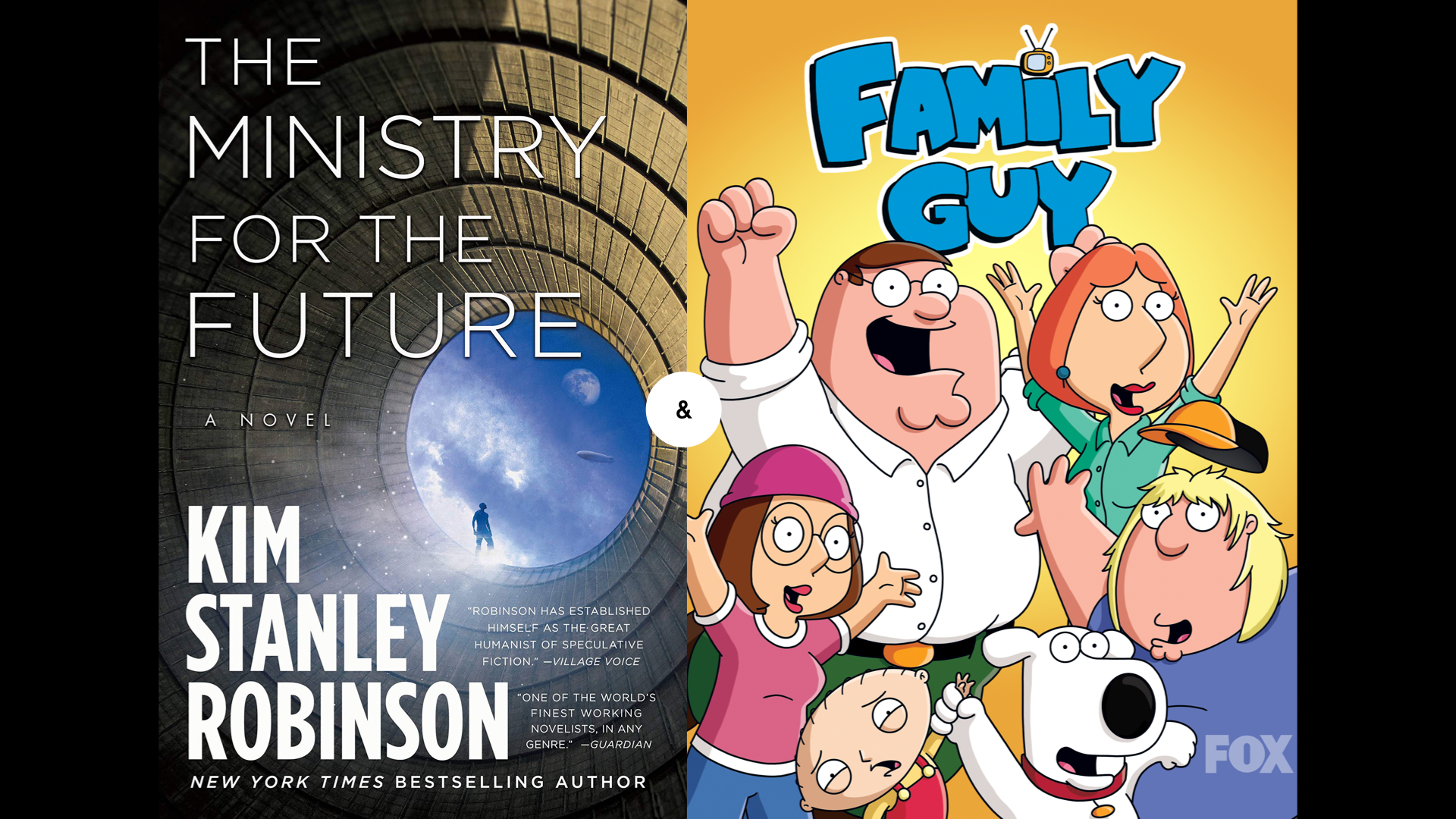
Slide 35: Ministry for the future & Family Guy
You probably thought I was going to reference The ministry for the Future by KSR, but hopefully I surprised you with Family Guy! It’s creator, Seth Macfarlane went on to create the optimistic, love-letter to Star Trek called “The Orville” and has this to say:
“Dystopia is good for drama because you’re starting with a conflict: your villain is the world. Writers on “Star Trek: The Next Generation” found it very difficult to work within the confines of a world where everything was going right. They objected to it. But I think that audiences loved it. They liked to see people who got along, and who lived in a world that was a blueprint for what we might achieve, rather than a warning of what might happen to us.” – I think we can say the same for the work of design.
Slide 36: KSR – Anti-Anti-Utopia
I’m going to read this quote from Kim Stanley Robinson. It’s long but hopefully worth it.
“It’s important to remember that utopia and dystopia aren’t the only terms here. You need to use the Greimas rectangle and see that utopia has an opposite, dystopia, and also a contrary, the anti-utopia. For every concept there is both a not-concept and an anti-concept. So utopia is the idea that the political order could be run better. Dystopia is the not, being the idea that the political order could get worse. Anti-utopias are the anti, saying that the idea of utopia itself is wrong and bad, and that any attempt to try to make things better is sure to wind up making things worse, creating an intended or unintended totalitarian state, or some other such political disaster. 1984 and Brave New World are frequently cited examples of these positions. In 1984 the government is actively trying to make citizens miserable; in Brave New World, the government was first trying to make its citizens happy, but this backfired. … it is important to oppose political attacks on the idea of utopia, as these are usually reactionary statements on the behalf of the currently powerful, those who enjoy a poorly-hidden utopia-for-the-few alongside a dystopia-for-the-many. This observation provides the fourth term of the Greimas rectangle, often mysterious, but in this case perfectly clear: one must be anti-anti-utopian.”
Slide 37: Dear Alice for Chobani by The Line
I’ve been reading a lot of solar punk lately in search of such utopias. But – The absolute best vision of a desirable future I have seen in recent years has not come form a tech company, or a government – but a Yoghurt maker. This is the design of the future as a hope product.
“We worked closely with Chobani to realise their vision of a world worth fighting for. It’s not a perfect utopia, but a version of a future we can all reach if we just decide to put in the work. We love the aspiration in Chobani’s vision of the future and hope it will sow the seeds of optimism and feed our imagination for what the future could be. It’s a vision we can totally get behind. We couldn’t be more happy to be part of this campaign.” – The Line
Slide 38: Goal is not ‘sustainabilty’. Goal is to get to Type 1 Kardashev
In 1964 a physicist named Nikolai Kardashev proposed a speculative scale or typology of civilisations, based on their ability to harness energy.
Humans are currently at around .7 on the scale.
A Type I civilization is usually defined as one that can harness all the energy that reaches its home planet from its parent star (for Earth, this value is around 2×10^17 watts), which is about four orders of magnitude higher than the amount presently attained on Earth, with energy consumption at ≈2×10^13 watts as of 2020.
So, four orders of magnitude more energy is possible just from the solar potential of Earth.
A Type 1 future could be glorious. A protopia.
Slide 39: Moixa
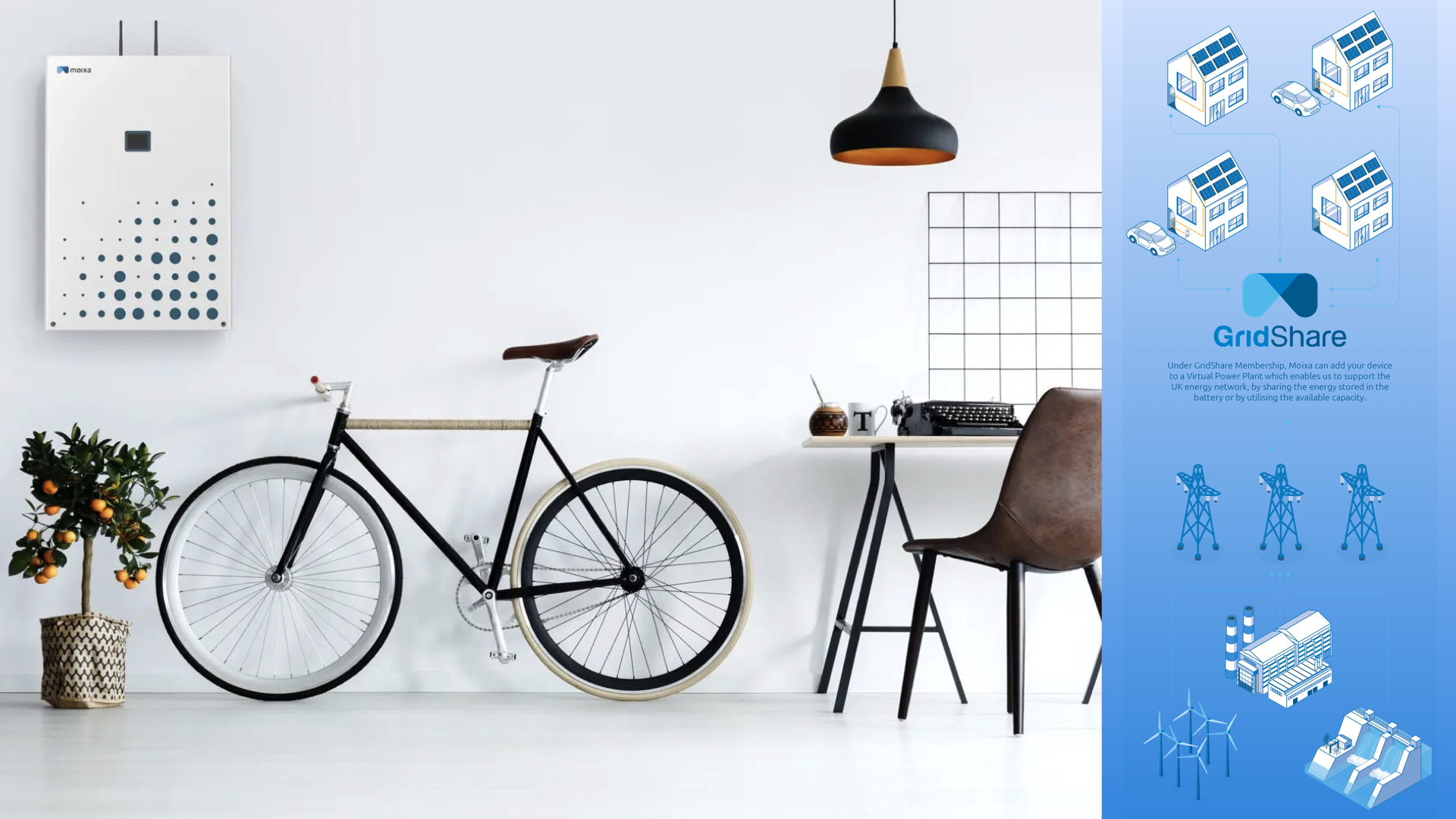
At Moixa we make something that we hope is a building block of something like this – solar energy storage batteries that can be networked together with software to create virtual power plants, that can replace fossil fuels. It’s one part of our mission to create 100% electric homes this decade.
The home is a place where design and desire become important for change. I hope we can make energy transition in the home something that is aspirational and accessible with good design.
Slide 40: Saul Griffith’s Electrify
I’ve also been very inspired by Saul Griffith’s book “Electrify” – please go read it at once! It points out a ton of design and product opportunity over the coming decade to move to clean, electric-powered lives.
As he says:
“I think our failure on fixing climate change is just a rhetorical failure of imagination. We haven’t been able to convince ourselves that it’s going to be great. It’s going to be great.”
– Saul Griffith
Slide 41: New manifesto!
I’ll finish with a couple more quotes:
“If we can make it through the second half of this century, there’s a very good chance that what we’ll end up with is a really wonderful world”
Jamais Cascio
“An adequate life provided for all living beings is something the planet can still do; it has sufficient resources, and the sun provides enough energy. There is a sufficiency, in other words; adequacy for all is not physically impossible. It won’t be easy to arrange, obviously, because it would be a total civilizational project, involving technologies, systems, and power dynamics; but it is possible. This description of the situation may not remain true for too many more years, but while it does, since we can create a sustainable civilization, we should. If dystopia helps to scare us into working harder on that project, which maybe it does, then fine: dystopia. But always in service to the main project, which is utopia.”
Was interviewed recently by Anastasiia Mozghova for Google ATAP’s twitter feed, where it’s being published as a thread in two parts (part one here).
It centred around ambient computing and work I’ve been involved in around that subject in the past – particularly looking at notions of ‘social grace’ in computing.
This was a concept we discussed a lot in relation to Soli, the radar sensor that Google ATAP invented. I was involved in that project a little at Creative Lab, then more peripherally still (as kind of a cheerleader if anything) at Google Research.
That concept of social grace, for me, begins in the writing of Mark Weiser and continues amplified in Adam Greenfield‘s “Everywhere” – which still has some very relevant nuggets in it, IMHO, for a book on technology written in 2006 (16 years ago at time of writing!)
I also mention another classic – which is fast coming up on it’s 20th anniversary (next year?) – Bruce Sterling’s Shaping Things.
Its eco-centric vision of ‘spimes‘ rhymes (sorry) with the current hype around web3, tokenisation, etc etc – but while that is obsessed with financialisation, Shaping Things instead hints at using data sousveillance means toward resource responsibility, circularity and accountability ends in design and manufacture.
It gets a little mention here in a long article about Google’s newly opened Bayview building.
Called ‘Bottom-Up Grid’ or ‘BUG’ it aimed to make electricity infrastructure more like the internet – able to flexibly store, route and reroute power, making it far easier for renewables to scale.
I’m making it up as I go along (which is what design is, remember?), with an awesome gang of talented people: creating speculative designs, dynamic simulations and infoviz, physical models, science-fair-like exhibitions to convince important people in nondescript buildings in mountain view.
Wait.
HOLYCRAPHOLYCRAP THAT’S LARRY PAGE. MAYBE WE *CAN* REMAKE THE ELECTRICITY GRID FOR THE 21stC!!!!!
He asks the very, very smart team we’re working with lots of questions including… how you might be able to cook pasta more quickly with high voltage.
Hoookay.
But he gives it the nod.
The project continues for a while… until it gets a smaller focus, becomes a pilot internally, quietly sunsets. I went on with the wonderful Creative Lab teams to do many similar fantastic projects with Google Access & Energy which – sadly no longer exists now that we really need it…
Late 2021: I’ve been back in London for about 5 years, working in Google Research and having a lot of fun with a bunch of studios – imagining what an alternate decentralised Google might be in future with private, personal AI for everyone – but BUG still… bugs me…
I’d installed a solar & battery system to my home in 2018 from a UK startup called Moixa.
It was the nearest thing to BUG I could find on the market: harvesting what energy you can from the UK sunshine (!), then storing it in a battery and sharing using innovative networking software…
And then… I saw they were hiring for a Principal Designer.
So… I figured I needed to go for it.
At Moixa we make something that we hope is a building block of something like this – solar energy storage batteries that can be networked together with software to create virtual power plants, that can replace fossil fuels.
It’s one part of our mission to create 100% electric homes this decade.
The home is a place where design and desire become important for creating change and impact in the climate fight.
I hope we can make energy transition in the home something that is aspirational and accessible with good design.
The last four Tuesday evenings have been for learning and messing about in Unity3D, as part of an excellent online Intro to Unity3d course from City Lit and taught by the knowledgeable (and patient) Rich Cochrane.
It’s been enormously enjoyable – and great to learn a new tool / learn in general. Although as fun as making my final sketch above futzing about with skyboxes, particle systems and physics was – I certainly won’t be giving Tobias Revell anything to worry about any time soon!
About a month ago, I woke up and decided I wasn’t getting any value out of using Twitter.
In fact I was getting negative value – it just made me angry, upset and stressed out.
So I stopped using it and deleted my account.
I was user number 821… I joined back in 2006 and it was a lot of fun for a lot of the twelve years I used it, but then it really, really wasn’t. So far, I don’t miss it that much.
The venerable flirble organization is no more, which means that the machines that hosted my Blackbeltjones.com domain from around 1999 are no more. Which means that if you’ve been trying to get hold of me (unlikely I know) through email to that address, you haven’t been. Please use Matt [at] moleitau [dot] com if you want to drop me a line from now on.




















 Petafloptimism