Cognitive Design Congress, Lubeck: Day 2: Prof. Loe Feijs

Another interesting talk, on semiotics, product and experience design:

The structure of product semantics
Prof. Loe Feijs
Technical Uni Eindhoven

was in phillips research labs for 17yrs
involved in embedded systems / software
then Industrial Design research

functions: usability, performance
meanings: implicit messages
aesthetics: beauty, balance

more soft concepts than he was used to!

got intrigued by the idea of products having meaning

gets more important when enter a world of ‘ambient intelligence’ or ubicomp whatever you want to call it

implications for semantics:

beahviour: embedded software
dialog: 2 way meaning
complexity: mediation, abundant data, programmed behaviour

progress of product design over time:
design for
beginning – craftsmanship
industrial rev – mass manufacturing
(electronics =) formless functions
telecommuication
now / next – programmed behaviour

computing science and semantics

syntactics, semantic domains and equations…

product semantics: tried to find a theoretic frame work from semiotics and CS semantic theory

symbol: must be learned
icon: resembles hting it stands for
index: imprint or physical connection (smoke is a sign of fire footprints in the sand sign of movement)

mechanism of sign production (eco)
ratio facilis: reusing existing sign
ratio difficils: creating a new sign

tried to apply CS structures: ‘meaning functions’

m(sign)= x

Eco calls it ‘s-code’

not clear in product … need multiple meaning functions
too complex to say what is a car mean
can perhaps say what is a car optimsed for (space, speed, comfort)

interaction meanings – see work by djajadiningrat (affordances?)
fritihjof meinel – deconstructing design meaning in furntiture
meaning at individual level (materials, form)
meaning at system level (stackable chair systems form, lightweight etc)

“every product is a medium”

meaning functions become very interesting and powerful in the role of how a product mediates

triangular joints = strong
= part of a system

prof burdeck of offenbach – product language is becoming the kernel of design

not everyone agrees:
stappers ,delft: product semantics is stale…

Work of richard appleby –

examples from design history conveying ideas through product design… e.g. streamlining of steam engines/futurism, reitvelt/de stijl -purity, duchamp – importance of context, found objects/reuse in products , memphis style, alessi, stark squeezer – non functional form

linguists and semioticians

lanaguage is a system – meaning of the sign is in the difference to the alternatives (saussure)
wittgenstein – language gains meaning socially
chomsky – innate language rules
gibson – meaning of object lies in the world – perception is through action in the world
eco – a design system should be able to lie
mcluhan – medium has social impacts, extension of the senses – embodied
ovebaker – all the senses and emotions are involved
samuels – semiotic pollution
baudrillard – the nature of the real

gave all this to students and said – design a chair / telephone!

students responded well! e.g. the ‘semiotic pollution chair’, seesaw chair

combinatory chair – made of tetris block – illustrating chomsky’s theories of combinatiral primatives and rules that grow language – blocks that fit together to ‘grow’ a chair. (very cool)

icons, indexes and symbols that combine in the form/behaviour of the product

education: “4d sketching” : asking students to express behaviours, emotions through time
using microprocessors, etc to sketch behaviours in objects
e.g. Dolly (love) by Jan Hoefnagels: embodies sweetness / generosity in it’s movements to deliver the user a walnut…

not good enough to animate it on computer – believe we need to prototype it and make it real – it’s important to hear the noise of the servo motors!!!

knowledge types necessary: a lattice diagram (seems reminiscent of Irene McCara-Williams “10d” model which she presented at 2002 doors?)

0 to many

with 0 people there is still logic, maths, philosophy
1 person: human factors, psychology, material, embedded systems
>1 sociology, ehthography, politics

one product: ergonomics, perception ,HCI
many products: Manufacturing, distributed software

1 person, many products: feature interaction product interaction ,semitotic pollution ,telecomms, shared resource
many people, many products: everything + economics…

fractal structure of the knowledge necessary to create success

what is the postmodern engineer?

“we try and address in educaton and research those topics that bring the digital and the physical together”
the virtual and the real – create a rich environment

Some upcoming related events:

DPPI: designing pleasurable producst and interfaces, eindhoven 24-27th october
DESFORM: newcastle, UK: november 11th – design and semantics of form and movement

Cognitive Design Congress: Day 2: August de los Reyes of Microsoft

August gave a great talk covering branding, cognitive models and their influence on the future form factors of the PC:

Keynote
The future of the PC
August de los Reyes
User Experience Manager, Microsoft

Windows hardware innovation and emerging markets – hardware features that afford new functionality (“new affordances”)

(shows BBC3 clip of the ipod butcher’s shop – from “2004 the stupid version”)

(shows clip of steve jobs dissing microsoft: “the problem with microsoft is they have no taste – and i don’t mean that in a small way, i mean that in a big way”)

msft misconceptions:

first reaction he gets when he says what he does: ‘there are designers at microsoft?’

from 3 designers who only designed icons, to 600 designers and usability people at microsoft today

77 open positions atm!

we don’t eat children or kill puppies or kittens

we’re not the borg

sometimes I wish we were – the borg ships are such a beautiful simple modernist expression…

shows picture of the homermobile instead…

we don’t get fired for using ipods.

one thing unites us, which is we are all passionate about technology

creative lead – visual design, branding

previously: msn – redesigns of homepage, my msn, msn search

Windows hardware innovation and emerging markets – hardware features that afford new functionality (“new affordances”)

design references… his boss came up with the scroll wheel

other mission: emerging markets: BRIC

reason why they are put together – the two extremes of the bell-curve, the role of hardware becomes increasingly important to the user-experience at both ends

semiotics systems of branding and symbols in the visual design of the products

assignment: “change perception of the windows PC – POSITIVELY!”

an emotional deficit with the PC

‘performance and quality are not enough’ – don norman / clayton christianson chart

raise the bar – so that user expectations and experience are excellent

if you only improve the engine in a car, don’t raise the perceived value. need to raise the user experience and brand experience to match

MSFT – some interesting structural challenges: August recently had lunch with the PM who manages the graphics for excel for pocket PCs – every feature has a program manager who is very passisonate about their feature. Can be challenging to maintain a holistic user experience – hence the picture of the Homermobile.

transforming PC to:

experience facilitator
people center
with you
life relevancy

need to change the form factor, so it doesn’t reminder people of work when they are at home.

worked in amsterdam for philips

phillips – most trusted european brand? (colleague stated this – he can’t back it up…)

was in ‘brand articulation team’

got into branding by accident – commuted everyday from amsterdam to eindhoven (4hours a day – read books on branding!)

marty niemeyer

brand is not a logo, corporate identity, product

it is a gut reaction

emotional, intuitive, non-rational, individual

if a company thinks they can control a brand they ar esorely mistaken – it’s in the perceptions of the beholder.

branding is hot because there is too much choice… not much differentiation around features and benefits

we buy on trust – gut reactions….

evolution of brands:
commodities – industrial revolution – trademarks (garanteur of quality) – post war boom of choice – post war birth of ‘aspiration’ – assocaiting product with related ideas – endorsement by association lifestyle or celebrity ‘donna reed kodak ads: buy this film to be a good mom’

from N. Klein’s ‘no logo’ : william morris bought Kraft for 12bn USD – paper valuation of assets was 2bn… then a boom in branding and advertising… when ‘nontangible assets’ were realised to be so valuable

then ‘malboro friday’ they cut they prices 20% to compete with generic cigarrettes -sent shoicking message to the markets that brand doesn’t matter, as malboro was the longest branding acitivity in the world…

two camps emerged: those who resigned to the commodification of their brands and another which August thinks emerged victorious – who emphasised brand experience.

all in the second camp have strong cutlures and experience centred – e.g. starbucks – eevrything has it’s own language ‘baristas’, ‘venti’ -have strong symbols – to the extent that people tattoo themselves with them (sigils!)

tommy hilfiger – is in the business of signing its name on other people’s designed and manufuctured products, implies the product is incidental…

experience adds value.

brand as belief has generated many theories – (refs red herring article with tens of definitions)

ideas like emotional value are not based on robust models…. lots of theories which are like folklore…

cogntive theory and brand

a brand is a type of mental model, representation

mental models have two aspects

coding: how we attain info
mapping: how we bring it to context

coding: sensory impressions, propositional framework – acts like a function – an ontology…
mapping: metaphor, metanym

metanym is key: where a part of something is used to represent the whole thing

in the aspirational age, branding was very metaphorical and aspirations: buy this film to be a good mom
in the experiential age: direct experience not proposition: e.g. BMW driving school – drive it on the race track for aday, then asked if you want to buy it

next, the transformative age:

1. buying something is a way of participating in a brand
2. people buy based on symbolic cues
3. symbols born out of experience have the greatest impact
4. experience that transform strengthn the power of symbols
5. an example of transformation is learning (e.g. go to a wine store that teaches you about tasting wine)

shows slides of playstation button symbols: metanym of playstation -very powerful experienced symbols…

shows sony clip ‘germidol’ – according to sony, only 3% of the audience see the playstation symbols in the advert – created viral buzz.. .the 3% were keen to explain to others…

another brand base on metanym: ipod shuffle… the crossed/twisted arrow shuffle feature icon from itunes… used to build an entirely new brand.

ok -back to our problem: changing the perception of the PC…

first thing August looked at was the software itself… Vista has 60 designers working on it.

metonymic translation into physical envirnoments – drew out all of the design descions that went into creating windows vista… tried to do metanymic translations into physical design…

do apple do it the other way round? i.e. start from the industrial deisgn… end up with brushed metal UI…

microsoft cant do that for obvious reasons!

shows MSFT scenario clip – home use… digitla home, digital family… lots of inidvidual and shared tablets, shared displays – big screen: windows home concept – with HP – no keyboards…. no mice… natural gestures…

Call it: Natural Computing

get cues from nature
the computing experience is metonymic to nature
camoflague – tech shoul harnes sits own power to integrate and disappear into environments
mold to the individual
universals like the golden mean and golden section
fibonacci

shows a picture of the ipod -it conforms to the fibbonacci boxes/golden section…!

monitors/TVs going to 16:9 – the golden section

resulting design trends:
restraint in the aethestic
elegant simplicity is sophisticated
serenity
when technology is brought into the home, they remind you of home – want technology to be in context of home….

end: shows startsomethingpc.com design comeptition promotional video – closing date is in 2 weeks…

Cognitive Design Congress, Lubeck: Day One:

Notes from the morning of day one of the congress. I didn’t manage to take notes in the afternoon as I was speaking.

Cathal McKee
Founder and creative director of CMK, Amsterdam
(was CD of Lostboys)

advertising everywhere

wwww.advertisingeverywhere.com

explosion of new ways to communicate
driven by technology

integrated media, integrated media
brands need to be more effective in this massive range of media…

return to look at communication/information theory (sender – media – receiver – feedback)

sender
message
medium
reciver
response
feedback interaction

all the above are being changed by media technology

ambient media

gave everyone at Lostboys a bike – covered in branding, to ride around amsterdam on…
gave 50 bikes to barcelona office… it’s too dangerous to ride the bikes here… so just chain them up… but they’ll be stolen… Great!!!

Blow-up children in the road to raise awareness of dangerous driving through a dutch town

personal media and branding

why is someone putitng themselves on ebay to get tattooed with the brand of the highest bidder any different from david beckham wearing a logo?
lance armstrong / “LIVESTRONG” wristbands

nuns in amsterdam asked an ad agency to sponsor warm clothing for the homeless… with ad campaigns on the back of them, which the nuns then gave out…

LED belt buckle

modern version of someone with boards on their chest saying ‘the end is nigh’?

digital media

blurring of commercial boundaries… internet forces transparency

mass amateurisation of advertising – converse are inviting people to make adverts for them which if they like them, they will put on MTV

new ideas
mailshot of “10% off”, “20% off” stickers from a store in holland… allowed to wander around the store and stick them on whatever you want to take to the checkout for the corresponding discount.

nike ID – mass customisation

in-game advertising…

augmented reality gaming

Nokia’s 20lives…

products that give continuous advertising
examples by Gro Design

anti-advertising products: tv be gone

question

is advertising dead? in the sense that candles are dead after the invention of the lightbulb… however you now spend far more on a candle than a light bulb… effectively death de-commodified it…

—————-
Hermann Maurer

Technological Dreams and Nightmares
an outlook to the (near) future

pc of 2012a

no spinning harddrive : massive solid state storage, no screen, no keyboard, no battery: fuel-cell or energy harvesting

eyeglasses delivering audio via bone-conduction
direct retina projection

changes how we use computers
input: speech, gesture, sensors/direction, brain activity

changes communication between people
rememberance agents… information retrieval during discussion

maybe this will empty our brains

from dawn of literacy: “he who learns to read and write, his mind will empty completely”

lost ability to remember, calculate, what next?

logical combination? thinking?

What will remain of us?

changing how we learn – we should look not at how elearning should be done… but WHAT learning should be done… what should be learnt, what should be retrieved from our powerful systems when necessary? (and again, what is lost?)

Changes humanity-

paper became an extension of our brain, now the PC and internet are also

what happens if there is catastrophic failure of these systems once we depend on them?

it is a miracle that a successful cyberattack has not happened. give a group of computer scientists 500m euros and the goal of shutting everything down, and they could do it.

interconnection of computer grid and power grid. a large, long power outage could stop the net.

if power fails for an extended period of time in an industrialised city, very quickly descends to a civil war situation

(his sf book ‘paranet’ describes worldwide breakdown of the net)

Some thoughts on how to avoid this:

need to support some forms of regionalisation in the face of overwhelming globalisation in order to foster redundancy against catastrophic failure of global networks (trade, energy, info)

“Balance or Destruction” by F.J. Radermacher
future increase in production is possible without further damage to environment – the growth must be distributed unevenly…

also – global marshall plan (google it)

Globalisation where necessary, reginalisation where reasonable

e.g. “asymmetric distance tax” based on GNP
increases stability through self-sufficiency
supports new redistribution of wealth
supports regionalisation and natural life
also holds for non-material aspects

globalisation is not just in material products – knowledge, media , information

more stability in networks / computers

radical apporach: give up john von neumann’s concept of computing – no distinction of data and programmes – no more bootstrapping
operating systems and basic software on chips. advantages – cannot be easily destroyed, more reliable.
would this improve the quality of software, as it’s more tnagible, and more costly to update?
write-once nature would challenge virus writers…

other approach – trusted computing approach

in a very globalised society we are very vunerable to breakdowns.

http://www.know-center.at
http://www.iicm.edu/Xperts

Team skills, the Rolling Stones way

Anecdote of the day, courtesy of the Guardian’s interview with Mick Jagger:

There was the time when, according to Watts, Jagger called him in the middle of the night, said “Where’s my drummer then?” and told him he was ready to record. Watts got out of bed, dressed himself – immaculate as ever, suit, tie, ironed shirt – walked downstairs to meet Jagger, pulled back his arm, swung his fist, and laid him out. “Don’t you ever call me your drummer,” he said. “You are my singer.”

Fantastic.

Guardian Finn Fest

Over the last few days The Guardian have flung themselves into Finland.

First, in the Guardian Review, an overview of Finnish popular literary action including Tove Jansson, creator of the Moomins:

“Tove Jansson wrote her last cult Moomin book for children in 1970, but lived till 2001. English-speakers were reminded of her later adult fiction by the reissue two years ago of her 1972 novel The Summer Book. Its publishers, Sort Of Books, are now working on a short story selection, and the novel Fair Play. In Jansson’s Helsinki penthouse studio-turned-museum, her niece, Sophia Jansson (the model for the six-year-old granddaughter in The Summer Book), tells me the elliptical fiction often explores relationships among artists, but leaves much unsaid. Tove grew up in a Bohemian household with a sculptor father and graphic artist mother, while her lifelong partner was the woman artist Tuulikka Pietilä. They spent time on the rocky islet in the Gulf of Finland where The Summer Book is set. And, says her niece, she still answered 2,000 fan letters a year by hand.”

Then, Monday saw Marimekko get the Grauniad once-over, highlighting the brand’s female-led work culture.

Some excerpts:

It is a proudly female company, run by women, for women, employing generations of women. From the moment you enter its low-rise building outside Helsinki, you know you are on female territory. The wide, open-plan interior is blindingly white in the late summer sun, devoid of the phallic statues that traditionally adorn business HQs, and its famous printed textiles – oversized geometric patterns in vibrant colours – hang down the walls…

…From its inception, Marimekko was in the hands of women. Even now, women occupy all the top positions. Founded in 1951 in Helsinki, it was initially intended to be a collaboration between textile designer Armi Ratia and her husband Viljo, who ran a small printing company. Legend has it that Ratia, as a woman, couldn’t get a bank loan, so it had to be done through her husband. But it was she who saw the potential for a designer-led textile house; she took charge and recruited Maija Isola, the first and most important of many young female designers, to create original prints: Marimekko was born…

The clothes were unconventional, informal, accessible to anyone – young or old, fat or thin. The name itself means “a dress for Mary” – ie the woman on the street. “Marimekko’s clothing in particular, with its clean unisex lines and free-flowing style, conveyed a utopian feel of sexual equality,” says Marianne Aav, director of the Design Museum in Finland. When Ratia was accused of peddling “sexless” clothes, she replied: “A woman is sexy, not a dress.”

…Paakkanen thrusts a sales chart into my hands. The graph shows a steady increase in sales from the 1950s to 1985, then the graph dips under the axis until 1991 when it skyrockets. Her two-inch painted talons jab at the dip: “During these years, men were in charge of Marimekko,” she laughs. “When I arrived in September 1991, it was like the end of the world; there was low morale, dirty windows, a broken building. The first thing we did was clean the windows…

…No one was surprised a woman was running Marimekko again. “I got flowers and faxes when I took over. People hoped I would take the company back to how it was when Armi Ratia was in charge,” Paakkanen says. She believes women have better business heads. “Men in business start at the top, they create positions for themselves then work down. Women work from the bottom up, and value their workers.”

…Isola’s daughter, Kristina Isola, who works at Marimekko, agrees. “If ‘feminist’ in business means women can take care of affairs themselves, then yes, Marimekko is a feminist company,” she says. “We don’t have to lean on men. Marimekko’s success has much to do with the fact it is a woman’s company: we’re practical, we don’t waste, we can do many things at the same time, we’re less nervous about our positions, we express our feelings better.”

Go Finland!

Outage

First the server that my mail and site live on gave up the ghost, then so did I. The mail is back, but I’m still sick so apologies for even-more-tardy-than-usual-reponse-rate to email.

IA Summit and the IA of personal mobile devices.


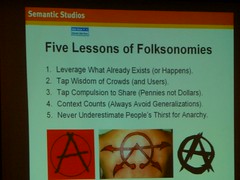
5 Lessons
Originally uploaded by emalone.

The wireframing power-elite are gathered in Montreal, and reading the flickr-tea-leaves leads one to believe a lot of fun and a lot of discussion of hot issues such as ‘folksonomies’ has occured.

Was also interested in what Jeff Veen posted about companies exposing support material and manuals on the web and the influence on purchasing decisions.

Not sure whether there was a lot of discussion about mobile devices.

I know from chatting at DesignEngaged that Thomas Vanderwal is obsessing on them at the moment between inventing buzzwords that get publsihed in sunday newspapers.

The IA of personal devices as they incorporate multi-gigabyte mass-storage of personal and paid-for content is a huge design challenge and opportunity.

Anyone who was there in Montreal – Is it getting any collegial thought in the IA-sphere?