
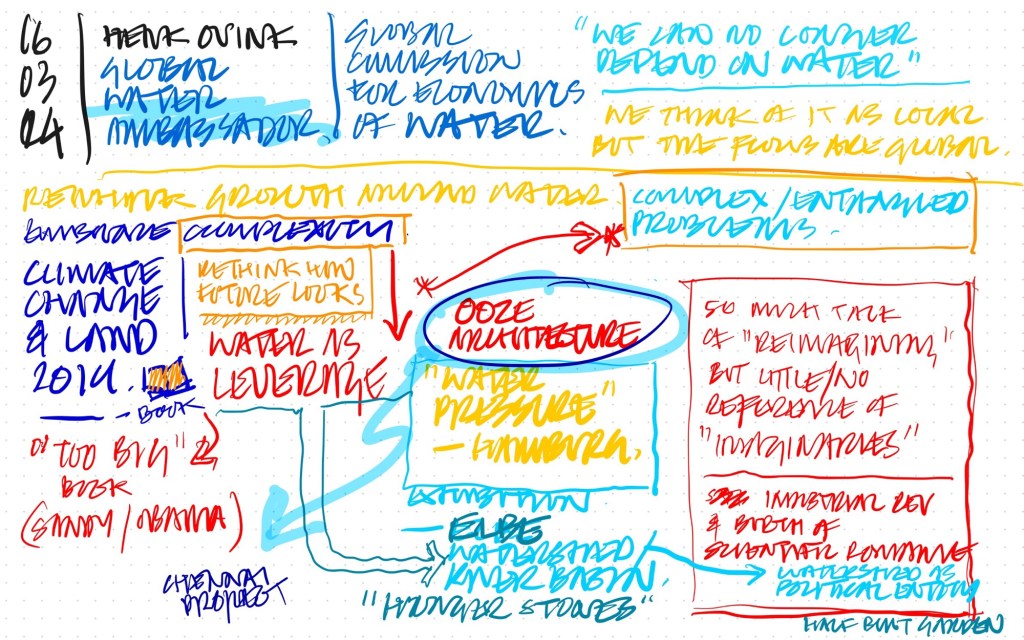


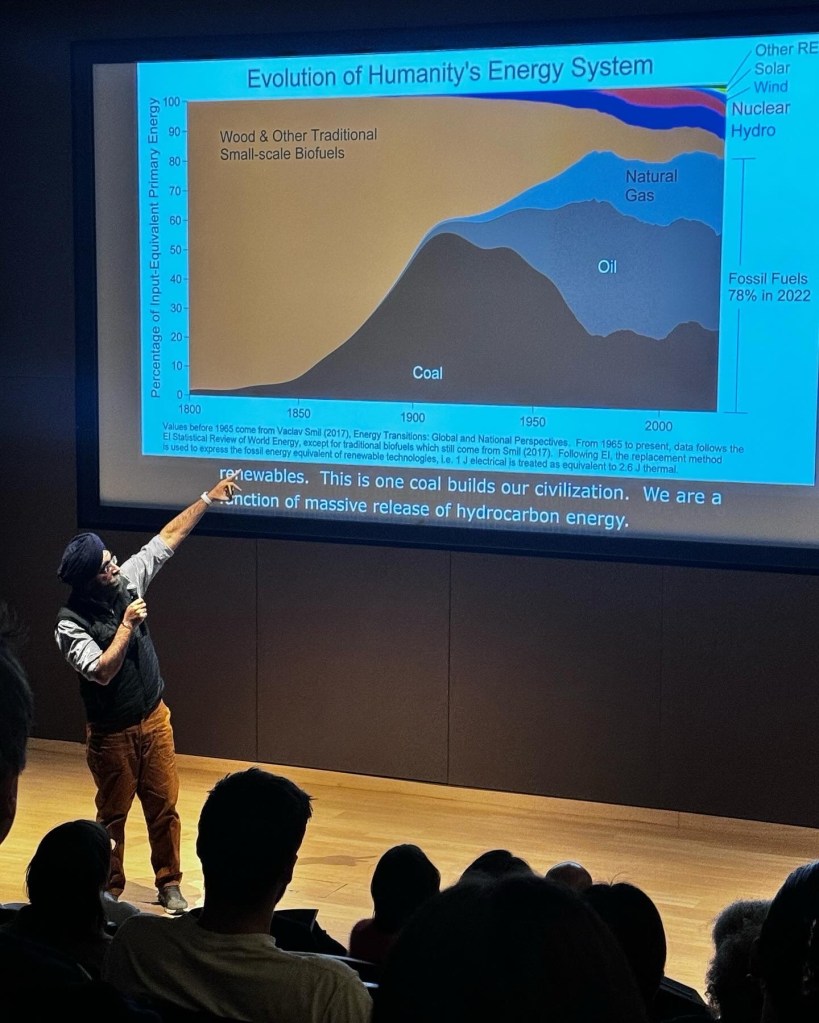
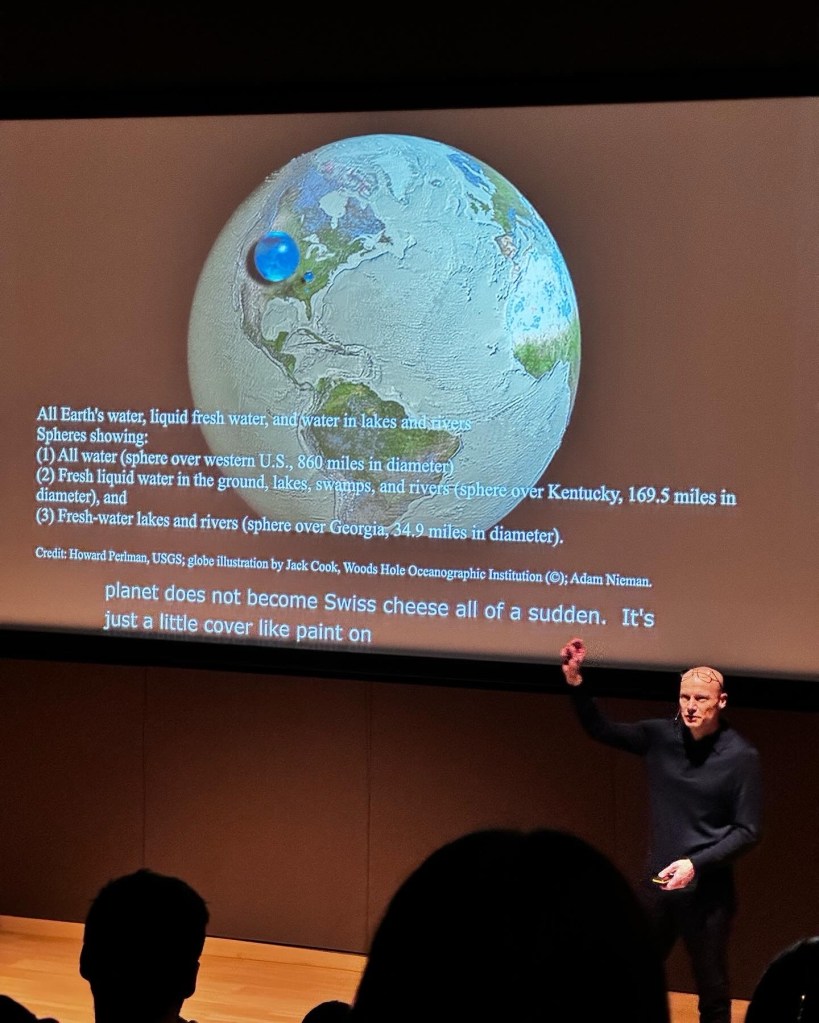

A thought provoking and sometimes heartbreaking event. My note taking trailed off through the event, not a reflection on the presentations other than my being engrossed in them!
A thought provoking and sometimes heartbreaking event. My note taking trailed off through the event, not a reflection on the presentations other than my being engrossed in them!
“We now use about eighty percent of the net primary product of land-based photosynthesis,” he said. “One hundred percent is probably impossible to reach, and our long range carrying capacity has been estimated to be thirty percent, so we are massively overshot, as they say.
We have been liquidating our natural capital as if it were disposable income, and are nearing depletion of certain capital stocks, like oil, wood, soil, metals, fresh water, fish, and animals. This makes continued economic expansion difficult.”
“Difficult!” Art wrote. “Continued?”
“We have to continue,” Fort said, with a piercing glance at Art, who unobtrusively sheltered his lectern with his arm.
“Continuous expansion is a fundamental tenet of economics. Therefore one of the fundamentals of the universe itself. Because everything is economics. Physics is cosmic economics, biology is cellular economics, the humanities are social economics, psychology is mental economics, and so on.”
His listeners nodded unhappily.
“So everything is expanding. But it can’t happen in contradiction to the law of conservation of matter-energy. No matter how efficient your throughput is, you can’t get an output larger than the input.”
…
“…manmade capital and natural capital are not substitutable. This is obvious, but since most economists still say they are substitutable, it has to be insisted on. Put simply, you can’t substitute more sawmills for fewer forests. If you’re building a house you can juggle the number of power saws and carpenters, which means they’re substitutable, but you can’t build it with half the amount of lumber, no matter how many saws or carpenters you have. Try it and you have a house of air. And that’s where we live now.”
…
No matter how efficient capital is, it can’t make something out of nothing.” “New energy sources…” Max suggested. “But we can’t make soil out of electricity. Fusion power and self-replicating machinery have given us enormous amounts of power, but we have to have basic stocks to apply that power to. And that’s where we run into a limit for which there are no substitutions possible.”
Green Mars, Kim Stanley Robinson

Season 4 of “For All Mankind” just started on Apple TV.
I imagine the venn set of folks who still read this and watch is largely overlapped, but for those who don’t it’s a alt-history of the 20thC/21stC space race on a divergent world-line where the USSR got to the moon first. As with most things prestige-tv, that becomes a setting for a soap opera, but hey.
But – the above moment, where one of the main characters communicates from Mars to their daughter was notable for the proustian rush it gave.
A perfect period piece of UI in production design – the brushed chrome and aqua buttons of the early aughts.
To have that kind of historical reference point from a field so profoundly (proudly?) ahistorical as design for technology is a shock.
Prior attempts to get LLMs to opine on futurist neologisms had not impressed but having installed the chatGPT app on my phone to try the voice interface, I thought I’d try again.
This, while typically bloodless, is better than I’d expected…
“As of my last update in January 2022, “breezepunk” isn’t a widely recognized term in popular culture, art, or design. The “-punk” suffix is often added to words to describe a subgenre or aesthetic, like “steampunk,” “cyberpunk,” or “solarpunk.” These genres often mix futuristic or alternative technology with certain periods of design or cultural elements.
If “breezepunk” were to follow this trend, it might describe an aesthetic or subgenre that emphasizes wind or air-based technologies, or perhaps a world where breezes, winds, or the atmosphere are central themes, combined with specific cultural or temporal elements. It could also be an aesthetic inspired by the feeling of breezy, airy places or concepts.
However, it’s important to note that without a clear and widely accepted definition, “breezepunk” can be interpreted in many ways. If it has emerged as a new term or trend after 2022, you might need to consult contemporary sources or communities for a current definition.”
I read this story on Canary Media with interest – “Solarpunk is going mainstream. This couple’s $1M Kickstarter proves it. Canary chats with the co-creators of the forthcoming video game Loftia, set in a renewables-powered utopia that celebrates community and climate optimism.”
I think it’s a little bit of a stretch to say that Solarpunk is going mainstream – but “cosycore” meets Animal Crossing x Ghibli aesthetic seems to be attractive. I’ve talked about the ‘protopia’ I call the “Chobani Cinematic Universe” before, and it seems in that vein.
At the end of the article it mentions an existing game, Terra Nil, which is available on Netflix and steam.
I downloaded it and started playing, with headphones in as recommended by the authors.
Smash cut to… oh, 3 hours later? It had gone midnight and I hadn’t noticed at all.
It’s game mechanics will be fairly familiar to casual gamers – you are tasked with transforming a map by introducing various types of resource in turn, with constraints on your budget to do so. The choices you make encourage different biomes / ecosystems to emerge and flourish. So far so fun.
But I think the sound design is something else.
It is immensely calming. Gentle repetition and seeming evolution in the soundtrack puts one to mind of many ambient favourites of the past, and the eno-esque ‘music as furniture’ feel contributes to your occupation / immersion in making “another green world”.
Ahem.
Anyway.
This put me to thinking about the use of ‘generative music as macroscope’, i.e. using generated soundscapes to create impressionistic understanding of large scale ecologies or systems that you’re embedded in.
Could that connect you more profoundly – or just pleasurably to the energy systems around you?
Or go further to ‘sonify’ natural systems that you’re entangled with (a nod here to Superflux’s recent work giving voice to rivers and watersheds via GenAI…)
Matt Brown made the Carbon Weather Forecast last year and in the past has made some lovely lyrical maps of the shipping forecast, as well as beautiful music-oriented pieces – including Making Future Magic’s soundtrack while we were at BERG.
I imagine he could do something rather wonderful in this arena.
What’s Pokemon Go meets Bloom meets Project Sunroof?
“If something is ugly, say so. If it is tacky, inappropriate, out of proportion, unsustainable, morally degrading, ecologically impoverishing, or humanly demeaning, don’t let it pass. Don’t be stopped by the “if you can’t define it and measure it, I don’t have to pay attention to it” ploy. No one can precisely define or measure justice, democracy, security, freedom, truth, or love. No one can precisely define or measure any value. But if no one speaks up for them, if systems aren’t designed to produce them, if we don’t speak about them and point toward their presence or absence, they will cease to exist.”
Dancing with Systems, Donella Meadows

It was wonderful to be invited back to AHO after such a long time to give a talk (see separate post) and a workshop for the interaction design students.
I decided to try a “walkshop” following in the footsteps (ahem) of James Bridle, Adam Greenfield, Deb Chachra (and many others I’m sure) to investigate how the invisible networks of electricity in our everyday lives, and the environment around us.
I based it loosely on Kevin Kelly’s “Big Here” quiz – that aims to ask (tough) questions that locate you in the technical, logistical and natural ecologies we are embedded in.
If I’d thought of it i should have shown the first 30 minutes of the first episode of James Burke’s “Connections”too.
We started the day with a short talk from me (the slides of which are below) introducing the topic and how we’d examine it in the walkshop.
After that we went on a ‘local energy safari’ and then for a few hours the students prepared responses and communication pieces based on what they’d found. I’ll post some of those separately.
It was a beautiful spring day – which was perfect for a ‘walkshop’ – and the students were enthusiastic participants in what I think was a *partially* successful experiment.
I’ll write a bit about that in another post on their responses.
Huge thanks to Mosse for the invitation and all the AHO students for their energy and patience!
I’d love to try this again – or have others try it! Please do get in touch if you’d like to do it somewhere else in Europe, or better yet invite me to do it with you!
Update [September 28th 2023]: Before I did this I was sadly not aware of Jenny Odell’s fantastic 2013 project “Power Trip”, which explores this territory beautifully.

I found the project coincidentally while sending a friend Odell’s site, based on his discovery of some google maps derived artworks, which I’d associated for years with the artist.
Back at Google Creative Lab, we’d worked with her on creating giant murals on the sides of data centres – themselves places of infrastructural fascination and critique by many of the artists referenced in this workshop…


One of my favourite pieces by Kevin Kelly is this – the ‘watershed quiz’.
In this he asks a set of questions which locate you in your ‘Big Here’.
You start where you are, and begin to pull the thread out to larger and larger scales…
“You live in the big here. Wherever you live, your tiny spot is deeply intertwined within a larger place, imbedded fractal-like into a whole system called a watershed, which is itself integrated with other watersheds into a tightly interdependent biome. At the ultimate level, your home is a cell in an organism called a planet. All these levels interconnect. What do you know about the dynamics of this larger system around you? Most of us are ignorant of this matrix. But it is the biggest interactive game there is. Hacking it is both fun and vital.”
The Big Here Quiz, Kevin Kelly https://kk.org/cooltools/the-big-here-qu/


Andrew’s book is a striking piece of “Big Here” writing – pulling on the thread of his squirrel-sabotaged internet cabling and ending up half way around the world watching divers swim ashore carrying backbone-fibre over their shoulders.
I want us to do something similar with our energy, leaving this room and following where our energy is coming from, and noting how others are embedded similarly.


We’re going to leave AHO and ‘pull on the thread of your electrons’, like Andrew Blum did with his connectivity bits…
• From the power you touch & use out to the distribution, then transmission
• Look for hints of new topologies, local production and new forms – what might be taking hold, hybrids, commercial, official, unofficial, municipal, local, improvised…
Then
• Create a journal / map / notes to record your impressions
• A piece of communication to yourself
• To others
Please remember!
• It doesn’t have to be “correct” – think like an amateur naturalist… record observations, things you see and interpret.

This morning I tried pulling on the thread from the apartment I’m staying at…

I looked up the names I found on the various (old) bits of electrical infrastructure in the apartment. This gave me some threads to pull on.
To pull on those threads I consulted the wonderful Open Infrastructure Map.

Do you recognise this building?

Yep – it’s right across the street from AHO. And it’s the first link in a big chain from this area out to where the electrons we’re using right now probably originate.
Let’s pull the thread!

Zooooooming out – we can see some next links in the chain


Looking at this, we can make a decision to follow the thread through the Sogn Substation back to the generating sources.


Again, we can decide to follow the thread of our electrons to one of the nearest hydroelectric generators – Nore II around 180km away.

We could drive there in about 3hrs – or take a very long but scenic cycle there in the extended Norwegian (summer) day…

I mean, it looks lovely there!

So – just from your desktop you can explore pulling on your energy thread. But today, we’re going to go outside and walk around our area to see what we can find.
We’re going to explore the Grunerløkka area in groups


[We then left AHO in groups and explored the area in our “Local Energy Safari”]

[After returning from the energy safari walkshop component, we attempted ‘design responses’ to what was found for about 90mins – this was in hindsight too short, but there were still some great outputs]

Now we’re going to make some designed responses to what we saw, recorded, found.
Again – these could be communications or mappings, or more generative/speculative responses. Here are some prompts from me, let’s see what we get!

You might have spotted interesting new hybrids emerging – what could those lead to?


You could think about social structures that could emerge around adversity or abundance – for instance some of the energy-sharing practices that emerged around Occupy Sandy in NYC.
And for inspiration only, the work of Clifford Harper in 1970s on ‘radical technology’ reprogramming and using appropriate technology to share resources in a town


Again for inspiration – perhaps make a page from a future whole earth catalog documenting technology, practices, methods around your energy safari ideas.


I had a wonderful experience last week of taking my ten year old daughter to the Goldsmiths BA Design show last week (thanks for the invite, Matt Ward!)

From the moment she walked through the door – her jaw dropped.

There was a delight and surprise that this might be something *they* could do one day.
That this might be what school turns into.
That the young people there who were only maybe a decade older could explore ideas, learn crafts old and new, make things, and ask questions with all that work.
And that they would be kind and clever and generous in answering her questions.
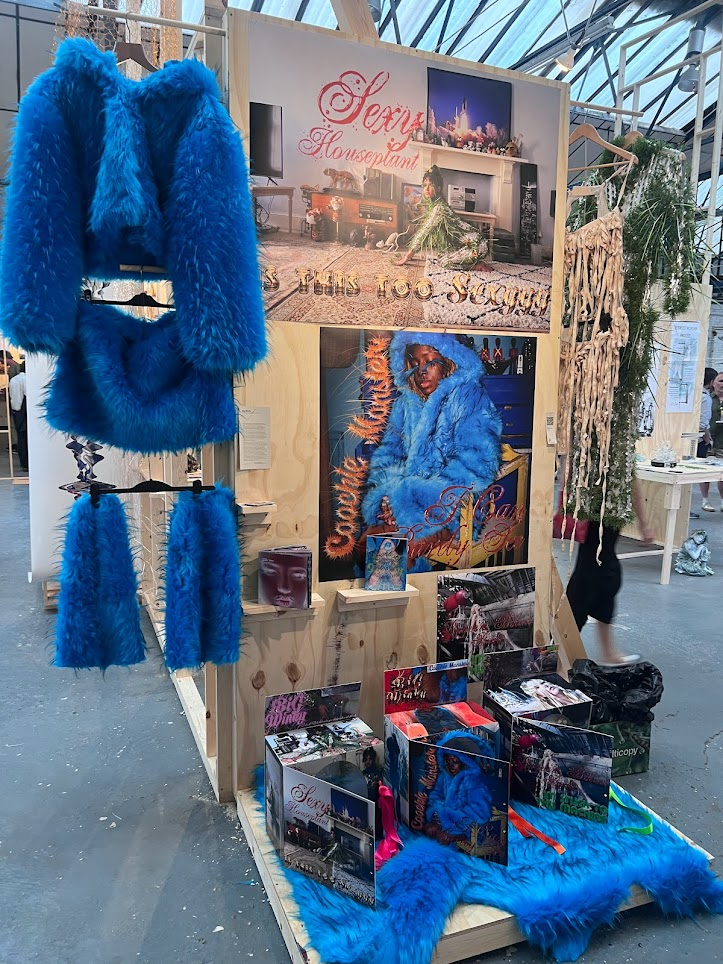
So – for sure, take your kids to the graduation shows, and design schools – maybe have a day where you invite local schools and get your students to explain their work to 10 year olds…?
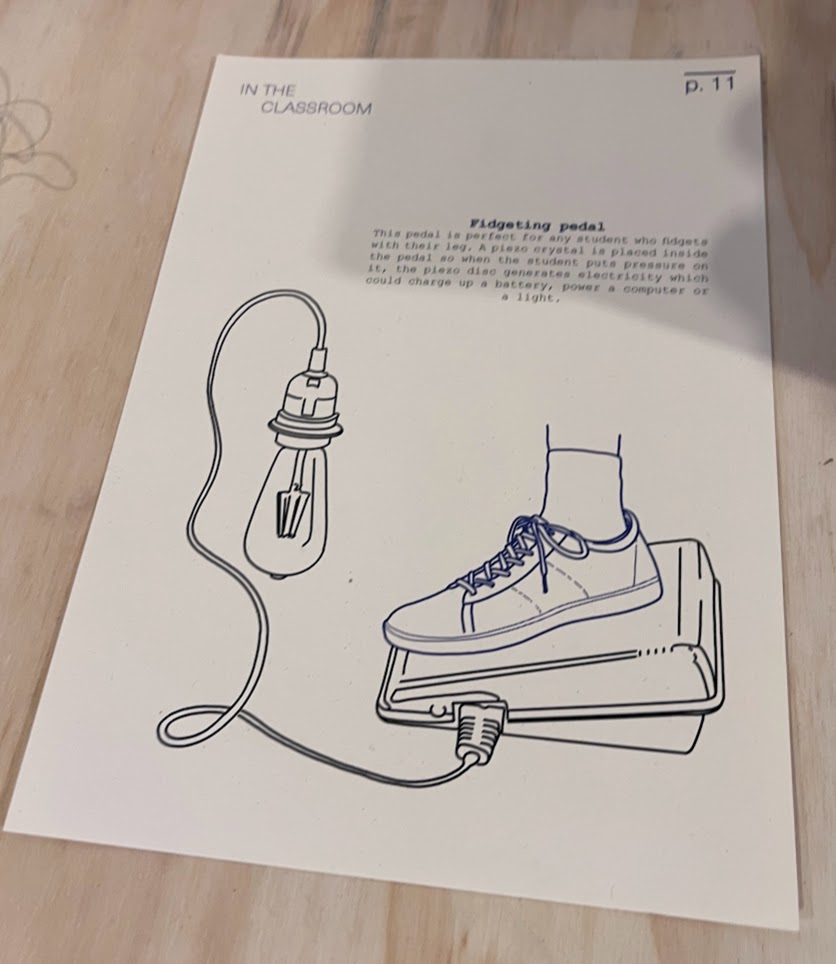
p.s. Apologies to the students who’s work I have images of, but didn’t capture the author at the time of the show. I will try and get hold of a catalogue and rectify here ASAP!!!

It was wonderful to be invited back to AHO and Oslo in early May by my old friends and sometime colleagues there – and the opportunity to speak about past projects but also what I’m doing now at Lunar Energy.
My framing was around the two biggest human-built machines on this planet – the cloud and the grid.
The former is the (much-younger) result of emergent properties and software that has traversed boundaries of territory and nations, while the latter has been a mainly top-down, deliberate design which is very anchored to geography, regulation and legacy technology.
When you put them together you start to get some interesting new possibilities for our energy transition – e.g. virtual power plants as made possible by Lunar’s Gridshare platform.
My talk was kindly hosted and supported by IxDA Oslo. Their extremely professional recording and transcription of the event was turned around in record time and can be found here.
Thanks to everyone who came, and your thoughtful questions and conversations afterwards. It was a lot of fun, and a delight to be back in Oslo after more than a decade.
The next day I hosted a workshop with Mosse at AHO for her students, which I entitled “Electrosheds”, after Kevin Kelly‘s “Big Here Quiz” that aims to locate you at the heart of their watersheds and local ecologies. I’ll talk about that in a separate post.

This is incredibly mundane, but like most blog posts that doesn’t stop me from writing it down.
We have a string of solar-powered LED lights in our backyard.
The plastic stand that it was supplied with broke, and so for the past few months it has been precariously balanced on various branches, bits of fence etc – falling off into shadow and powerlessness – blown by the wind or local cats on the prowl.
I wanted to make a replacement, but could never find the time / energy / foolhardiness to fire up one of the big sledgehammer CAD apps to crack this particular nut.
I’d played with Shapr3D in the past to quickly sketch things while working at Google – but never considered it for 3d printed output. I fired it up last night and in five minutes, with a glass of wine and taskmaster on in the background had made what I needed.
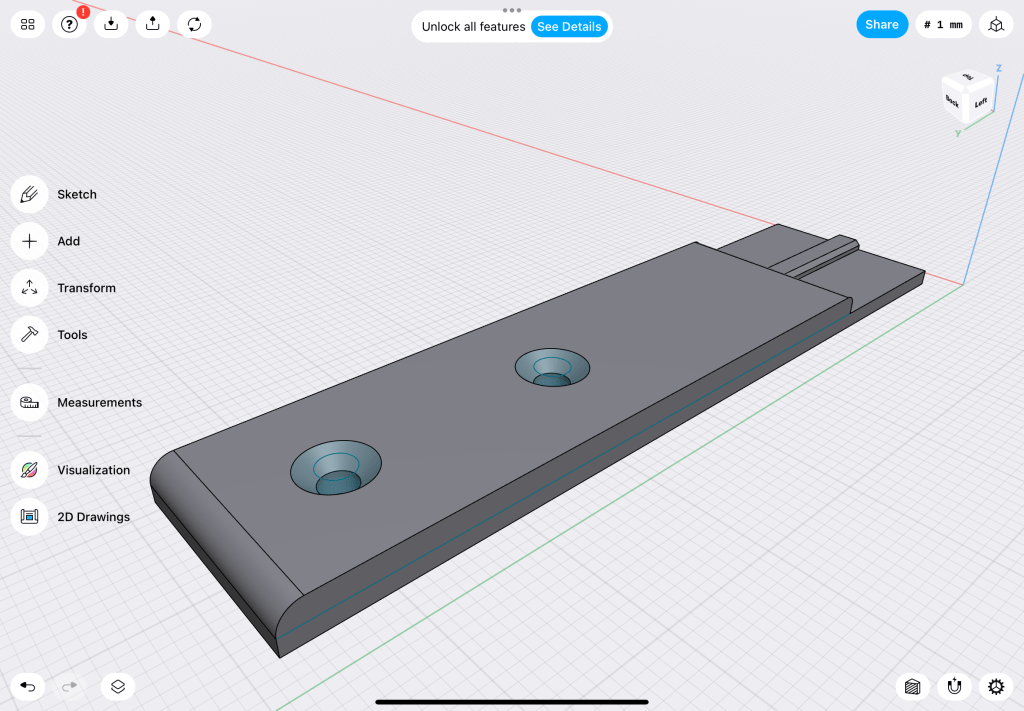
This morning, I printed it out on the AnkerMake M5. This thing has been a revelation.
I first got myself a cheap (<£500) 3D printer about 5 years ago – but it was damn fiddly.
It never really worked well, and the amount of set-up and breakdown after every (terrible) print meant that it sat unused most of the time while I sent prints off to be done, or while at Google prevailed upon colleagues to print something for me (shhhh)
The AnkerMake M5 is a different proposition entirely. While a little more expensive than my first (disappointing) machine – this lives up to the role that 3d printing has played in the imaginations of futurists, designers and maker-scene dilletantes (like me) for the past decade or so.
You print stuff. And it works. Fast.
That’s it.
Their bundled slicer software is pretty good – good enough for me at least, and you can have something like this little part spat out in about 5mins.
It is really fast.

I did one print – looked at it in-situ and decided it would need a bit more reinforcement. Back to Shaper3D, add a little reinforcing spine. While I’m at it, get fancy and countersink the screws with a little chamfer. Export STL, send to the slicer, print.
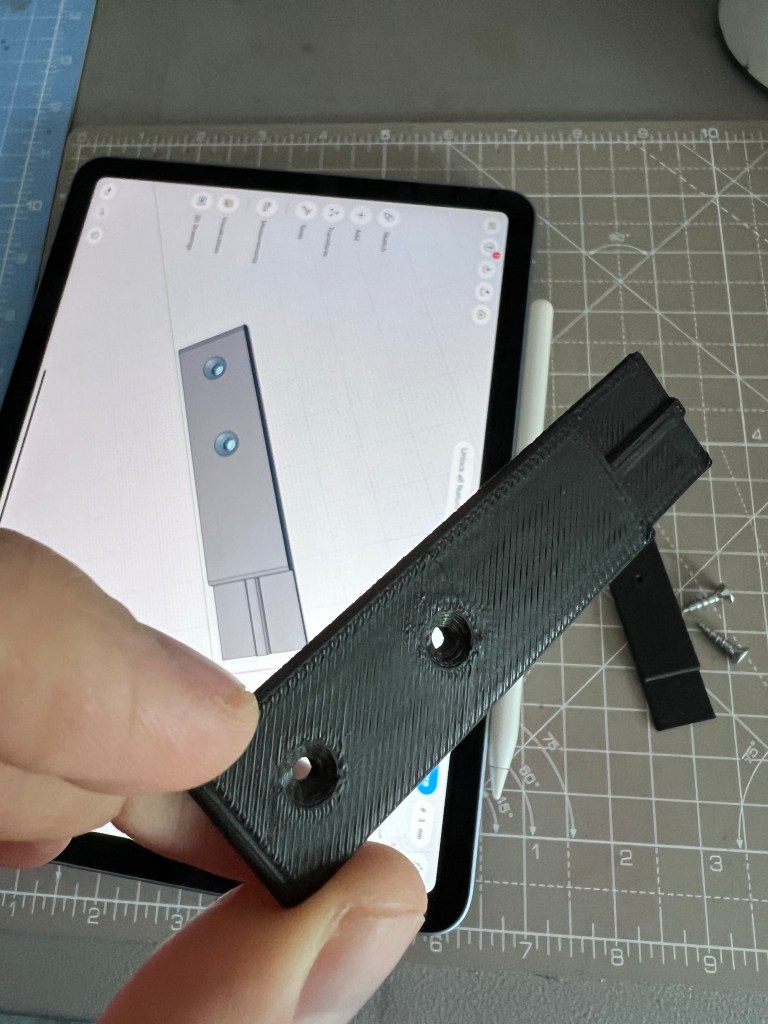
I’d iterated on the part and printed it in 15mins.
All that was left was to screw it to the fence, and the panel dangles in the wind no more – soaking up photons and making electrons for the LEDs to sip on at night.

Now I’m sat in a cafe while my son plays football writing this – and thought I’d play with the visualisation and AR tools in Shaper3D.
Amazing that this is on a cheapish, non-super-powerful tablet (>3yrs old iPad) and accessible enough for non-experts and maybe even kids.
Mundane maker magic on a Sunday.
 Petafloptimism