Some of us know what we want: private sufficiency, public luxury, doughnut economics, participatory democracy and an ecological civilisation. None of these are bigger asks than those the billionaire press has made and largely achieved: the neoliberal revolution that has swept away effective governance, effective taxation of the rich, effective restraints on the power of business and oligarchs and, increasingly, effective democracy.
So let’s break our own silence. Let’s stop lying to ourselves and others by pretending that small measures deliver major change. Let’s abandon the timidity and tokenism. Let’s stop bringing buckets of water when only fire engines will do.
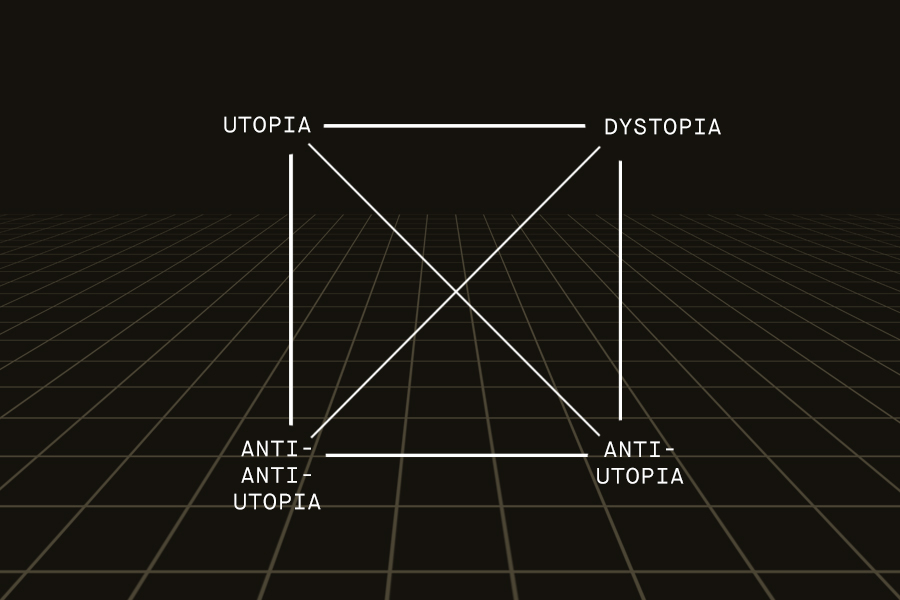
“It’s important to remember that utopia and dystopia aren’t the only terms here. You need to use the Greimas rectangle and see that utopia has an opposite, dystopia, and also a contrary, the anti-utopia. For every concept there is both a not-concept and an anti-concept. So utopia is the idea that the political order could be run better. Dystopia is the not, being the idea that the political order could get worse. Anti-utopias are the anti, saying that the idea of utopia itself is wrong and bad, and that any attempt to try to make things better is sure to wind up making things worse, creating an intended or unintended totalitarian state, or some other such political disaster. 1984 and Brave New World are frequently cited examples of these positions. In 1984 the government is actively trying to make citizens miserable; in Brave New World, the government was first trying to make its citizens happy, but this backfired. As Jameson points out, it is important to oppose political attacks on the idea of utopia, as these are usually reactionary statements on the behalf of the currently powerful, those who enjoy a poorly-hidden utopia-for-the-few alongside a dystopia-for-the-many. This observation provides the fourth term of the Greimas rectangle, often mysterious, but in this case perfectly clear:one must be anti-anti-utopian.”
“Dystopia is good for drama because you’re starting with a conflict: your villain is the world. Writers on “Star Trek: The Next Generation” found it very difficult to work within the confines of a world where everything was going right. They objected to it. But I think that audiences loved it. They liked to see people who got along, and who lived in a world that was a blueprint for what we might achieve, rather than a warning of what might happen to us.”
“An adequate life provided for all living beings is something the planet can still do; it has sufficient resources, and the sun provides enough energy. There is a sufficiency, in other words; adequacy for all is not physically impossible. It won’t be easy to arrange, obviously, because it would be a total civilizational project, involving technologies, systems, and power dynamics; but it is possible. This description of the situation may not remain true for too many more years, but while it does, since we can create a sustainable civilization, we should. If dystopia helps to scare us into working harder on that project, which maybe it does, then fine: dystopia. But always in service to the main project, which is utopia.”
If it is coming, and if it is a big deal, then surprisingly few have paused to carefully consider the actual source of the metaverse, an undertaking which seems like a good idea, especially because that source is a deeply dystopian novel about a collapsed America that is overrun by violence and poverty. The metaverse was born in Neal Stephenson’s 1992 Snow Crash, where it serves as entertainment and an economic underbelly to a poor, desperate nation that is literally governed by corporate franchises.
You will see no trace of the metaverse’s origins in these strategy announcements, which so far seem to hint mostly at creating and uniting more immersive digital environments in which entertainment might be consumed and work carried out—and advertising displayed, workers surveilled, and branded NFTs and loot boxes sold. No trace, that is, unless maybe you read about it on your Twitter feed, where a news item about a metaverse product is likely to be sandwiched between stories about crushing health care debt or anecdotes about rampant inequality.
I have friends that work there, I wish them all the best and hope they forgive me saying so – but I find very few more depressing word combinations in our language than ‘Facebook Reality Lab’…
You don’t really expect to see energy company CEOs interviewed in Dezeen, so it’s a nice to surprise to see one of the founders of Bulb (where afewfriends of mine work) quoted there this week.
The founders also felt that eventually, homes would become energy producers as well as consumers. By installing solar panels, anaerobic digesters, micro-CHP (combined heat and power) plants or any other small-scale clean-power generator, householders could sell surplus energy back to the grid, using home-storage batteries or electric cars to store the power until it’s needed.
“It wasn’t really happening at the time, but we thought that homes could become a source of energy,” Wood explained.
“If people had solar panels on their roof, or if they had a battery in their home or an electric vehicle and those batteries were plugged into the grid, the homes could at times be providing energy into the grid.”
“Also, the grid becomes more efficient when the electrons travel a shorter distance,” he added. “If you have generation embedded within the grid locally, then the whole system becomes more efficient.”
It has taken a while for this “two-way grid” to become a reality but Wood believes it is now poised to take off.
“That’s one of the things we’re quite excited about now that there are more options available to consumers for solar panels, electric vehicles, heat pumps and batteries.”
In the article he stresses that the architecture and design profession are central to making this happen in the next decade – connecting back to my post earlier this week featuring Saul Griffith’s exhortations to redesign and electrify our domestic lives. I’m hoping to write more about this soon.
One of my biggest regrets was that we didn’t spend more time talking about the approach to energy, water and other services when we were at the start of the design process.
But thinking about the home as a machine not just for living in, as Corbusier had it, but also a machine for generating, regenerating, recycling, re-using… That would have been a fantastic opportunity – that I’m sorry to say I missed. This time!
Owning a house is a position of huge privilege of course – as is being able to make alterations on your own terms to where you live.
Designers and architects must also look to provide for those who rent and share buildings – and give them innovative tools/services that increase their agency to save and generate energy.
Thinking about places in the pace layers to make design interventions that are practical, portable, affordable – and make some impact on our climate emergency.
Rounding off the week though with another approach to the urgent problem of decarbonising our way of life – and longer term heading toward a Kardashev Scale 1 civilisation.
Saul Griffith is always worth paying attention to – and his recent work at Rewiring America is no exception.
The way he breaks down the climate challenge into daunting-but-doable tasks is inspiring.
Making water heaters and kitchen appliances as appealing as Teslas is going to be hard-but-rewarding work for designers and engineers over the next decade.
As he says on his site:
I think our failure on fixing climate change is just a rhetorical failure of imagination.
We haven’t been able to convince ourselves that it’s going to be great.
The sketched graph above is taken from Saul’s recent keynote for the Verge Electrify conference, which is on youtube, takes 12mins to watch, and is well worth it.
How can meaning make a difference? It doesn’t seem to be the kind of physical property, like temperature or mass or chemical composition, that could cause anything to happen. What brains are for is extracting meaning from the flux of energy impinging on their sense organs, in order to improve the prospects of the bodies that house them and provide their energy. The job of a brain is to “produce future” in the form of anticipations about the things in the world that matter to guide the body in appropriate ways. Brains are energetically very expensive organs, and if they can’t do this important job well, they aren’t earning their keep.
Colonising the future: If Speculative Design builds competency in thinking about future alternatives, the design community needs to ensure that it is aware of the structural inequalities that allow for a privileged voice. I think it’s become painfully obvious that we don’t need any more white male billionaires telling us how the future looks, therefore by moving Speculative Design outside of the “academy” we need to make sure it’s reaching people who don’t normally have say over the future. We should aim to empower alternative views about how the world could be.
“Through gaps in the cloud layer she could see the light-but-dark blue of the Terran sky, subtle and full.
It looked like a blue dome flattened at the center, perhaps a few kilometers above the clouds—she reached up for it—although knowing too that it was just a kind of rainbow made it glorious.
A rainbow that was blue everywhere and covered everything. The blue itself was complex, narrow in range but infinite within that range.
It was an intoxicating sight, and you could breathe it—one was always breathing it, you had to. The wind shoved it into you!
Breathe and get drunk, oh my, to be free of all restraint, minimally clothed, lying on the bare surface of a planet, sucking in its atmosphere as if it were an aqua vitae, feeling in your chest how it kept you alive!
No Terran she had ever met properly appreciated their air, or saw their sky for what it was. In fact they very seldom looked at it.”
This caught my eye from Benedict Evan‘s latest newsletter
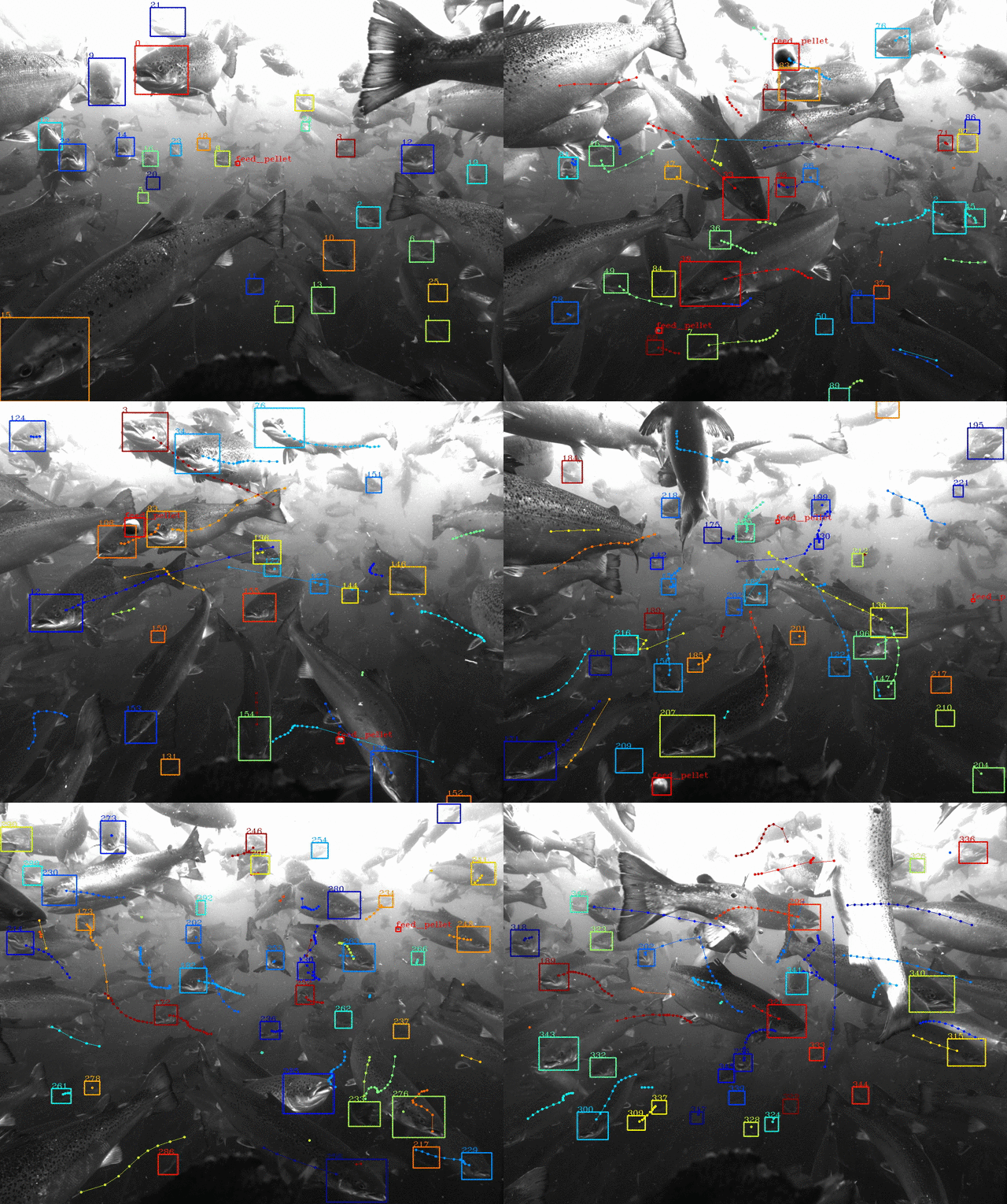
Baked into the chip – the nature of fighting.
The dynamics of violence between humans to be detected at the edge, reported to… wherever.
My mind drifted to a future Gibsonian street-fighting style that might be informed by this evolutionary pressure from an eye that can see all the fights of the past.
A Capoeira-n malandragem of movement specifically devised and evolving to be unseen by machine overseers.




 Petafloptimism