“While something is “tomorrow,” institutions can hold it at arm’s length: debate it, study it, delay it, run pilots, treat it as optional. The moment it becomes “today,” the debate stops being about feasibility and becomes about distribution, governance, and consequence. The bottleneck shifts away from engineering and toward whether we have the institutional capacity to absorb a new infrastructural layer arriving faster than our social contracts can update.”
“Look at the pattern this seashell makes. The dappled whorl, curving inward to infinity. That’s the shape of the universe itself. There’s a constant pressure, pushing toward pattern. A tendency in matter to evolve into ever more complex forms. It’s a kind of pattern gravity, a holy greening power we call viriditas, and it is the driving force in the cosmos. Life, you see. Like these sand fleas and limpets and krill—although these krill in particular are dead, and helping the fleas. Like all of us,” waving a hand like a dancer. “And because we are alive, the universe must be said to be alive. We are its consciousness as well as our own. We rise out of the cosmos and we see its mesh of patterns, and it strikes us as beautiful. And that feeling is the most important thing in all the universe—its culmination, like the colour of the flower at first bloom on a wet morning. It’s a holy feeling, and our task in this world is to do everything we can to foster it.”
“Deuterium–tritium fusion, the kind of fusion that most star builders are doing, releases ten million times the amount of energy per kilogram as coal. Ten million. If you had a fusion reactor in your house, you’d have to go to the deuterium-tritium shed once for every ten million times you went to the coal shed. What this means is that the mass of a single cup of water contains the equivalent energy of 290 times what the average person in the US uses each year. The mass of an Olympic swimming pool contains an amount of energy in excess of total world annual energy use.”
“People aren’t the apex species they think they are. Other creatures—bigger, smaller, slower, faster, older, younger, more powerful—call the shots, make the air, and eat sunlight. Without them, nothing.”
“‘It’s going to be all right,’ he said, looking at as many of them as he could. ‘Every moment in history contains a mix of archaic elements, things from all over the past, right back into prehistory itself. The present is always a melange of these variously archaic elements. There are still knights coming through on horseback and taking the crops of peasants. There are still guilds, and tribes. Now we see so many people leaving their jobs to work in the flood relief efforts. That’s a new thing, but it’s also a pilgrimage. They want to be pilgrims, they want to have a spiritual purpose, they want to do real work – meaningful work. There is no reason to keep being stolen from. Those of you here who represent the aristocracy look worried. Perhaps you will have to work for yourselves, and live off that. Live at the same level as anyone else. And it’s true – that will happen. But it’s going to be all right, even for you. Enough is as good as a feast. And it’s when everyone is equal that your kids are safest.”
“There is a possible future for humanity where we have stabilized our climate, where everyone has the energy and resources that they need to survive and thrive, where we get to connect with each other in myriad ways. I get to use “we” in the best possible way, meaning all of humanity. Running the numbers and realizing exactly how abundant renewable energy is, and then realizing how close we are to being able to harness it—it’s an absolute game changer. We’re accustomed to thinking about making the transition away from fossil fuels to renewable sources as one that we are doing under duress, making a sacrifice to stave off disaster. But that’s not what we’re doing. What we’re doing is leveling up. We—you, me, anyone who is alive today—we have the opportunity to not just live through but contribute to a species-wide transition from struggle to security, from scarcity to abundance. We can be the best possible ancestors to future generations, putting them on a permanent, sustainable path of abundance and thriving. And we can do it for all of our descendants—all of humanity—not just a narrow line. But we can only do it together, and we still need to figure out how to get there.”
“It’s a miracle the weeds push up. Where is their sustenance, what are they feeding on? They see them only on the roads, by the mast towers, and on the airport runway where they landed. It is as if they thrive on provocation, rising up only when they have something to tear down. They are impish and morbid and embittered and they sort of love them. On the black rubble beaches, on the lower hillsides, they linger; they sit back, wait for the hubris of industry.”
“Another of his favourites, even more puzzling to young men and women conditioned to seek answers, was, ‘Uncertainty is all we have. It’s our advantage. It’s the virtue of the day.’”
John De La Parra, a food scientist from the Rockerfeller Foundation spoke on the first day of The Conference, after a pretty esoteric (to me) presentation that asked us to participate in a guided meditation, listen to plants and submit our dreams to an experimental app.
“See, there are basically two kinds of Philosophy – one’s called prickly, the other one is called goo. Prickly people are precise, rigorous, logical – they like everything chopped up and clear. Goo people like it vague, big picture, random, imprecise, incomplete and irrational. Prickly people believe in particles, goo people believe in waves. They always argue with each other but what they don’t realize is neither one of them can take their position without their opposition being there. You wouldn’t know you are advocating prickles unless someone else was advocating goo. You wouldn’t even know what prickles was and what goo was. Life is not prickles or goo, its gooey-prickles or prickly-goo.”
That stuck with me – and I searched for the quote on my return to the UK – to find that it had been animated, in a production from… Matt Stone and Trey Parker of South Park fame.
Nice one, universe.
* Incidentally, note the anachronism in that scene from “Her”, where Artificial Superintelligence coincides with gas hobs and stove-top kettles!Paging Rewiring America to demand an electrified directors cut!
As a fan of Alan Kay and the original vision of the Dynabook is made me very happy.
But moreover – as someone who has never been that excited by the chatbot/voice obsessions of BigTech, it was wonderful to see.
Of course the proof of this pudding will be in the using, but the notion of a real-time magic notebook where the medium is an intelligent canvas responding as an ‘intelligence amplifier‘ is much more exciting to me than most of the currently hyped visions of generative AI.
I was particularly intrigued to see the more diagrammatic example below, which seemed to belong in the conceptual space between Bret Victor’s Dynamicland and Papert’s Mathland.
I recall when I read Papert’s “Mindstorms” (back in 2012 it seems? ) I got retroactively angry about how I had been taught mathematics.
The ideas he advances for learning maths through play, embodiment and experimentation made me sad that I had not had the chance to experience the subject through those lenses, but instead through rote learning leading to my rejection of it until much later in life.
As he says “The kind of mathematics foisted on children in schools is not meaningful, fun, or even very useful.”
Perhaps most famously he writes:
“a computer can be generalized to a view of learning mathematics in “Mathland”; that is to say, in a context which is to learning mathematics what living in France is to learning French.”
Play, embodiment, experimentation – supported by AI – not *done* for you by AI.
I’ve long thought the assistant model should be considered harmful. Perhaps the Apple approach announced at WWDC means it might not be the only game in town for much longer.
My first email to him had the subject line of this blog post: “Magic notebooks, not magic girlfriends” – which I think must have intrigued him enough to respond.
This, in turn, led to the fantastic experience of meeting up with him a few times while he was based in Edinburgh and having him write a series of brilliant pieces (for internal consumption only, sadly) on what truly personal AI might mean through his lens of cognitive science and philosophy.
As a tease here’s an appropriate snippet from one of Professor Clark’s essays:
“The idea here (the practical core of many somewhat exotic debates over the ‘extended mind’) is that considered as thinking systems, we humans already are, and will increasingly become, swirling nested ecologies whose boundaries are somewhat fuzzy and shifting. That’s arguably the human condition as it has been for much of our recent history—at least since the emergence of speech and the collaborative construction of complex external symbolic environments involving text and graphics. But emerging technologies—especially personal AI’s—open up new, potentially ever- more-intimate, ways of being cognitively extended.”
I think that’s what I object to, or at least recoil from in the ‘assistant’ model – we’re abandoning exploring loads of really rich, playful ways in which we already think with technology.
Drawing, model making, acting things out in embodied ways.
Back to Papert’s Mindstorms:
“My interest is in the process of invention of “objects-to-think-with,” objects in which there is an intersection of cultural presence, embedded knowledge, and the possibility for personal identification.”
“…I am interested in stimulating a major change in how things can be. The bottom line for such changes is political. What is happening now is an empirical question. What can happen is a technical question. But what will happen is a political question, depending on social choices.”
The some-what lost futures of Kay, Victor and Papert are now technically realisable.
“what will happen is a political question, depending on social choices.”
That is, Apple are toolmakers, at heart – and personal device sellers at the bottom line. They don’t need to maximise attention or capture you as a rent (mostly). That makes personal AI as a ‘thing’ that can be sold much more of viable choice for them of course.
Apple are far freer, well-placed (and of coursse well-resourced) to make “objects-to-think-with, objects in which there is an intersection of cultural presence, embedded knowledge, and the possibility for personal identification.”
The wider strategy of “Apple Intelligence” appears to be just that.
But – my hope is the ‘magic notebook’ stance in the new iPad calculator represents the start of exploration in a wider, richer set of choices in how we interact with AI systems.
“If something is ugly, say so. If it is tacky, inappropriate, out of proportion, unsustainable, morally degrading, ecologically impoverishing, or humanly demeaning, don’t let it pass. Don’t be stopped by the “if you can’t define it and measure it, I don’t have to pay attention to it” ploy. No one can precisely define or measure justice, democracy, security, freedom, truth, or love. No one can precisely define or measure any value. But if no one speaks up for them, if systems aren’t designed to produce them, if we don’t speak about them and point toward their presence or absence, they will cease to exist.”
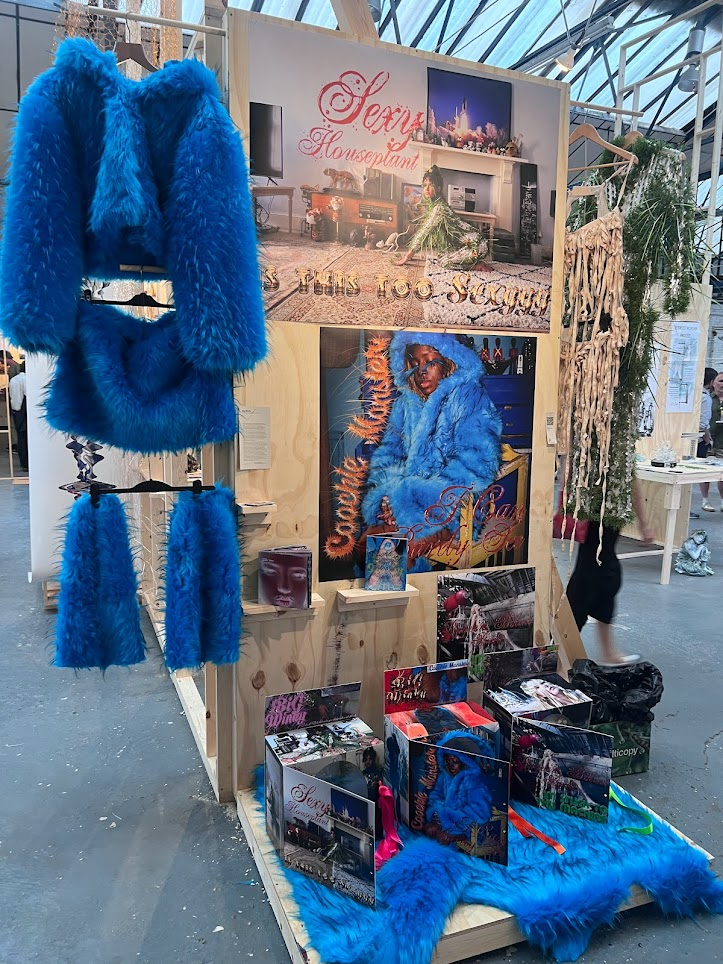
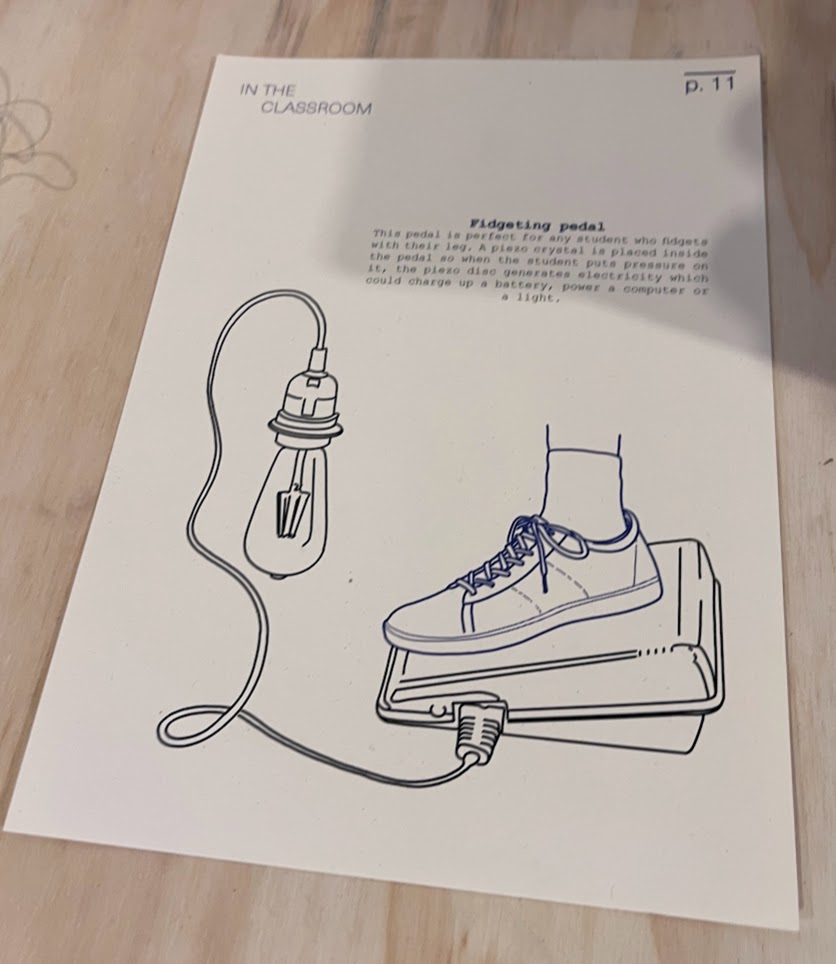
I had a wonderful experience last week of taking my ten year old daughter to the Goldsmiths BA Design show last week (thanks for the invite, Matt Ward!)
Interacting with work that physically translates letters into a lost language
From the moment she walked through the door – her jaw dropped.
Another of my daughter’s favourites.
There was a delight and surprise that this might be something *they* could do one day.
That this might be what school turns into.
That the young people there who were only maybe a decade older could explore ideas, learn crafts old and new, make things, and ask questions with all that work.
And that they would be kind and clever and generous in answering her questions.
So – for sure, take your kids to the graduation shows, and design schools – maybe have a day where you invite local schools and get your students to explain their work to 10 year olds…?
Work by Anna Savel at the Goldsmiths BA Design show, 2023
p.s. Apologies to the students who’s work I have images of, but didn’t capture the author at the time of the show. I will try and get hold of a catalogue and rectify here ASAP!!!
I’m stealing Matt Webb’s “filtered for” format here – for a bunch of more or less loosely connected items that I want to post, associate and log as much for myself as to share.
And – I’ll admit – to remove the friction from posting something without having a strong thread or thesis to connect them.
I’ve pre-ordered “No miracles needed” by Mark Jacobson – which I’m looking forward to reading in February. Found out about it through this Guardian post a week or so ago.
The good news below from Simon Evans seems to support Prof Jacobson’s hypothesis…
The world has reached peak fossil fuels for electricity, thanks to the rapid growth of wind & solar
Wind & solar are the cheapest sources of electricity for 96% of the world's population
“I found this sort of approach really interesting but mostly I like the small scale of it yes I like the fact that it’s you know it’s something that you could imagine just proliferating as a standard component that’s attached to sort of Street Furniture or things around the house or whatever it is you might put them on your windowsill because they’re quite small and they just generate like enough power to make a sensor work or a light or something and yeah it’s this this alternative future to the big powerful set piece green Energy Future that’s obviously being pushed and should continue to be pushed because that’s competing against the big Power and the fossil fuel future but I like this idea of like the smaller cuter weirder fluttery imagine it’s quite fluttery yeah so yeah so this is this is Breeze Punk everybody…”
I like the idea of it being a standard component – a lego. A breezeblock?
I would like it to become… a thing. I suppose that’s why I’m writing this.
Used to be how you made things become things.
It’s probably not how you do it now, you need a much larger coordinated cultural footprint across various short-form streaming formats to make a dent in the embedding space of the LLMs.
Mind you, that’s not the same as making it ‘real’ or even ‘realish’ now is it.
A bit vogue-ish perhaps, to prove a point I asked ChatGPT what it knew about Breezepunk.
It took a while, but… it tried to turn into the altogether less satisfying “windpunk”…
I like making the cursor blink on ChatGPT.
The longer the better. I think it means you’re onto something.
Or maybe that’s just my Bartle-type showing again.
The production design of the recent adaptation of William Gibson’s The Peripheral seemed “fluttery” – particularly in it’s depiction of the post-jackpot London timeline.
Or perhaps the aesthetic is much more one of ‘filigree‘.
There’s heaviness and lightness being expressed as power by the various factions in their architecture, fashion, gadgets.
It’s an overt expression of that power being wielded via nanotechnology – assemblers, disassemblers constructing and deconstructing huge edifices at will.
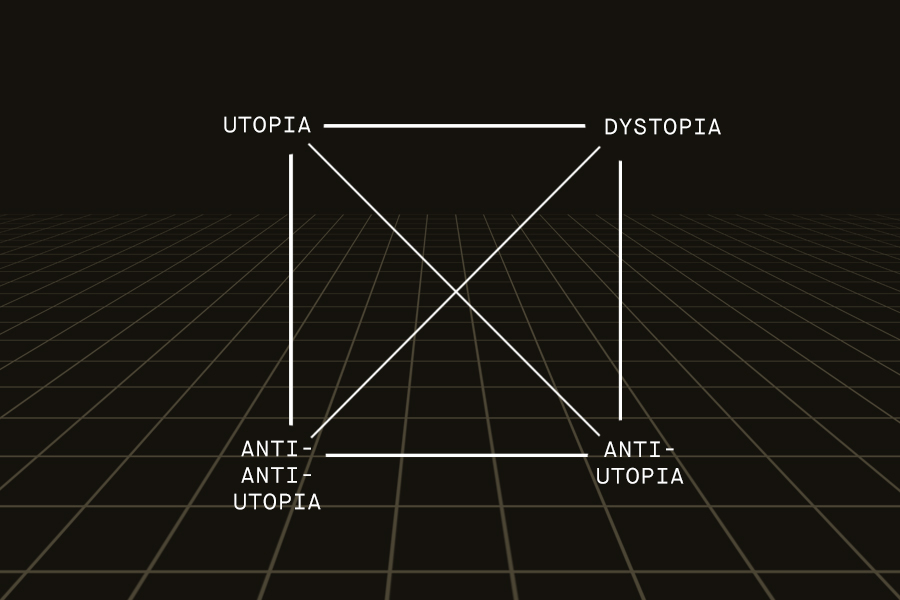
“It’s important to remember that utopia and dystopia aren’t the only terms here. You need to use the Greimas rectangle and see that utopia has an opposite, dystopia, and also a contrary, the anti-utopia. For every concept there is both a not-concept and an anti-concept. So utopia is the idea that the political order could be run better. Dystopia is the not, being the idea that the political order could get worse. Anti-utopias are the anti, saying that the idea of utopia itself is wrong and bad, and that any attempt to try to make things better is sure to wind up making things worse, creating an intended or unintended totalitarian state, or some other such political disaster. 1984 and Brave New World are frequently cited examples of these positions. In 1984 the government is actively trying to make citizens miserable; in Brave New World, the government was first trying to make its citizens happy, but this backfired. As Jameson points out, it is important to oppose political attacks on the idea of utopia, as these are usually reactionary statements on the behalf of the currently powerful, those who enjoy a poorly-hidden utopia-for-the-few alongside a dystopia-for-the-many. This observation provides the fourth term of the Greimas rectangle, often mysterious, but in this case perfectly clear:one must be anti-anti-utopian.”
“Dystopia is good for drama because you’re starting with a conflict: your villain is the world. Writers on “Star Trek: The Next Generation” found it very difficult to work within the confines of a world where everything was going right. They objected to it. But I think that audiences loved it. They liked to see people who got along, and who lived in a world that was a blueprint for what we might achieve, rather than a warning of what might happen to us.”
“An adequate life provided for all living beings is something the planet can still do; it has sufficient resources, and the sun provides enough energy. There is a sufficiency, in other words; adequacy for all is not physically impossible. It won’t be easy to arrange, obviously, because it would be a total civilizational project, involving technologies, systems, and power dynamics; but it is possible. This description of the situation may not remain true for too many more years, but while it does, since we can create a sustainable civilization, we should. If dystopia helps to scare us into working harder on that project, which maybe it does, then fine: dystopia. But always in service to the main project, which is utopia.”
Saul Griffith is always worth paying attention to – and his recent work at Rewiring America is no exception.
The way he breaks down the climate challenge into daunting-but-doable tasks is inspiring.
Making water heaters and kitchen appliances as appealing as Teslas is going to be hard-but-rewarding work for designers and engineers over the next decade.
As he says on his site:
I think our failure on fixing climate change is just a rhetorical failure of imagination.
We haven’t been able to convince ourselves that it’s going to be great.
The sketched graph above is taken from Saul’s recent keynote for the Verge Electrify conference, which is on youtube, takes 12mins to watch, and is well worth it.




 Petafloptimism