Brian Eno and Steven Johnson at the ICA: Raw Notes

.flickr-photo { border: solid 2px #000000; }
.flickr-yourcomment { }
.flickr-frame { text-align: left; padding: 3px; }
.flickr-caption { font-size: 0.8em; margin-top: 0px; }

Will tidy up and edit later, but for now, here’s the raw stuff:

eno vs johnson: ica : 4.12.06

eno introduces the long now foundation
this is it’s first manifestation in the uk
he is only non-american

listen to stephen in the context of ‘long now thinking’

his books represent a connection to the deep future

how embarrasing: johsnon starts with the enoquest story.

the ghost map is about the cholera epidemic of the 1850s. informaiton design, detective story.

telling the story as one of urbanism: cities create problems, and solve them.

2.5 million ppl – largest city in the history of the world. falling apart – Elizabethan infrastructure. vast scavenger class of 100k improvising recycling and waste disposal.

miasma theory was the orthodoxy of the time. relatively intuitive seeing how horrible the air quality was.

sense of impending doom: everytime you had an upset stomach, there was a fare chance you and all your family would be dead within 48hrs.

noone had done this before i.e. cram so many people into such a small area. a frontier of density people thought ‘this is not something humans are meant to do’ –

after the solution of the cholera problem moved to a new paradigm: sustainable metropolitan living began to be seen as something that would be possible.

“a crucial week in the invention of modern life as we know it”

—-
johnson outlines the way Snow and Whitehead investigated the water-borne cholera theory that is in book
—-

important to remember this was about scale out of control, cities out of control and people not thinking rationally.

even with limited resources it took just 12 yrs to solve the problem of cholera. the map was key to the solution.

map was a marketing vehicle for his theory, not a ‘theory object’ to help him work it out.

jumping up 1 scale and seeing the broad patterns involved enabled lay-ppl to understand the problem. it resonated with ppl. and thats what helped eliminate cholera.

—–
eno:

next yr: 50% of humanity will be city-dwelling
WE still harbour the thought that cities are not our natural state and the megacities we are entering will collapse

Stewart brand argues that our future are in cities as they have a small footprint for the amount of humans they can sustain. (also cf. richard rogers)

another big date coming up – milestone of how many ppl in the world will not have access to clean water (200m?) known, solvable problem. could be solved if there was the motivation.

local level of power is not there – sucked up to the national level, but also not released at the global level (.e.g. USA not signing global treaties) lots of global problems that it’s not in the interest of single nations to solve.

tragedy of the commons.

one thing that happens in SJ’s book is that you keep zooming between the local, short-term level and extrapolating out to more global levels to see the impacts.

lester brown book: ‘plan b’ environmentalist
SJ said it made eno look ‘unusually optimistic’

“world is like USSR in 1988 – everything looks stuck, but within a year it’s all gone.”

like a chrysalis, all the change inside waiting to burst

SJ: ‘what sort of bursting will it be?”

SJ: 1800 3% of humanity was living in cities. the change to us being an urban species. this is the most overwhelmingly most important fact.

demographics/population plateauing, and then imploding in 2056 (?)

people have far fewer kids once they move to cities
‘having a bunch of hands around the farm is useful, having them around a small apartment is not so useful…’

when you move into a city since victorian times, your life expectancy increases.

jane Jacobs: cities became great disease conquerors

‘red states’ in US politics are really states without big cities.

[what about exurbs though? aren’t they red?]

mountain states are now urbanising at a great rate.
this is going to change the electoral map.


i asked a question about exurbs. SJ’s answer about reaching density where ‘city’ nodes appear in exurbs.. e.g. LA has done this.

eno start talking about SL. philip rosedale talked at longnow. said that old cities will be museums for where we will live (in SL) ‘a very long now thought’

SJ starts telling SL anecdotes about ‘lazarus devine’ who bought infinitely thin strips of land and built infinitely thing skyskrapers on that land to extort money out of landowners who’s view he stole – not brekaing any laws, so encouraged the users to start a debate on what the laws of the land should be.

It’s a revival of ‘utopian’ thinking and conversation which has not been seen in the intellectual landscape.

the thought that the internet will replace cities is an old one – george gilder/telecottages etc. didn’t happen. internet drives people to live in cities. the internet enhances cities as the connections multiply.

internet gives the power to create more kinds of f2f encounters.

eno: games point to a new way for humans to find knowledge. you don’t have to take things apart, you just see if you can emulate it. e.g. the sims: gave kids the opportunity to see if they could make a city that work. it makes clear the complex interconnections in systems.

q: very struck with the idea of cities collaborating with each other, not with national governments. global warming is going to effect the big cities (on coasts, or nr rivers) shouldn;t they collaborate on solving it?

SJ: tension operating on climate change -regions are operating on the problem. california is effectively a country when it comes to this – very active and so large as a force equivalent to nations elsewhere.

nations are too big for us to be comfortable with – why we have abstractions such as flags to help. if you can express problems at a(/your) city-scale, then its more affecting/engaging.

q: why are you talking about 1st world cities and SL, when the real 50% becoming urban are in developing countries: e.g. squatter cities / slums

ENO: bob neuwirth: shadow cities – he found that new forms of governance and economies, emergent communities. While I might not choose to live there, perhaps they aren’t dead-ends.

SJ: RN’s book is an interesting counterpoint to Mike Davis (mentioned by questioner) – are cities engines of better living or prisons for those driven off the land? a parallel to the situation in the west in the 17th/18th century. there are reasons for hope and despair.

the questioner responds: is it really parallel?, because, in the 1850’s the rich and poor lived together so necessary to solve the problem. with modern megacities, rich live in enclaves, isolated from these problems.

ENO: the rich city doesn’t have such an impermeable wall over time – takes a long time but these things break down and raise standards throughout.

Q: is the rev. whitehead the real scientist, as he proved himself wrong, whereas Snow went in with preconceived ideas?

SJ: Snow was what you might call ‘a consilient thinker’ – he was looking at things on a number of different scales. he built a theory that worked on the very small and the very large scale at the same time.

Eno: new ideas, new media don’t replace old media. had a very long email friendship with all of the people in the long now foundation. speed of feedback loop is as important as physical prescence. there is a quality of relationship in f2f communication which is not in electronic media. but humans are good at assimilating new things – we just treat it as technology.

SJ: public space, sidewalks, contact with strangers – public sphere (cf jjacobs again). question is does the internet potentially reduce or increase the contacts/converstions between strangers?

q: didn’t choose to write ‘SimCholera’ – you didn’t write a game, you wrote a book. you wrote about the diff between narratives/simualtions in ‘everything bad’ – do you think narrative is holed below the waterline or revived?

SJ: to persuade, there is no better medium than the book. no better way to move people through a linear argument. ‘gosh, ppl really like stories’ – realisation while writing ghost map.

what are the devices that make people think in ways that they don’t necessarily intuitively think in – e.g. the clock of the long now.

London Games Festival: The Future of AI in games

Imperial

Just been to a talk at Imperial College London, put on as part of the London Games Festival, presenting viewpoints form the games industry (Peter Molyneux and someone from Eidos) and from AI Academia. Very accessible and interesting.

I’ve tried my best to do an Alice, but I’ve not quite got the knack – so far from verbatim notes below:

The future of AI in games
London Games Festival

4.10.06

peter molyneux, prof. mark cavazza., dr. simon colton

intro
john cass, icl

article in the economist from the summer (CF)

next challenge is to develop believable characters and intelligences in game worlds

bring together two communities: the game devlopers from industry and artificial intelligence research community from academia

take industry to a new level

—-

peter molyneux

this is the most interesting area of game design to him

sorry – on behalf of games industry for grabbing the term AI and totally abusing it.

there is very little real AI in games

AI is mistaken for
– navigation
– avoidance
– crude simulations
– scripted behaviour

this is where we are, where do we want to be?

we need a whole raft of REAL AI and we’re starting to get the processing power to do it. next gen consoles could be the key.

– agent AI: need for convincing characters, recognizing what you are doing as a player. we are doing so much more as players – more freedom, more emotion. fable2: friendship, family – relationships… how do this convincingly?

– cloning AI: online is here to stay and this creates big problems… what about having a clone of yourself to remain in a persistent world so you can stay ‘present’ when you should go to sleep (UK vs. australia)

– learning AI – adapting to players and play.

– balancing AI: we’ve failed because we are not mass market – we only appeal to a very small audience… biggest game = 20m should be 200m… one of the reasons we have not got the reach is that we have no way to balance the difficulty of the game – looking at how the player plays and balance the game play accordingly (cf. czymihalyi flow, robin hunicke’s work)

AI future – will change the way that games are designed, create new types of game, create unique experiences… my game experience will be different from yours. far more realistic worlds can be created… visually we are getting close, but need great AI to back this up otherwise they will feel flawed. i will be able to stand up in 5yrs time and say look at how games have changed due to AI.

—-
DR. MARK CAVAZZA, UNIVERSITY OF TEESIDE

AI for interactive storytelling

‘long term endeavor to reconcile linear story and interaction’

reincorporate aesthetic qualities of linear media

character-based storytelling: Hierarchical Task Network Planning (AI technique – look up?) to describe characters roles.

AI maintains consistency of the story, while allowing adaptation… but often driving towards satisfying conclusion (interactive storytelling is not just changing the ending!)

sitcom generator: each characters role is described as a HTN plan. (modelled on ‘Friends’)

dynamic interactions between characters contribute to generating multiple situation not encoded in the original roles.

sitcom chosen to test the theory – as they are essentially/generally simple story forms (not shakespeare!)

we are generating a lot of stories and a lot of them are rubbish… need to filter these… and we can only generate about 6mins…

what’s the diff between this and The Sims? Sims have no narrative drive, they react (narrative is in the eye of the beholder)

every time these characters act.. they have a plan.

silent movies atm, but next step is dialogue.
this is very processing power intensive, but making progress with small scaling demonstrations. (shows one) Scalability is not really there atm.

real challenge is to develop true interactive storytelling capabilities.

The world is an actor: worlds behaviour drives narrative events. blurring the boundaries of physics and AI – the world is ‘plotting against the character’… inspired by the ‘final destination’ movies!

the whole environment ‘has a plan’

its easy to look clever in AI in small exmaples, the real challenge is scability… but we think the principles here are sound.

(doing research project with DTI/Eidos)

Dr. Simon Colton
AI and Games – Do’s and Don’ts

(games industry)unhealthy obsession #1: the modeling of opponents

(AI academia) unhealthy obsession #2: playing board games
From the machine learning journal: ‘learning to bid in bridge’ is a 30 yr project and it’s still going!

multiple mismatches in these two worlds
– what AI in games have low ram, low cycles, low time
– AI agents really want lots of ram, time, cycles

– ‘An AI’ that is referred to in games does not exist as termed by academia… a ‘complete AI’ would have emotional intelligence, reasoning, etc…

we’re developing AI the wrong way round – higher reasoning rather than basic instincts (cf. rodney brooks)

– ‘playing chess is a doddle compared to avoiding a tiger’

– AI researchers think it’s about BEATING the player, whereas games industry want AIs to help engage the player further in the game world.

so, what else can we do

– data mining game-play data
— changing how the game plays
– affective computing (HCI)
— how to tell from a players face what their emotional response is and changing game-play
– automatic avatars (to step in your place for sleep and toilet breaks!)
– but could be most useful in the design stage

comparison to the biotech industry
is designing a game more difficult than designing a drug? maybe? do drug companies have more funds? more IP issues? maybe?
BUT – drug companies absolutely make more use of AI in their design process than the games industry…

picks and shovels (where the money is) – getting the computer to program itself (misused phrase,but.. )
– machine learning
– genetic programming
— combining gives more than the sum of parts

one possible approach

evolutionary approach enables you to generate new entities for games – NPCs, cars, object… program AIs to use middle-ware to create these things

AI makes 100 bad models of a football – choose best 10 then breed… 1000s of generations later get valuable assets…

machine learns your aesthetic as a designer…

AI for game environment design

possible human-computer interaction in the design phase of games

designer creates a few building in his/her style
AI takes over and creates rest of city, designer refines the process…

great at design stage, but possibilities at run-time…

now the hard part: it’s still not easy to use AI/machine learning techniques in the off the shelf manners
– the best techniques come with a human (expert)

majority of AI academics don’t know how games are designed – start of a conversation?

summary: good AI opponents still a way off

AI people should think about engaging rather than conquering opponents

games people should think more about using AI tools in the design phase.

google: “AI bite”

On running a session at Eurofoo06

I really didn’t know what to expect, or what expectations to set for those participating.

I wanted to use a session to get deeper into the ‘Big-Here Tricorder’ concept I had written about here.

The slot was right at the start of the sessions on Sunday – would this work for me (low expectations i could exceed) or against me (low energy I couldn’t fight)

I put together the most minimal of introductions to the subject I wanted to attack (PDF of the slides here, 927k).

My preconception of Foocamps past was that 1-way “talks” with lots of slides were frowned upon, and anyway I wanted to exploit the group of people there to help build something.

The timeslot was only 1hr, so in order to try and produce as much as possible I elected to split the group into 3 streams.

Fortunately, Matt Webb and Simon Willison kindly stepped up at very short notice to help run an interaction design stream and an S60 python coding exploration stream.

Meanwhile I roped a few people into wandering the streets of Brussels to ask the questions on Kevin Kelly’s ‘Big-here’ quiz and capture their answers on video in a sort of ‘lightning documentary’

So – what happened?

It was a bit of shambles TBH, and I’m not sure any of the three streams were particularly successful.

First of all, it seemed that being thrown into a ‘workshop’ situation seemed to confront people a little in terms of it being the first session and on a sunday too! I think also the introduction I gave was hurried and perhaps lacking in concrete details for people to work from. Also, despite the ‘hey, we’re an emergent democracy’ vibe, probably not a good idea for the workshop-leader (me) to leave the room for 30 minutes.

Our small group, despite valiant efforts lacked anyone who spoke the native language(s) and so the barrier to understanding once one went beyond the most basic of questions was impossible to surpass.

Matt’s stream (at least from the impression I got walking back into the room) – at best had trouble getting down from discussion at a very high-level about the ‘big-here’ as a concept, and at worst slipped into stale old LBS concepts such as ‘find my nearest pizza’ etc.

Simon’s stream looking into how to code the thing seemed at least to make the most tangible progress – managing to analyse the bits and pieces of code necessary to make something in the area of the problem come to life. Hopefully I can get some of the notes and links off Simon to add here.

For a first timer, I still think I could have done better. Being generous, perhaps you could say that people left the session with some thoughts of their own that they might pursue. In hindsight, I should have done more work to constrain and concretise the problem in order to get the most out of people in the limited time, and also I think ideally something like what I wanted to achieve would have needed half a day really – in order to get people warmed-up and cranking.

Or perhaps we should have all just wandered around Brussels with videocameras asking the unsuspecting populace questions from KK’s quiz?

[Here’s a movie hurriedly made from clips taken with my Nokia N93, Vimeo, Quicktime, 5.8Mb]

It was great fun, wandering around Brussels asking people where their poop went…

Picnic in Amsterdam

A conference that I’ve been involved with and will be speaking at in Amsterdam is coming up on it’s early-bird registration deadline (31st July)

So if you fancy an indian summer of shooting the breeze on all manner of digital media stuff in the ‘Dam, then get to it!

PICNIC ’06 is an international conference focused on cross media content and technology related to media and entertainment which is being held from September 27 – 30th in Amsterdam. We expect approximately 1000 delegates from Europe, North America and Asia.

Speakers will include top creatives and entrepreneurs such as Michael B. Johnson, Moving Picture Group Lead at Pixar, John de Mol, Co-Founder of Endemol and Founder of Talpa, Craig Newmark, Founder of craigslist, Philip Rosedale, Founder of Linden Lab/Second Life, Jamie Kantrowitz, Senior VP Marketing Europe at MySpace, Lorraine Twohill, Marketing Director in Europe for Google, Marko Ahtisaari, Director of Design Strategy, Nokia, Dan Gillmor, Founder and Director of the Center for Citizen Media, Marc Canter, Founder and CEO of Broadband Mechanics, Joseph Jaffe, Author of “Life after the 30-Second Spot”, Matt Locke, Head of Innovation at BBC New Media & Technology, Emile Aarts, Vice President and Scientific Program Director at Philips Research Laboratories, and many more. For complete information, visit www.crossmediaweek.org

Early Bird Registration Rate until July 31st

Please sign up asap to take advantage of the Early Bird discount registration rate of EURO 500 plus VAT which is available until Monday, July 31st. As of August 1st, the normal registration rate will be EURO 750 plus VAT. The online registration form accepts credit card payments as well as bank transfers.

www.crossmediaweek.org/register

One for the diary: Future City: Experiment and Utopia in Architecture 1956-2006

Jonathan Glancey in today’s Guardian, on an upcoming must-see exhibition at the Barbican:

“Cities built out to sea. A city that encircles the globe. Houses that look like space pods. An “instant city” that can be constructed almost overnight. Visions like these are the stars of Future City: Experiment and Utopia 1956-2006, an exhibition opening next month at the Barbican in London. It will include some 300 intriguing and often baffling drawings, models and animations of attempts by the most radical architects of the past 50 years – from Archigram to Zaha Hadid via Shigeru Ban and Superstudio – to create the architecture of the future.”

And in his closing paragraph of the preview, Curly’s almost channeling BLDGBLOG:

“If only the members of Archigram or Superstudio had been able to buy, in the 1960s, the kind of cheap digital technology available on high streets today. They may not have been able to get their dream cities constructed, but they could have visualised them in mini-movies – much more enticing than so many drawings, lectures and models.”

Of course if he really was on the BLDGBLOG tip, then he would have followed through into newer media of the 21st century, i.e. gaming and avant-garde architecture…

Here’s the link to the Barbican website about the exhibition. It starts on June the 15th.

What put the “architecture” into “information architecture”?

From Peterme’s closing plenary at the IASummit:

“…I think that web 2.0 puts the “architecture” in information architecture. Think of an architect. They design the space. People flow through it, meet in it, contribute to it.! With that model, the bulk of information architecture currently on the web isn’t really architecture — it’s some form of hyperdimensional document organizing. We’re not creating a space that people move through, and engage with. We’re classifying material to be retrieved. But with web 2.0, we are providing an architecture — a space, a platform through which and upon which people move, contribute, and change…

…If information is a substrate running through an increasing amount of our “real-world” lives, and we believe that these web 2.0 principles are important for the future of information architecture, how do we merge the two?”

And

“as digital networked media pervades more and more of our lives, the idea of a discreet region called “cyberspace” starts to feel like an anachronism. Who here has a mobile phone on them? One that can send photos by email, for example? Well, you’re all carrying “cyberspace” in your pocket. And once that happens, distinguishing that from the “real world” becomes impossible.”

Design Museum Script Debate: Are Designers Slaves to Industry?

Last Monday I was invited to participate in a debate as part of the Design Museum’s ‘Script’ series, alongside Tom Barker of the RCA and the Design Museum’s new head, Deyan Sudjic.

Dejan Sudjic at Script, Design Museum

What I was doing in such illustrious company I do not know, and I’m not sure I acquited myself that well having got off a 22hr flight from Australia the day before (that’s my excuse and I’m sticking to it) but I had a lot of fun – thanks to the gracious hosts, the thoughtful and funny speeches of my fellow panelists, the intelligent questions and apres-debate pub conversation from the attendees.

Tom Barker at Script, Design Museum

What follows is my recollection of what I said, based on my notes I’d made before hand, and re-written a little to make some kind of sense.

There will apparently be an audio recording of the debate available online shortly so if you’re really bored you could listen to that and come back here to point out I said nothing of the sort at a later date.

Script: Design Museum, Monday 2oth March 2006

The question put to us is ‘are designers slaves to industry?’

It was put to me on holiday by Kyla (thanks for that!) and I must admit I wrangled with it quite a bit. My first instinct was to take apart the question, but my wife (who was a college debating champion!) told me that’s dull and no-one likes it when you do that, so I thought I would just try and connect together some dots that have been on my radar lately as they relate to what I think is the spirit of the question and hope they are good grist for our mill tonight.

Of course, the everyday reality of working in design for industry is far more multilateral and intertwingled than suggested by the question which I guess is designed to make us take some interesting stances.

Kyla told me I wasn’t to bring any slides, but I could bring some artifacts. So I brought a diagram (the walls of our flat are covered in diagrams…) by Charles and Ray Eames. [pass round diagram – Deyan Sudjic points out that it’s by Charles Eames…]

Eames office digram of design (c) Office of Charles and Ray Eames

The diagram features:

  • a shape that represents the concerns of society of a whole
  • a shape that represents the concerns of the client
  • a shape that represents the concerns of the design office

The intersection of those shapes represents the area that the designer might work with ‘enthusiasm and conviction’

Right now, I”d say nearly all of these representative shapes – of the vectors or influences on the work of shaping things – are in flux.

“Shaping Things” is the title of a book by Bruce Sterling which introduces the concept of ‘spimes‘: a neologism for a class of artifact or object which is data first and always, and a material object now and again.

I’d like to read a short passage from it now that describes our transition from an industrial technoculture of mass-produced ‘products‘, through the current age of software-enhanced ‘gizmos‘ towards the age of the ‘spime‘. [read ‘Shaping Things’ page 10-11]

An anecdote that might illustrate that we at the dawn of the spime age. The Tesco CEO – interviewed in a business periodical (I forget the reference for now) was asked what he would say was most important to the continuing success of the business. His answer might be suprising to some: not the properties or the stock on the shelves of those properties – but the database of the Tesco Clubcard loyalty scheme. From that dna of data, of relationships and preferences he could reboot the store.

Spimes could be seen as genes, recipes, songlines – digital incantations for ‘things’. Things that are gaining the ability through the ‘fabbing‘ technology of mass personalisation to sing themselves into existence.

If ‘things’ become transient – haeccities of need, context and available resource, then what does that mean for design?

Sterling suggests that we designers are wranglers, protocrats – choreographing and guiding constant, contigent, bespoke microsolutions rather than mass-producing products in response to general needs.

Moreover, he suggests that ‘citizen designers’ – the people formerly known as consumers in the industrial age – will take over the means of design and production from the elite class of designer put there by the needs and machinery of industry.

Another book that’s fired my imagination recently is John Thackara’s “In the bubble” He echoes this last point of Sterling and points to design as social fiction to deal with this science fictional situation. Service design is growing in importance right now, as we slouch up the slopes of Sterling’s spimeworld.

Thackara also points to growing need for co-creation: end-user community involvement in the design of solutions offered to them. He sees designers are facilitators in this situation – shapers of possibility spaces*, rather than things.

Thackara would suggest that we have nothing to lose but our chains but adopting these practices and becoming sherpas not slaves.

In conclusion: should this flux of multiateral forces: services not things, cocreation not lone auteurship, possibility data not material objects – be seen as slavery to industry, or would indeed it seem that unfamiliar to the Eames?

Perhaps not – they might be even tempted to paraphrase themselves: ‘design is doing the best with the most for the least’ – which to me seems a noble duty, rather than base slavery.

Thank you.

* some things that pop into my mind now which I wish I’d brought up if there was time at the event – Martin Pawley’s “Terminal architecture” and Neil Spiller’s discussion of the ‘architecture of the second aesthetic’ [pdf], perhaps even a mention of what games designers are thinking about auto-generating content and gameplay i.e. Will Wright’s numerous talks esp. about Spore.

BONUS LINK #1: Hot Thackara-on-Sterling spime-laden macroscopic action

BONUS LINK #2: Anne Galloway’s pulsing, growing, bibliography /ongoing police-action of the ‘internet of things’.

Lift – the spirit

.flickr-photo { border: solid 2px #000000; }
.flickr-yourcomment { }
.flickr-frame { text-align: left; padding: 3px; }
.flickr-caption { font-size: 0.8em; margin-top: 0px; }


Cory Doctorow pp.1, originally uploaded by blese.

If you wanted to catch up on what happened at Lift06 in Geneva last week, you could go and listen/watch the audio and video from this site – or you could click through this set of incredible stream-of-consciousness notes by Aram on one of the free pads placed on every seat in the conference hall by a local newspaper.

They might not capture all the content, but the spirit of the event is reflected well…

Fantastic.

Aleph Slide

.flickr-photo { border: solid 2px #000000; }
.flickr-yourcomment { }
.flickr-frame { text-align: left; padding: 3px; }
.flickr-caption { font-size: 0.8em; margin-top: 0px; }


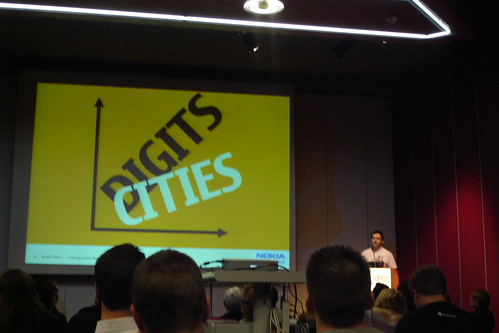
Digits, cities, originally uploaded by Ti.mo.

Gave my talk this morning at Lift06. Felt horrible from the stage – rushed through interesting stuff and dwelt on the wrong things. Luckily people still wanted to talk afterwards and got a lot of what I was trying to say about play and mobility.

Whether they thought it was right is another thing of course.

Personal highlight was being heckled by Bruce Sterling, after forgetting Olafur Eliasson’s name.

Timo took a picture a slide that I put in at the last minute, which looking back on it, basically sums up and communicates everything I’m interested in, or ever been interested in or think is important at the moment – my own personal aleph.

So I guess I’m done!