Deathmatch in the stacks

Ah to be in NYC…

DEATHMATCH IN THE STACKS
Celebrating the launch of The Game Design Reader: A Rules of Play Anthology
Edited by Katie Salen and Eric Zimmerman, published by MIT Press

An evening of impassioned discussion and playful debate with game critics,
game creators, and game players about the past, present, and future of games

Friday, December 9th, 7pm-9pm
Tishman Auditorium, 66 West 12th Street, NYC
Free Admission

DEATHMATCH IN THE STACKS marks the launch of The Game Design Reader, a groundbreaking collection of essays that spans 50 years of game design and game studies. Eight contributing authors to the book, including many of the most influential figures working in the field of videogames and play scholarship today, will share short selections from their essays and engage in spirited exchange with game players, game designers, and game critics. Also featuring a panel discussion on game design with the creators of Half-Life, Paranoia, and Adventure for the Atari 2600.

DEATHMATCH players include Katie Salen and Eric Zimmerman in discussion with:

Ken Birdwell, game designer
Greg Costikyan, game designer and writer
Gary Alan Fine, game sociologist
Linda Hughes, playground folklorist
Henry Jenkins, videogame scholar
Warren Robinett, game designer and programmer
Richard Rouse III, game designer and writer
Brian Sutton-Smith, play scholar and theorist
Stephen Sniderman, game and puzzle designer

Plus: appearances by New York City game players and luminaries
Ze Frank (designer), Tami Meyers (LARPer) Karen Sideman (designer),
and McKenzie Wark (theorist)

KATIE SALEN and ERIC ZIMMERMAN are game designers, theorists, writers, advocates, and educators. Katie is the Director of Graduate Studies in Design and Technology at Parsons School of Design. Eric is the co-founder of the experimental game development company gameLab. DEATHMATCH IN THE STACKS follows in the tradition of STORMING THE PLAYGROUND, a raucous and thought-provoking event in 2004 that marked the launch of their critically acclaimed book, Rules of Play: Game Design Fundamentals.

DEATHMATCH IN THE STACKS is sponsored by gameLab, the Design and Technology Program at the New School University, and Games for Change

Unfortunately it looks like the sort of thing that will be too much fun for anyone there to take any notes…

Design Engaged 2005

.flickr-photo { border: solid 2px #000000; }
.flickr-yourcomment { }
.flickr-frame { text-align: left; padding: 3px; }
.flickr-caption { font-size: 0.8em; margin-top: 0px; }


Buddy Henge 🙂, originally uploaded by pachanga.

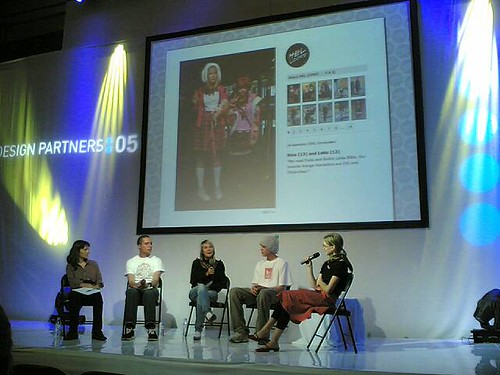
I spent the weekend with 30-or-so engaged designers of things, thoughts and theories in Berlin.

Design Engaged is a small retreat-which-isn’t-really (an Attack?) staged by Andrew “Hey” Otwell two years running now. last year was the first, in Amsterdam.

The premise is that everyone presents, performs or produces something – that there isn’t really a static audience for anything, and he introduces just enough structure for something to emerge from it.

As last year, it was fantastic, frustrating, engaging and tiring – and has dumped me like a Tamarama roller: battered, but exhilarated and re-enthused.

This year was slightly bigger I think than last year – at around 33 participants; and, our group at Nokia underwrote some of the set-up costs of the excellent venue – Spreeblick.

I didn’t present anything, as Andrew had given me an assignment already: design a game for the particpants to play through the 3 days. I’ll write about that in a separate post.

My favourite moments would take to long to filter from the whole thing, but here’s a few:

  • meeting the inspiring visualisation crimefighting duo that is Eric and Mike from Stamen
  • walking through Alexanderplatz, then storming the Bond-villain-lair aquarium of the SAS Raddison with excellent company
  • Mike K’s sterling efforts in coordinating insightful and interesting local guides for us, especially ours who didnt mind my tacky desire to go and see giant Bond-villain-lair aquariums
  • Ben’s take on Aldo Van Eyck
  • Nurri Kim’s poetic Tokyo Blues project
  • general sparring with Greenfield, Butterfield, Ward, Poisson, Chang and Schulze
  • Ti.mo’s “Graphic Language of Touch” project, and his flying fingers-style of Final Cut Pro fighting
  • “Pizza Fagin”
  • Heathcote getting all the triple word scores
  • what it felt like being the first creature with an eye – and bumping into the second
  • Malcolm McCullough and Christiane Woodley holding everyones (constant, partial) attention expertly without powerpoint
  • Gastromancer
  • the Poisson distribution
  • managing to shake hands at last with Kevin Slavin, but not managing to actually talk with him
  • Fabio Sergio’s thunderingly-thought-provoking question: “what is the material of interaction design”
  • Ulla-Maria saying “Not now”
  • Regine’s retina-scarring clothing
  • really great retina-scarring buffet food and lunches
  • really great pizza (fagin!) after huge steins of beer
  • the visual energy of Berlin
  • and, of course spending a wonderful rare weekend away with Foe.

The very best bit in terms of renergising and renewing my enthusiasm for what I do, was, as last year – the group ‘charrette’-style design exercise.

Last year, there was a bit of frustration for me at least at the start of this, as people argued over what the problem or breif should be – this year – in the spirit of Andrew’s general goals for the gathering – there was just enough structure for something to emerge, and just enough brief to have some real fun with.

We were asked ‘what is your favourite place?’ and how we would respond to what we’d seen in Berlin in terms of creating devices, designs, services or experiences that might resonate with that question in peoples minds.

Our group (Fabio, David Irwin, Ti.mo, Michelle Chang, Adam and myself) went for a walk and started talking about our favourite places in general, our favourite places on the walking tour we had done as a group, and ‘placemaking’ as a human behaviour in general.

Quickly on our return, we moved from debate and theorising to making things. Many things, which we presented back to the group under the banner of ‘Your new favourite places’.

One of my responses is pictured above, and was performed or ‘bodystormed’ by Fabio: the Gemurtlith.

We gathered words for ‘cosy’ or comfortable places in many of the languages we had represented: Dutch, Norwegian, and German, where it is ‘Gemütlich’.

As frequent readers will know, I am fond of a pun – so quickly this became The GemütLith – small ritual stones that make cosy places whereever you may be.

Jack Schulze had presented earlier in the event a prototype of a USB-connected puppet that physically represented buddylist presence/status information.

Combining this influence with the primtive figures / coptic jars from Anthony Gormley’s “Field” gave me the BuddyHenge – a ritually placed circle of GemütLiths that brings my friends to me wherever I am.

In his performance, fabio upped the shaman-technopagan content, by sprinkling a demarkating circle of arphid-smartdust around him, prior to laying down his nanotarp (a active mediasurfaced tarpaulin inspired by Nurri’s work and brought to life onscreen by Ti.Mo’s 20 minutes-flat guerilla video compositing) and arranging his GemütLiths just so…

Enormous fun. It’s left me not just looking forward to Design Engaged 2006, but also looking forward to being a designer in 2006 in general…

DUX05 (Partial) Notes: day one

Without warranty, and certainly not a complete record – but here are raw notes from Day One of the DUX 2005 conference:

Dux day one

user steered content

coloursmart app / home depot usa

mr blandings builds his dream home
90% of all paint sales are whites/neutrals

experience model of redecorating/painting process
‘mindsets’ for personas

—-

buying loose diamonds at amazon.com
“i really don’t want to screw this up” = person’s primary thought through this task

cut/colour/clarity/carat-weight = parameters

no way to tell the size/scale

people are scared of getting ripped off, and the system shold be designed to build confidence

(screenshot of really nice ajaxy-slider app)

learn – refine – learn = loop

300% increase in sales.

——–
Avenue A/Razf

developed a social network for the designers internally
rapid turn-around of questions answered by the community via rss feeds of queries being posted.

playing on the inherent curiosity of groups about their particpants.

showcase of your own cool stuff- create identity

——
the paradox of the library
messy libraries vs neat ones…
abe crystal / chapel hill

library as a symbol vs library as working place

messy informally organised personal collections are some times more often used than more organised collections

information ecologies

——

AFTERNOON

——

fred dust / ideo

smart spaces

“it’s not technology unless you’re crawling around on the floor”

started out as a frustrated architect

talk about the difficutly of the word user

design for parlimentary syztem of finland?

empathy as a tool

we need to love our users, not just understand them.

designing for behaviours rather than target markets – psychographics not demographics

storyteller / functionalist / camper

campers are people who NEVER really move in…

design for activities / behaviours and you get more than your target

—-
rhona tannenbaum

obsessed with information + people

new products for the NYT – generated from observation of the readers

using eyetracking to establish how people read
arts and leisure section

worked on alexa for brewster kahle

visualisation of large amounts of data for alexa: the collective intelligence of the internet

working on the open library project, that launched last week

understand how others are reading the text

own project: storymixer

also working with plum.com?

—-

Friday/DUX: BBC English Regions message boards

.flickr-photo { border: solid 2px #000000; }
.flickr-yourcomment { }
.flickr-frame { text-align: left; padding: 3px; }
.flickr-caption { font-size: 0.8em; margin-top: 0px; }


Friday/DUX, originally uploaded by blackbeltjones.

At DUX2005 in San Francisco.

As part of the first session on “user-steered content”, The BBC’s Jane Muirison just gave a wonderful, witty little presentation about using tagging in message boards in order for particpants to find conversations that interest them. I think the papers are going to be online.

Good stuff.

Inaugural Mobile Monday London: November 7th…

UPDATE
———-
If you have arrived here by searching for MoMoLondon, let me be completely clear, this is not the site of MoMoLondon!

If you are planning on going to Mobile Monday London,

  1. please do go and join the group/mailing list at http://groups.yahoo.com/group/momolondon/
  2. Visit and bookmark the nascent official site: www.mobilemonday.org.uk
  3. Make sure you PRE-REGISTER on the mailing list

———-

I’ve just been on a conference call with the group that are starting up the London ‘branch’ of the Mobile Monday events. If you’re not familiar with them, then they have been running ideas, debate and networking events about mobile technology, business and culture around the world for a few years.

The first London Mobile Monday (or, MomoLondon) will take place on the 7th November at Vodafone’s offices on the Strand in central London from 6pm. N.B. YOU WILL NEED TO PRE-REGISTER FOR SECURITY REASONS! Visit the MoMoLondon Yahoo Group for details.

The theme was tentatively set as “Connecting the physical and digital world” – with topics such as location-based services, optical code reading and some others to be agreed.

One of the messages that came out loud and clear from those participating on the planning call was that it should be idea-rich and powerpoint-light.

Yay!

Also, it was stressed that what interested most people was to move forward the thinking as a whole at the intersection of business, technology and user-experience.

One other idea that was strongly supported was trying to get academic and industry research in the mix – so that we finally can move on from the “Joe arrives in a new city and wants to find his nearest pizza” use cases…

Personally, I’d like to see the definition of the mobile discussion stretch outside of just cellular – to personal media players, connected game decks (anyone from Sony London Studio still reading??) and ubiquitous computing.

From a very selfish viewpoint, I’d like a monthly event about mobile tech, design, business and culture that I looked forward to, so, I’ve tried to mail a few folk I know who work on designing user-experience for mobile to get them roped in, and hopefully posting here, cast the net a little wider and get more user-research and design folk involved.

Here are the details of the group if you’d like to join:
http://groups.yahoo.com/group/momolondon/

The main driving purpose is of course to get together those in working on mobile digital stuff to talk, drink, swap ideas and have a laugh. Please do pass this on to people you work with if they would be interested, and hopefully see you soon at one of the MoMoLondons…

Cognitive Design Conference, Lubeck

At Hamburg Airport… I have been in Lubeck at the International School of New Media for the first “Cognitive Design Conference”. I have posted some raw notes, but I will go back and tidy, illustrate and summarise as best I can come the weekend.

This morning’s talks (day 2) I found especially stimulating.

For now, it was a pretty stimulating start to a discussion area that can’t define itself too well yet. Brain science? Neuromarketing? Semiotics? Philosophy? Branding? Knowledge Management? Visualisation? Interaction Design?

All of the above?

It was quite a curates egg as a result, but curates egg served with relish on tasty German wry…

They promise to do it all again next year, and I look forward to the iteration.

Advice for bloggers, podcasters – and conference speakers

.flickr-photo { border: solid 2px #000000; }
.flickr-yourcomment { }
.flickr-frame { text-align: left; padding: 3px; }
.flickr-caption { font-size: 0.8em; margin-top: 0px; }

As seen on the Heathrow Express this morning.

I’m in Lübeck, Germany for the intriguingly-titled “Cognitive Design” conference, where Doors of Perception’s John Thackara will be giving the keynote tomorrow morning.>

I’m going to be giving a Post-Nintendo-Revolution remix of the talk Chris and I gave at Etech this year, with plenty of play in there.

In moving back to the UK, I forgot to bring any of the Nokia NFC phones with me. So unfortunately I won’t be able to demo them which is a pity – I’ll have to wave my arms about twice as much as usual.

There’s also a keynote by August de los Reyes of MSN / Microsoft on “The future of the PC” – which should be interesting given the very recent reorganisation of MSFT.

People making places

People make places @ Demos

Just wandered tonight along to Demos for the launch of their “People make places” report. A skim on the bus home made it seem the sort of thing I would like the Dan Hills and Anne Galloways of the world to have a look at…:

“The rise of privately owned corporate malls, out-of-town shopping centres and the virtual landscapes of the internet have cast doubt on the publicness of our towns and cities. Privatised space is seen to be in the ascendancy and, it is argued, this is squeezing out the possibility of shared social spaces in our cities, replacing them with a ‘shopping mall culture’ of sanitised, frictionless consumer environments where architecture and technology are used to filter out undesirable people and groups. So far it is unclear whether the new set of public spaces created through the urban renaissance are countering this trend and proving effective hosts for shared public life and exchange between people, or whether they are adding to the loss of publicness by imitating the character of private space. Many of the shiny new quaysides and squares seem either curiously empty of people or curiously monocultural in the type of people they attract.

The mission of Demos over the past 12 months has been to take on this uncertainty and track down the public life of cities – to identify the shared spaces of interaction and exchange, the value that such spaces generate and how that value is created. We explored in depth three cities in the UK – Cardiff, Preston and Swindon – to discover and illuminate the processes by which the public life of cities more widely might be reinvigorated.”

I arrived a little late as I only read about the event on the train back from Farnborough, so I don’t know whether it was covered before I got there, but there was little on the effects of digital technology, particularly personal, mobile digital technology on the use of public space. The debate wasn’t all that, although Greyworld were exciting – pointing out the role of play and playful technologies in invigorating and maintaining public spaces.

There’s a small mention of the venerable grassroots geoguide Knowhere in the report, but otherwise very little investigation it seems (again, I haven’t read it in great depth yet) of the impacts of digital technology.

There is a tantalising section heading: “Visible and invisible choreography” on page 62 of the report [PDF], with a brief mention of NYC’s “311” phone line as a concrete example – but nothing about pershaps, how space and place can be ‘reprogrammed’ smartmobs-style by mobile technologies, or how invisible infrastructures can change a place, e.g. free wifi in Bryant Park. I’m sure there are better examples, but hopefully you get my drift (derive?)

Worth a read, and as I say, I hope some of the more hardcore cyburbanists I know will offer their 2p…